
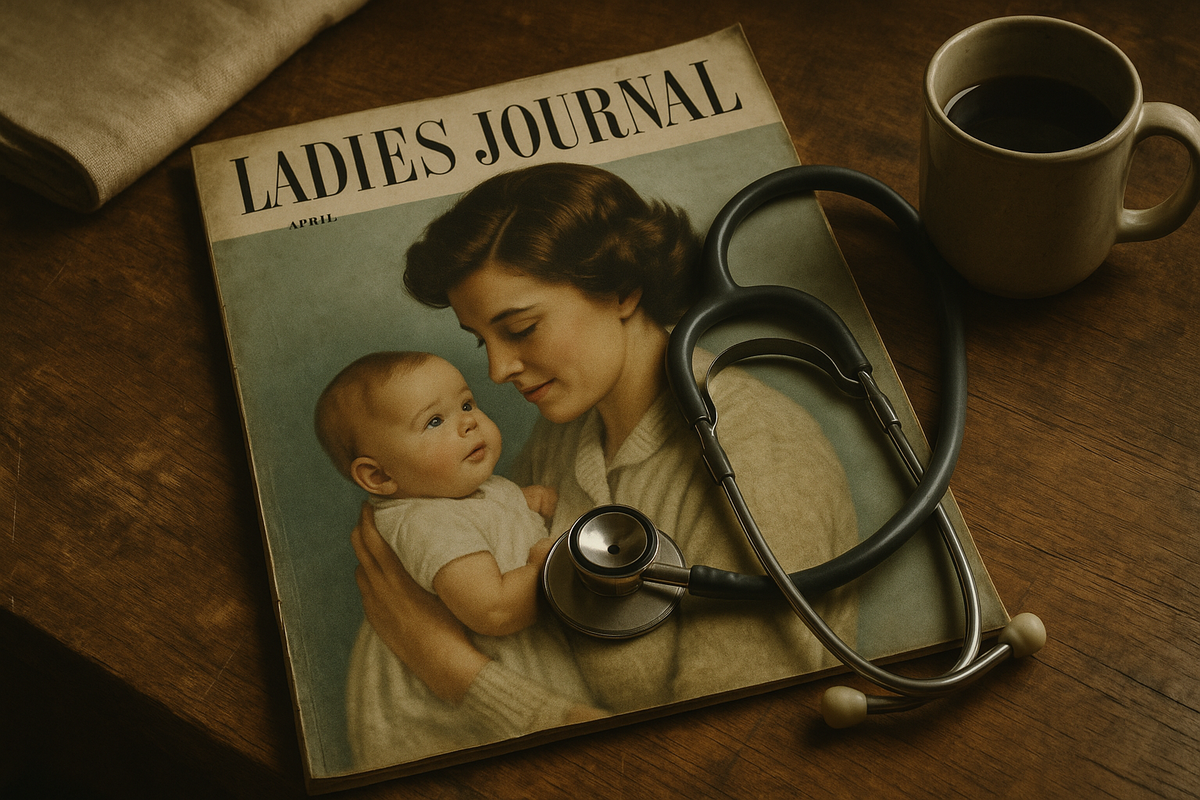
When America's Most-Read Women's Magazine Declared War on Cervical Cancer
How the April 1955 Ladies' Home Journal transformed preventive medicine from medical secret to mainstream survival strategy
April 1955. Across America, millions of women opened their mailboxes to find the latest issue of Ladies' Home Journal—and between the Lana Turner shampoo ads and the spring fashion spreads, they discovered something that would redefine the boundaries between beauty columns and survival.
The headline didn't whisper. It didn't hedge. It made a promise: "Women Need No Longer Die of Their No. 1 Cancer Foe!"
For a generation of women who had watched mothers, sisters, and neighbors vanish into hospital wards with diagnoses that arrived too late, this wasn't just health reporting. It was a lifeline printed on glossy paper.
The Silent Killer Meets Mass Media
By the early 1950s, cervical cancer held a grim distinction: it was the leading cause of female cancer deaths in America. The disease moved quietly, often symptomless until advanced stages made treatment futile. Women died in their thirties and forties—mothers of young children, wives in the prime of life—while medical science stood largely helpless.
But 1955 marked a pivot point. Dr. George Papanicolaou's screening test—what we now call the Pap smear—had moved from research labs into clinical practice. The technology existed. What didn't exist was widespread knowledge among the women whose lives depended on it.
Ladies' Home Journal bridged that gap.
With a circulation reaching millions of subscribers, the Journal occupied a unique position in American culture. It was simultaneously middlebrow and authoritative, domestic and worldly. Women trusted it for recipes and childcare advice, yes—but they also turned to it for serious journalism that other publications reserved for male readership. When the Journal spoke, American women listened.
The April 1955 issue deployed that trust with surgical precision.
Archive Details
Publication: Ladies' Home Journal
Issue Date: April 1955
Feature Article: "Women Need No Longer Die of Their No. 1 Cancer Foe!"
Key Figure: Dr. Charles S. Cameron, Vice President, American Cancer Society
Medical Innovation: Pap smear screening (Dr. George Papanicolaou)
Historical Context: Cervical cancer was the leading cause of female cancer deaths; this article marked a turning point in public health communication
Medicine Meets the Living Room
What made this article revolutionary wasn't just its subject matter—it was its execution. Medical journals had discussed Papanicolaou's work for years. But medical journals didn't sit on coffee tables in Kansas City or suburban Philadelphia. They didn't share pages with Daniel Green shoe advertisements and serialized royal memoirs (Born to Be Queen, Part II ran in the same issue).
The Journal translated clinical authority into plain language without condescension. It gave women actionable instructions: begin regular examinations at age 35, see your doctor twice yearly, watch for irregular bleeding or watery discharge. It cited international research from Quebec to Paris to Long Island, building a case that this wasn't experimental medicine—it was established science, backed by studies of thousands of women worldwide.
Then it did something quietly radical: it paired the medical information with a photograph of a young mother holding her baby, captioned with a message about safer futures. The subtext was unmistakable. This wasn't about abstract statistics. This was about survival. About children who would keep their mothers. About families that would stay intact.
The Journal understood its audience. The postwar baby boom had made motherhood a cultural obsession and a demographic reality. But beneath the cheerful domesticity ran a current of anxiety—about polio, about nuclear threats, about all the ways the modern world could destroy what families were building. Cervical cancer represented a threat that science could actually neutralize. The article offered control in an era that often felt uncontrollable.
The Architecture of Hope
The piece succeeded because it balanced realism with optimism. It didn't minimize the disease's lethality—the "No. 1 Cancer Foe" framing made that clear. But it refused to traffic in fatalism. The message was urgent but not despairing: This kills women. But it doesn't have to kill you.
The article drew on cultural and epidemiological observations that reflected mid-century medical anthropology, noting different cancer rates among Jewish and Muslim women and linking health outcomes to lifestyle and hygiene patterns. This was 1950s medical discourse—earnest, sometimes clumsy by contemporary standards, but driven by genuine attempts to understand disease patterns before modern genetic and environmental research existed.
Dr. Charles S. Cameron, Vice President of the American Cancer Society, closed the piece with institutional authority: education and prevention could save thousands of lives annually. This wasn't speculation. It was measurable, achievable public health policy.
And it worked. In the decades following 1955, cervical cancer mortality rates in America began a steady decline that continues today. Mass media health campaigns—pioneered by articles exactly like this one—transformed preventive care from medical luxury to standard practice.
The Revolutionary Test
Dr. George Papanicolaou's screening method—the Pap smear—could detect cervical cancer before symptoms appeared, transforming it from a silent killer into a preventable disease.
International Validation
The article cited research from Quebec, New York, Paris, India, and Long Island, demonstrating that this wasn't experimental—it was established science backed by global studies.
Actionable Instructions
Women received clear guidance: begin examinations at age 35, see doctors twice yearly, watch for irregular bleeding or watery discharge—medical empowerment in plain language.
Cultural Context
The article appeared alongside Lana Turner ads and Ethel Barrymore memoirs, proving that women's magazines could seamlessly blend consumer culture with life-saving medical journalism.
The Artifact and Its Afterlife
For collectors of vintage magazines, the April 1955 Ladies' Home Journal occupies rarefied space. It's not just a periodical—it's a hinge point in women's health history, preserved in original form.
The issue captures contradictions that defined mid-century American womanhood: beauty standards and medical activism, domesticity and autonomy, consumer culture and life-or-death information, all coexisting on the same pages. Flip through it and you move from Alka-Seltzer advertisements to cancer prevention to Ethel Barrymore's memoirs without tonal whiplash. That fluidity—the Journal's ability to make everything from shampoo to survival feel equally urgent—was its genius.
Copies in good condition remain sought after by historians of medicine, women's studies scholars, and collectors of mid-century Americana. The issue represents one of the earliest mass-market discussions of cervical cancer prevention, delivered when "mass market" meant something tangible: physical magazines in millions of mailboxes, read and reread, passed between neighbors, clipped and saved.
This was information architecture before the internet—editorial curation as public health intervention.
Legacy in Paper and Policy
Ladies' Home Journal endured for over a century because it understood a fundamental truth: women's lives contained multitudes. They wanted fashion tips and medical facts, fiction and policy analysis, beauty advice and survival information. The magazine refused to choose. It gave them everything.
The April 1955 issue crystallizes that philosophy. It treated its readers as complete human beings—capable of understanding complex medical information, entitled to accessible explanations, worthy of both style and substance. It didn't talk down. It didn't oversimplify. It informed, and in doing so, it saved lives.
Today, vintage issues of Ladies' Home Journal function as primary sources for understanding how American women received information before digital media fractured the monoculture. They document the exact moment when certain ideas entered mainstream consciousness—when preventive care became not just possible but expected, when women's health transitioned from whispered topics to public discourse.
Collector Significance
The April 1955 Ladies' Home Journal stands as proof that magazines could do more than reflect culture—they could change it. Surrounded by the commercial apparatus of postwar consumerism, this single article delivered knowledge that translated directly into saved lives. It made prevention mainstream. It gave millions of women language to advocate for their own health care.
Historical Milestone
One of the earliest mass-market discussions of cervical cancer prevention, reaching millions of American women when medical information was typically gatekept by academic journals.
Cultural Snapshot
Captures the contradictions of 1950s womanhood—beauty ads alongside life-saving medical journalism, domesticity coexisting with scientific empowerment.
Research Value
Primary source material for historians studying women's health, mid-century media, public health campaigns, and the evolution of preventive medicine in America.
Preservation Status
Copies in good condition are increasingly rare. This issue is sought after by medical historians, women's studies scholars, and collectors of mid-century Americana.
Holding this issue means holding the moment when one of medicine's greatest public health victories began reaching the people who needed it most. Not in academic journals. Not in specialist publications. In a magazine that arrived with the mail, read over coffee, discussed with neighbors.
That's not just collectible. That's how history moves—one informed reader at a time.
Explore the Archive
Our collection spans decades of original Ladies' Home Journal magazines, from 19th-century issues through the mid-20th century. Each edition preserves a specific moment in American women's history—authentic artifacts from the era when magazines shaped lives, informed decisions, and changed the world.
Browse Ladies' Home Journal Magazine Collection