
When Huey P. Newton Sat for Power
The photograph stops you cold.
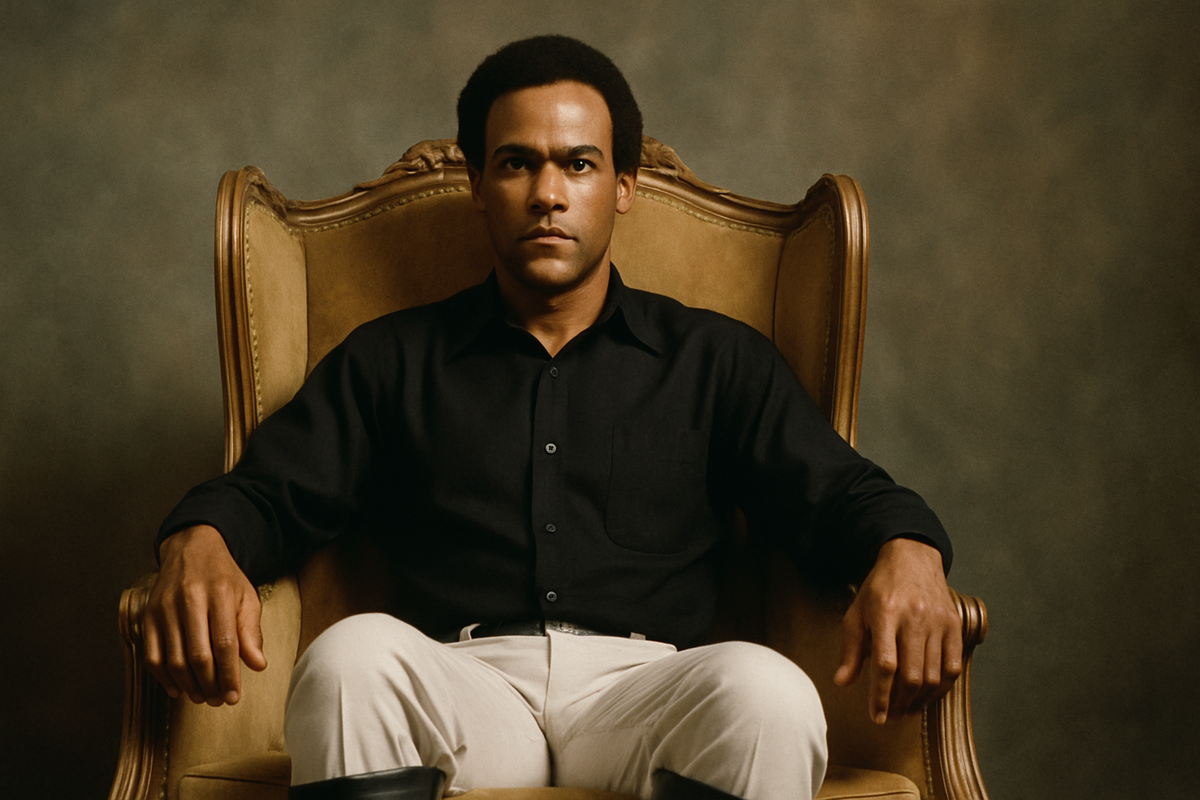
Huey P. Newton, co-founder of the Black Panther Party, sits enthroned in a gold armchair, boots polished to military precision, white pants pressed sharp as a manifesto. His gaze is direct, unflinching—the stare of a man who has survived assassination attempts, imprisonment, and the full weight of federal surveillance. The headline cuts across the top: "Special Report on Black Panthers."
This wasn't celebrity journalism. This was a reckoning.
When the May 11, 1972 issue of Jet Magazine hit newsstands, it arrived at a moment when the Panthers were being written off as relics of the militant '60s—burned out, fractured, irrelevant. The FBI had declared them neutralized. Mainstream media had moved on. But Jet, the pocket-sized publication that had become the trusted messenger of Black America, saw something different: a movement in metamorphosis, shedding one skin to grow another.
What Newton and the Panthers were attempting in 1972 was audacious. They were trying to transform revolutionary rage into sustainable power—to turn street patrols into voter rolls, manifestos into medical clinics, and armed resistance into the patient work of community survival. The question wasn't whether they could fight. The question was whether they could build.
Jet's special report captured that inflection point with rare clarity. And the image of Newton—regal, composed, strategically softer than his 1967 wicker throne portrait with spear and rifle—became the visual argument itself.
Archive Details
Historical Figure: Huey P. Newton, Co-Founder of the Black Panther Party
Issue Date: May 11, 1972
Archive Source: Jet Magazine
Cultural Significance: Documents the Panthers' strategic pivot from armed militancy to community survival programs and electoral politics
The Context: Why 1972 Mattered
By the early 1970s, the Panthers had become the most hunted organization in America. The FBI's COINTELPRO program had designated them the nation's "greatest threat to internal security," unleashing infiltrators, arrests, and psychological warfare designed to collapse the Party from within.
But the external pressure was only half the story. Internal fractures had begun splitting the organization along ideological fault lines. Eldridge Cleaver, the Party's firebrand Minister of Information, had fled into exile and was pushing for international revolutionary alliances and armed confrontation. Newton, recently released from prison, was advocating something different: survival programs, electoral politics, and community infrastructure that could outlast any single leader or slogan.
The tension wasn't just tactical. It was existential. What did Black Power actually mean in practice? Was it armed self-defense, or was it free breakfast programs? Was it revolution, or was it winning city council seats? Could it be both?
By 1972, Newton had made his choice. The Panthers would pivot—not away from radicalism, but toward a radicalism rooted in the unglamorous work of keeping communities alive.
What Jet Showed Its Readers
Jet Magazine occupied unique cultural ground. At pocket-size, it traveled easily—tucked into purses, jacket pockets, barbershop counters. It brought news that mattered to Black America into spaces where mainstream outlets rarely ventured, and it did so without the condescension or distortion that characterized much white media coverage of Black radical movements.
The May 11, 1972 special report gave readers an intimate, multidimensional portrait of Newton and the Panthers' evolution:
The Survival Programs
Jet detailed the Panthers' expanding network of community services—free health clinics, food distribution centers, and educational initiatives that functioned as shadow government programs in neighborhoods the state had abandoned.
The Sickle Cell Campaign
The Panthers had screened more than 13,000 people for sickle cell anemia, a genetic blood disorder that disproportionately affected African Americans and had been systematically neglected by the medical establishment.
Electoral Strategy
Newton explained the Panthers' shift toward voter registration and political candidacy. The Party had helped register over 10,000 Black voters across California and was running candidates for local office.
The Cleaver Split
Jet didn't shy from internal conflict. Newton addressed the rupture with Cleaver directly, criticizing him for what Newton saw as a drift toward opportunism and empty militancy divorced from community accountability.
For Jet's audience, this was essential reporting. It documented Black struggles with urgency and dignity, ensuring that African Americans saw their own leaders and movements represented authentically. Newton's self-styled title as "Supreme Servant of the People" underscored a leadership philosophy that positioned authority as service rather than domination—a pointed reframing that attempted to differentiate Panther governance from both white institutional power and the cult-of-personality politics that had consumed other movements.
The Photograph as Political Statement
The cover image deserves close reading. Newton's 1972 pose deliberately echoes his legendary 1967 photograph—the one where he sat in a wicker peacock chair, Mozambican rifle in one hand, spear in the other, framed by zebra skins and African shields. That earlier image announced the Panthers as an armed, unapologetic force.
This new photograph carried a different message. The gold chair suggested authority, even sovereignty. The white pants and dark shirt were sharp but not military. Newton's posture radiated control without overt threat. The image said: We are still here. We are still serious. But we have evolved.
For Jet readers—many of whom had watched the Panthers rise, suffer government assault, and splinter—this visual statement mattered. It confirmed that Newton wasn't retreating. He was adapting. And adaptation, in the face of state repression and internal chaos, was its own form of defiance.
The Lesson in the Archive
Looking back at Jet's 1972 coverage reminds us that history rarely moves in straight lines. The Panthers didn't simply rise and fall. They changed—strategically, messily, imperfectly—in response to pressure, opportunity, and the brutal realities of trying to sustain radical politics in a hostile state.
Newton's pivot toward survival programs and electoral organizing wasn't surrender. It was recognition that revolution, if it meant anything beyond martyrdom, required infrastructure. It required the unglamorous work of clinics, voter rolls, and community accountability. It required surviving long enough to build.
Whether that strategy succeeded is a matter of historical debate. What's undeniable is that Jet documented the attempt with seriousness and respect—giving its readers not just news, but a record of how Black movements thought, argued, and evolved under fire.
That's why this magazine matters. Not because it tells us the Panthers succeeded, but because it shows us what they were trying to become.
Why This Issue Endures
Historical Precision
This issue captures the Panthers at an exact moment of transformation—neither at their militant peak nor in their eventual decline, but in the uncertain middle ground where vision meets implementation. It's raw historical data, unfiltered by later revisionism.
Visual Iconography
The Newton cover ranks among Jet's most memorable images, a photograph that functions as both portraiture and political theory. For collectors of visual culture, it's a masterwork of symbolic communication.
Narrative Counterweight
At a time when the Panthers were being reduced to caricature—dangerous thugs to some, romantic martyrs to others—Jet provided nuance. It showed complexity: a movement wrestling with strategy, identity, and survival under siege.
Cultural Artifact
Beyond its content, this issue represents the role of Black-owned media in shaping historical memory. Jet didn't just report on the Panthers—it created space for them to define themselves on their own terms.
Explore the Archive
From the 1950s through the 2000s, Jet Magazine chronicled the full span of African American life—civil rights marches, cultural milestones, political battles, and the everyday dignity of a people building power in a nation that denied their humanity. These aren't just magazines. They're evidence. They're memory. They're the archive speaking directly to the present.
Browse Jet Magazine Collection