
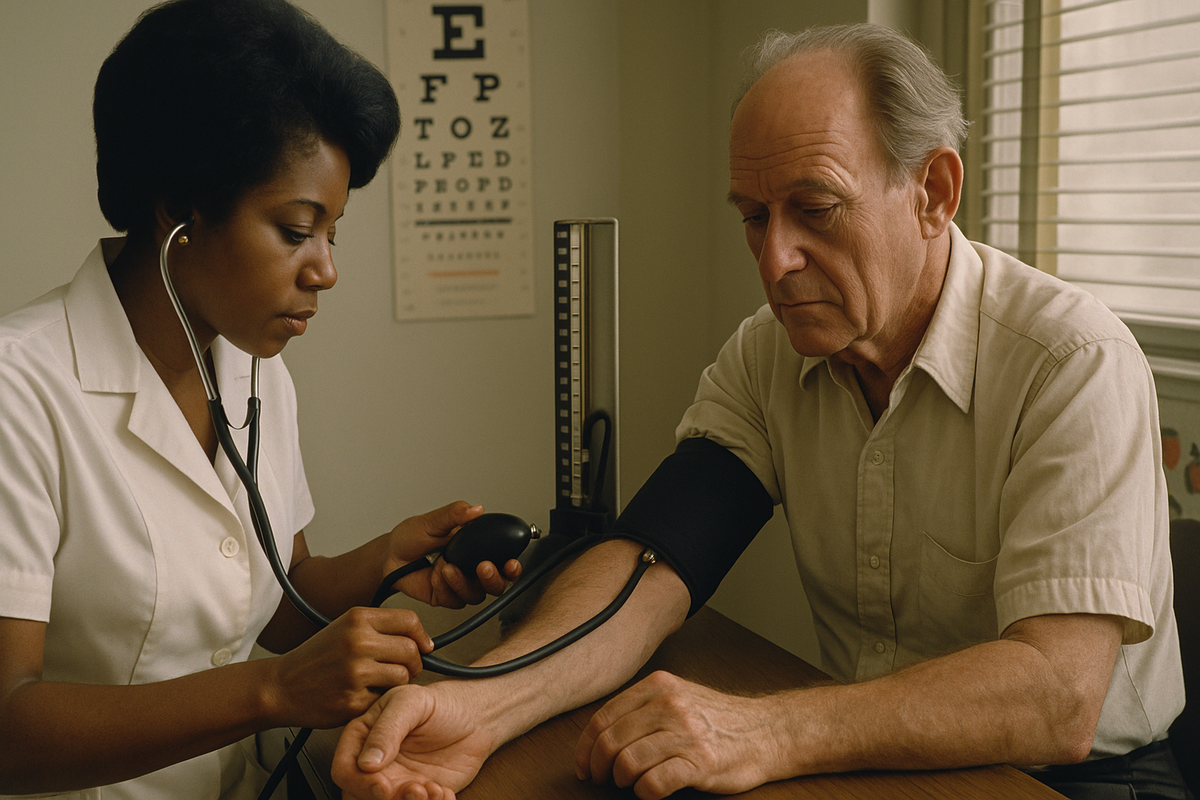
The Magazine That Made America Fear Its Own Pulse
How Time Magazine's January 1975 cover transformed hypertension from a silent epidemic into a national reckoning
On January 13, 1975, American newsstands carried a cover that didn't show a politician, a war, or a scandal. Instead, Time Magazine confronted its readers with four words that would redefine a generation's relationship with their own bodies: "Conquering the Quiet Killer."
Inside, the nation's most influential newsweekly had turned its spotlight on hypertension—a condition that was silently ravaging 23 million Americans, most of whom had no idea they were in danger. No fever, no pain, no warning. Just blood pressure rising in the dark, waiting to strike.
This wasn't health journalism as the public knew it. This was Time wielding the full force of its editorial authority to declare a medical emergency—and in doing so, it transformed an invisible epidemic into a national reckoning.
Historical Context
Publication: Time Magazine
Issue Date: January 13, 1975
Cover Story: "Conquering the Quiet Killer"
Featured Subject: Fayeure Curry, Chicago health worker
Key Researcher: Dr. John Laragh
Archive Significance: Medical milestone in public health awareness
The Crisis Hiding in Plain Sight
By 1975, America had survived two world wars, the atomic age, and the turbulence of the 1960s. But the enemy that Time identified wasn't at a foreign border or in a distant jungle. It was circulating through the arteries of millions, undetected and lethal.
The numbers were staggering: over 23 million Americans suffered from high blood pressure. Stroke. Heart attack. Kidney failure. These weren't acts of God or random misfortune—they were predictable consequences of untreated hypertension. Medical science had reached a turning point: the "quiet killer" could be measured, diagnosed, and stopped. But first, people had to know it existed.
Time understood something fundamental: Americans didn't fear what they couldn't see. The magazine's mission was to make the invisible visible.
Journalism as Public Health Weapon
What made the January 13 issue so powerful wasn't just the science—it was the storytelling.
The article opened with Fayeure Curry, a 47-year-old Chicago health worker who discovered she had high blood pressure only after suffering a stroke. Her story wasn't a cautionary tale buried in medical jargon. It was a mirror held up to millions of readers who might be next.
From there, Time deployed every tool in its arsenal:
Photography That Personalized the Epidemic
Patients having their blood pressure checked at the dentist. Families eating high-salt diets at dinner tables. Dr. John Laragh in his laboratory, pioneering the hormonal research that would revolutionize treatment. YMCA exercise classes where prevention became a communal act.
Diagrams That Turned Statistics Into Anatomy
Readers saw exactly how hypertension ravaged the brain, heart, kidneys, and arteries—transforming the abstract numbers on a blood pressure cuff into visceral, bodily consequences.
Plain Language Where Others Used Jargon
Time translated renin levels, arterial resistance, and sodium intake into terms anyone could grasp. The sphygmomanometer—that mysterious device doctors wrapped around your arm—was demystified in a single, clear explanation.
A Blueprint for Survival
This wasn't medical reporting. This was a guide written for a mass audience—urgent, accessible, and potentially life-saving.
The Social Fault Lines of a Health Crisis
Time didn't stop at the science. The magazine understood that hypertension wasn't just a medical problem—it was a mirror reflecting America's deepest inequalities.
The article documented how African Americans were disproportionately affected, facing both higher genetic vulnerability and systemic barriers to care. In 1975, as the nation processed Watergate's aftermath and grappled with economic stagflation, Time was drawing explicit connections between disease and inequality, between blood pressure and social justice.
This was medicine as social commentary—a recognition that who lived and who died often came down to who had access, who was screened, and who was believed.
The Preventive Revolution
The 1970s marked the dawn of a new American consciousness: the belief that health was something you managed, not something that merely happened to you.
Time's hypertension issue arrived at the perfect cultural moment. Exercise programs were proliferating at local YMCAs. Dietary advice about salt and fat was entering the mainstream. Routine screenings were becoming civic rituals. Americans were learning to think preventively—to see their bodies not as machines that would eventually break down, but as systems they could maintain.
The article captured this shift with urgency and optimism. Public health campaigns featured cartoons urging readers to "perform a death-defying act—have your blood pressure checked." The message was clear: you didn't need a prescription or a hospital. You needed awareness, action, and a blood pressure cuff.
From high salt consumption in the West to lower stroke rates in Japan, Time made the case that national health was shaped by national choices. Hypertension wasn't fate. It was a problem with solutions—if Americans would only pay attention.
A Cover That Commanded Attention
The January 13, 1975 cover was stark, serious, and unmistakably urgent. No glossy celebrities. No lifestyle distractions. Just the headline: "Conquering the Quiet Killer."
This was Time at its most powerful—journalism as public service, the alarm bell rung at maximum volume. Where other publications might have buried hypertension in the health section or sensationalized it into panic, Time did something harder: it explained the crisis with authority and clarity, trusting its readers to understand the stakes.
Inside, the magazine balanced personal narratives with medical expertise, human drama with statistical evidence. It was reporting that didn't just inform—it activated. Millions of Americans who had never thought about their blood pressure would, after reading this issue, make an appointment with their doctor.
In that sense, the magazine didn't just cover a health crisis. It helped end one.
Why Collectors Seek This Issue
A Medical Milestone
This issue marked the moment hypertension moved from doctors' offices into living rooms, when an invisible killer became a household term.
A Cultural Snapshot
The photographs, the public health campaigns, the dietary debates—this is how Americans in the 1970s understood their bodies and their responsibilities. It's a window into a nation learning to take its health seriously.
Enduring Relevance
Hypertension remains one of the world's leading causes of death. The issue isn't a historical curiosity—it's a document that still speaks to the present.
The Living Legacy
Nearly five decades later, the "quiet killer" is still with us. But because of reporting like this—authoritative, urgent, and deeply human—millions became aware, sought treatment, and survived.
The January 13, 1975 issue of Time Magazine didn't just inform readers. It armed them with knowledge that saved lives. It turned fear into action, silence into conversation, and statistics into stories.
For anyone who values the intersection of journalism, medicine, and social change, this issue is more than a collectible. It's an artifact of the moment when awareness began—and when America learned to conquer the quiet killer, one blood pressure reading at a time.
Own a Piece of Medical History
Original copies of Time Magazine from January 13, 1975 are still available for collectors, historians, and anyone who understands that some magazines don't just report history—they make it.
Browse Time Magazine CollectionWhether you're preserving medical milestones, documenting the evolution of public health, or simply collecting the moments that shaped modern America, this issue belongs in your archive.