
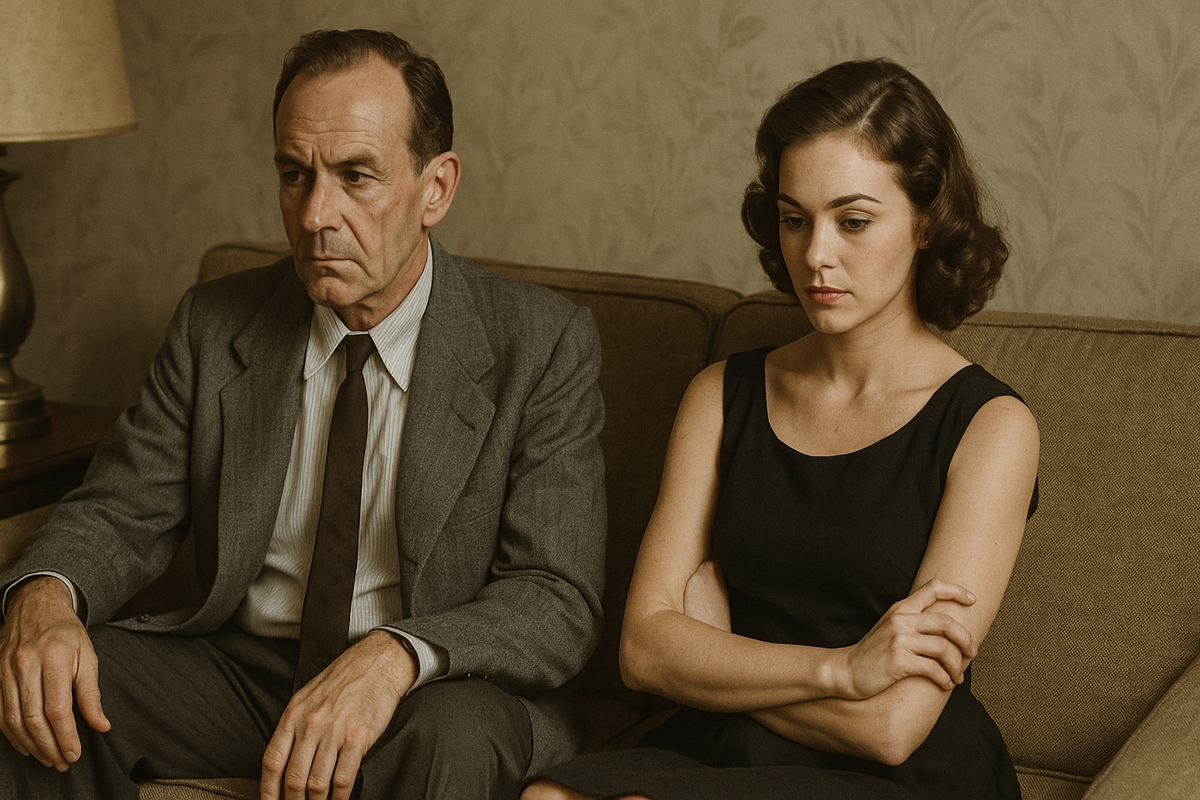
The Man Who Couldn't Be Traded In
Helen Lawrenson's 1954 Takedown of Male Delusion in Esquire Magazine
In March 1954, American men opened their copies of Esquire expecting the usual—sleek bourbon ads, William Faulkner fiction, maybe some advice on Windsor knots. What they got instead was a verbal throat-punch from Helen Lawrenson.
Her essay, "Don't Trade in Your Old Wife," carried a tagline that landed like a dare: "Look before you weep: the upkeep on that shiny new model may kill you." It was satire aimed directly at the midlife male ego, published in the one magazine where that ego felt safest. And it worked precisely because Esquire wasn't afraid to betray its own audience.
This wasn't self-help. It was a mirror held up to the postwar American man, showing him what he looked like when he confused his wife with a Buick.
The Illusion Economy: 1954 and the Business of Upgrades
The March 1954 issue arrived during America's most intoxicating consumer boom. The hydrogen bomb loomed. The Cold War raged. And yet, Detroit was selling the idea that you could trade in last year's sedan for this year's chrome fantasy—newer, shinier, yours for the taking.
Lawrenson saw the metaphor spreading like oil slick. If cars could be upgraded, why not wives? Madison Avenue had trained American men to see obsolescence everywhere. The economy demanded it. The culture rewarded it. And the midlife crisis—not yet named, but fully operational—became the unspoken justification.
Her essay exposed the con. Men weren't upgrading. They were sidetrading into debt, generational incompatibility, and the hollow realization that youth couldn't be purchased at any price.
What made it radical wasn't the message. It was the venue. Esquire was a men's magazine that didn't pander. It provoked. And in 1954, provocation meant letting a woman writer tell male readers they were delusional.
Issue Archive Details
Publication: Esquire Magazine
Issue Date: March 1954
Featured Essay: "Don't Trade in Your Old Wife" by Helen Lawrenson
Contributors: William Faulkner, Winston Churchill, A.E. van Vogt, Hans Knopf
Illustrations: Jason Crump
Historical Context: Cold War era, hydrogen bomb consciousness, peak consumer culture
Esquire in 1954: Where High Culture Met Whiskey Ads
By the mid-1950s, Esquire had evolved into something rare—a magazine that could run Winston Churchill's political memoirs opposite pictorials of women in cocktail dresses, fiction by Faulkner next to etiquette columns, all bound together by advertising that sold masculinity as a lifestyle.
The March 1954 issue embodied this contradiction perfectly. Lawrenson's essay faced a full-page Old Crow Bourbon ad featuring a romanticized 19th-century tavern scene—statesmen, writers, tradition, camaraderie. On one side: heritage and ritual. On the other: a female writer dismantling the myths men told themselves about aging and desire.
That juxtaposition wasn't accidental. Esquire's editorial strategy depended on tension. It sold men an idealized version of themselves while simultaneously publishing essays that questioned whether that ideal was worth the cost.
Jason Crump's illustrations for Lawrenson's piece—fragmented faces, overlapping gender symbols, surreal compositions—pushed the magazine's visual language into avant-garde territory. This wasn't the slick realism of Life or the earnest photojournalism of Look. Esquire used design to unsettle, to make readers pause before turning the page.
The contributors list alone confirmed the magazine's cultural reach: Faulkner, Churchill, A.E. van Vogt, Hans Knopf. This was a publication that moved seamlessly between genres and audiences, literary without being precious, stylish without being shallow.
Lawrenson's Thesis: The True Cost of the Trade-In
The essay's argument was deceptively simple: men believed younger women offered renewal. The reality delivered financial ruin, emotional exhaustion, and the dawning recognition that generational gaps couldn't be bridged by desire alone.
Lawrenson weaponized the language of consumer capitalism against itself. If women were "models" to be traded in, then men should understand the fine print—the maintenance costs, the incompatibility of parts, the depreciation curve that made the "upgrade" worthless within years.
Her tone was crucial. She didn't moralize. She didn't plead. She mocked, with surgical precision. The humor disarmed male readers long enough for the critique to land. By the time they realized they'd been called out, they were already laughing at themselves.
This was radical for a women's voice in a men's magazine in 1954. Most publications either flattered male egos or ignored women's perspectives entirely. Lawrenson did neither. She spoke with authority, wit, and zero concern for whether her audience would find her likable.
The Consumer Metaphor
Lawrenson transforms the "trade-in" language of car dealerships into a scathing critique of how men viewed relationships in the age of planned obsolescence.
Female Authority
A woman writer commanding editorial space in a men's magazine to challenge male readers directly—unprecedented for its time.
Editorial Courage
Esquire risked alienating its core audience by publishing satire that exposed rather than flattered masculine anxieties.
Visual Innovation
Jason Crump's fragmented, surreal illustrations elevated the essay beyond text, making the psychological fracture visible.
Why This Issue Still Matters
The March 1954 Esquire is more than a collectible. It's a diagnostic report on American masculinity at a cultural turning point.
The hydrogen bomb had made mortality tangible. Consumer culture promised immortality through acquisition. Men were caught between Cold War anxiety and suburban prosperity, breadwinner expectations and personal dissatisfaction. Lawrenson's essay named the trap without offering easy exits.
Seventy years later, the piece reads as prophecy. The "upgrade" mentality hasn't disappeared—it's metastasized. Men still confuse aging with obsolescence. Women still resist being treated as replaceable models. And consumer culture still sells the fantasy that unhappiness can be cured by trading in what you have for something newer.
The difference is that Lawrenson saw it coming.
Esquire's Gamble: Style That Interrogates Itself
What separated Esquire from its competitors was its willingness to undermine its own mythology. The magazine sold sophistication, but it also questioned whether sophistication was enough. It celebrated masculinity while publishing essays that exposed masculine fragility.
Lawrenson's piece exemplified this approach. Esquire could have run a bland relationship advice column. Instead, it published satire that accused its readers of treating women like appliances.
That editorial courage is why vintage Esquire issues remain relevant. They didn't just document culture—they dissected it in real time, using humor and design to make the medicine go down.
Final Word: A Mirror from 1954
When a man picked up the March 1954 Esquire, mixed a drink, and settled into his chair, he expected to feel validated. What he got was Helen Lawrenson telling him that his fantasies were expensive, his anxieties were showing, and the "shiny new model" was a con.
Some men laughed. Some men threw the magazine across the room. Either way, they remembered it.
That's the test of great magazine publishing—it lingers. The March 1954 issue lingers because it captured a truth that advertising wanted to bury: that trading in what you have rarely gets you what you want, and the cost is always higher than promised.
For collectors, cultural historians, or anyone fascinated by mid-century America's contradictions, this issue is essential. It's not just reading material. It's evidence—proof that even in 1954, someone was paying attention, calling out the myths, and doing it with enough style to get published in the very magazine that profited from those myths.
Collector's Perspective
The March 1954 issue represents peak mid-century Esquire: literary weight, visual sophistication, historical significance.
Literary Value
The Lawrenson essay alone justifies ownership—it's a primary source on postwar gender dynamics, consumer psychology, and magazine publishing's golden age.
Multiple Contributors
Add Faulkner's fiction, Churchill's reflections, and Crump's illustrations, and the issue becomes a multidimensional artifact.
Advertising as Context
The Old Crow spread, fashion layouts, and automobile promotions weren't just commercial filler—they were the cultural oxygen that Lawrenson's essay breathed.
Cultural Moment
This isn't about mint covers. It's about preserving a specific cultural moment when a magazine dared to challenge its own readership.
Explore the Archive
From the 1930s through the 1970s, Esquire chronicled American identity in real time—style, politics, literature, and the anxieties underneath. These aren't replicas. They're the original documents.
Browse Esquire Magazine Collection