
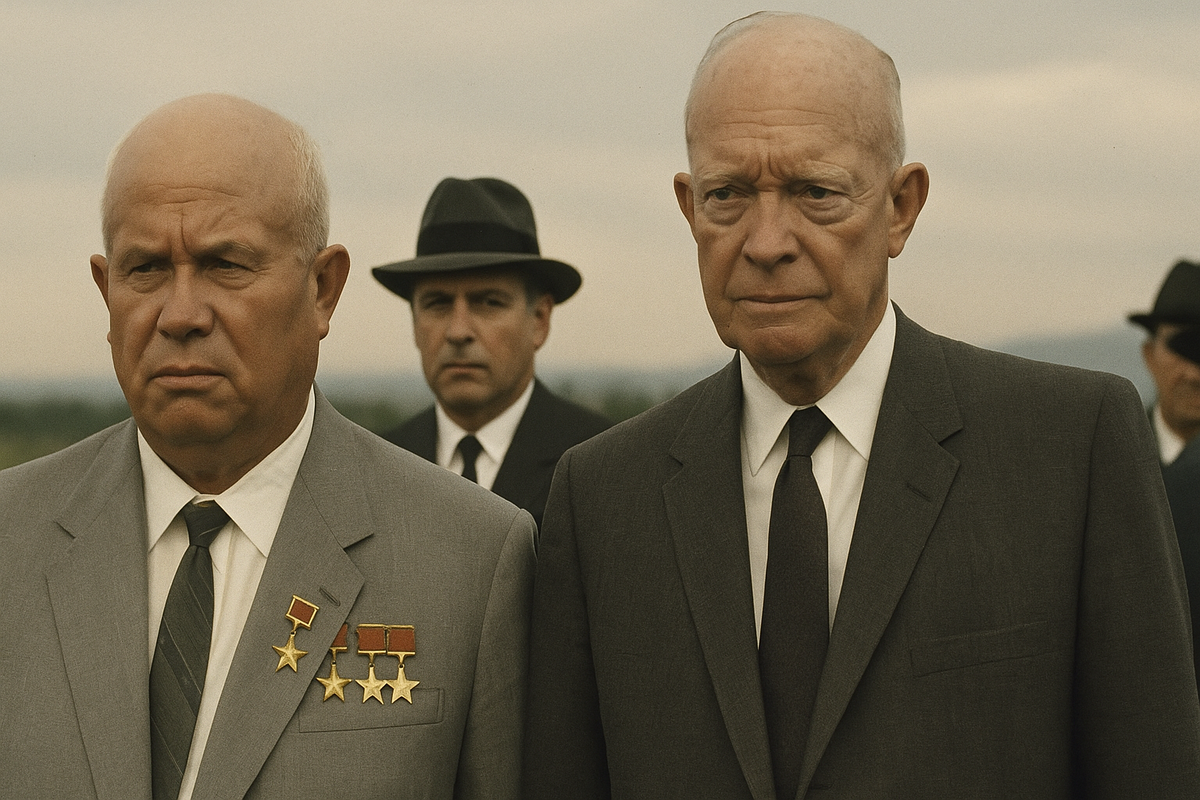
The Magazine That Captured the Moment the Cold War Shattered
Inside The New Yorker's May 28, 1960 Issue: Richard H. Rovere's Masterful Analysis of the Failed Paris Summit
On May 16, 1960, the Paris Summit collapsed before it could begin. Nikita Khrushchev stormed out. Dwight Eisenhower sat in stony silence. The world's last, best hope for détente died in a French conference room, killed by a spy plane and the lies told to cover it up.
Twelve days later, The New Yorker arrived in mailboxes across America with Richard H. Rovere's "Letter from Below the Summit"—not a news report, but an autopsy. What readers held in their hands wasn't yesterday's headlines. It was the first draft of history, written with the kind of clarity that only distance from the daily news cycle could provide.
This is why the May 28, 1960 issue remains one of the most sought-after editions in the magazine's archive. It didn't just document a crisis. It explained what the crisis meant.
The Summit That Never Was
By the spring of 1960, a fragile optimism had begun to thaw the deepest freeze of the Cold War. The Paris Summit was scheduled to convene President Dwight D. Eisenhower, Soviet Premier Nikita Khrushchev, French President Charles de Gaulle, and British Prime Minister Harold Macmillan. On the agenda: nuclear disarmament, Berlin, and the possibility—however faint—of coexistence.
Then came May 1. An American U-2 spy plane, piloted by Francis Gary Powers, was shot down deep inside Soviet territory. The Eisenhower administration's first instinct was denial: a weather research aircraft had strayed off course. But Khrushchev had the wreckage. He had the pilot. And he had the photographs Powers had been taking of Soviet military installations.
The lie collapsed. So did the summit.
When the four leaders finally gathered in Paris on May 16, Khrushchev arrived with a prepared tirade. He demanded an apology, a punishment for those responsible, and a guarantee that such flights would never happen again. Eisenhower, unwilling to apologize for espionage he considered necessary, offered none of these. Khrushchev walked out. The summit died in its crib.
What had been intended as a turning point became a breaking point.
Historical Record
Publication: The New Yorker
Issue Date: May 28, 1960
Featured Essay: "Letter from Below the Summit" by Richard H. Rovere
Cover Artist: Arthur Getz
Historical Context: Published 12 days after the collapse of the Paris Summit Conference
Rovere's Anatomy of Failure
Richard H. Rovere did not traffic in breaking news. As The New Yorker's chief political correspondent, his métier was interpretation—the kind of incisive, literary journalism that made sense of chaos without surrendering to it.
"Letter from Below the Summit" dissected the collapse with surgical precision. Rovere understood that this was not merely a diplomatic failure but a revelation of deeper structural truths:
The Foundation of Mistrust
The U-2 incident exposed that espionage wasn't an unfortunate necessity—it was the organizing principle of the relationship. Both sides spied because neither side could afford to trust.
Theater as Strategy
Khrushchev's walkout reinforced his credentials at home as a defender of national honor while painting the Americans as duplicitous aggressors abroad. He lost nothing diplomatically that he hadn't already written off.
The Limits of Flexibility
Eisenhower was trapped between the secrecy required by intelligence work and the transparency demanded by democratic accountability. He chose pride over diplomacy—a choice that left the United States isolated.
Beyond Grand Gestures
The summit's failure proved that conferences and handshakes made for good optics, but the Cold War was not a misunderstanding. It was a collision of incompatible world systems.
Rovere didn't editorialize. He didn't need to. The facts, arranged with care, told the story.
Arthur Getz's Butterflies and Storm Clouds
The cover of the May 28, 1960 issue, illustrated by Arthur Getz, depicted a swirl of colorful butterflies rising into a sky that darkened toward the upper edge of the frame. At first glance, it was whimsical—almost pastoral in its delicacy.
But New Yorker readers in 1960 knew how to read a cover. Paired with Rovere's essay, those butterflies became something else: fragile hopes for peace ascending into gathering storms. The magazine had always excelled at this kind of visual irony—art that appeared light until you understood the weight it carried.
Getz's cover didn't explain the news. It felt like the news.
The Magazine as Mirror
What made The New Yorker essential in 1960 was not speed but perspective. While newspapers raced to report what happened, the magazine explained why it mattered. It bridged the gap between event and understanding, between headline and history.
Rovere's "Letter from Below the Summit" gave readers what they couldn't get anywhere else: a framework for making sense of the chaos. It offered neither false hope nor cynical despair, only clear-eyed analysis of power, pride, and the limits of diplomacy.
That kind of journalism doesn't age. It compounds.
Why This Issue Endures
A Hinge Moment
The collapse of the Paris Summit marked the end of the Eisenhower era's cautious optimism and the beginning of a darker, more cynical phase. The missiles would follow. So would Berlin. So would Cuba.
Primary Source Material
Rovere's essay remains required reading for understanding Cold War diplomacy. His work is still cited in graduate seminars and monographs on mid-century international relations.
Visual Storytelling
Arthur Getz's cover is a masterclass in visual narrative—sophisticated illustrations that balanced accessibility with depth, making abstract geopolitics feel intimate and immediate.
The Magazine at Its Zenith
This was The New Yorker as cultural institution—a publication that could assume its readers were intelligent, informed, and willing to sit with complexity. No dumbing down. Just thought, rendered with style.
Owning this issue means holding a document of how Americans processed world-historical events in real time—not through hot takes or cable news shouting, but through patient, literary journalism.
Final Word
The May 28, 1960 issue of The New Yorker is a reminder of what magazines could be when they operated at the highest level: not just vessels for content, but instruments of understanding. Richard H. Rovere's essay didn't just report the failure of the Paris Summit—it revealed what that failure said about power, trust, and the human capacity for self-deception.
In an age when the world seemed perpetually on the brink, The New Yorker offered something rarer than comfort: clarity.
That clarity is still there, preserved in ink and paper, waiting to be read again.
For Collectors and Historians
If you're building a collection of 20th-century American magazines, the May 28, 1960 New Yorker belongs in it—not as decoration, but as evidence. Evidence of how a nation read. Evidence of how culture and politics intertwined. Evidence of a moment when the world teetered, and journalism rose to meet it.
We maintain an archive of original New Yorker issues spanning decades—each one a time capsule of wit, politics, art, and history.
Browse The New Yorker Magazine CollectionThese are not reproductions. They are the artifacts themselves—pages that were printed, delivered, and read in their moment. For collectors, historians, and anyone who values the intersection of literature and history, they are irreplaceable.