
Land Reform, Cold War Strategy, and the Defeat of Communist Influence in Postwar Japan
How The Saturday Evening Post documented MacArthur's most decisive Cold War victory—fought not with weapons, but with property deeds
The rice paddies of rural Japan seemed an unlikely front in the Cold War. Yet in January 1949, when Americans opened their copies of The Saturday Evening Post, they witnessed exactly that—a battlefield where property deeds proved more powerful than propaganda, where the stroke of a pen transferring land ownership dealt communism a blow more decisive than any military campaign could deliver.
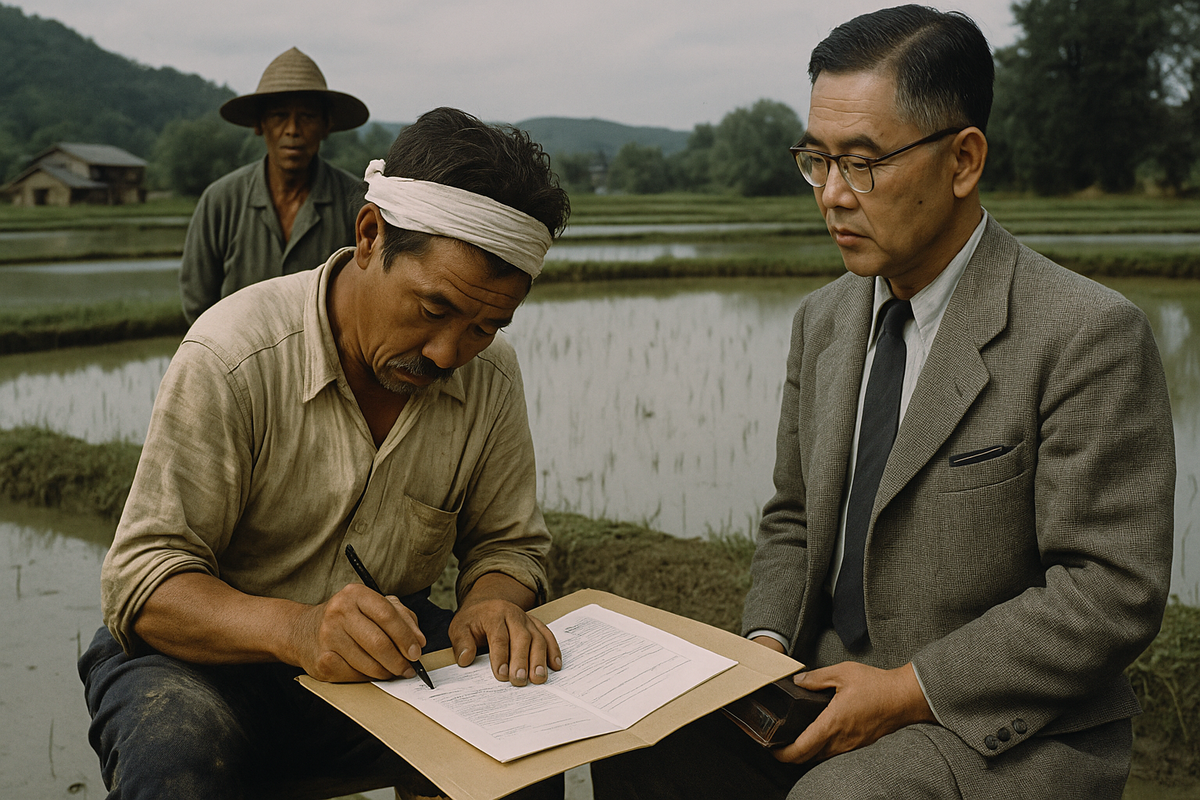
The article inside, "Japan's Communists Lose a Battle," documented something unprecedented: General Douglas MacArthur's land reform program was dismantling a 400-year-old feudal system, handing over 5 million acres to the farmers who worked them, and in the process, pulling the ideological ground from beneath communist organizers. This wasn't charity. It was strategy. And it was working.
Archive Details
Publication: The Saturday Evening Post
Issue Date: January 8, 1949
Cover Artist: Stevan Dohanos
Featured Article: "Japan's Communists Lose a Battle"
Historical Context: U.S. Occupation of Japan, Land Reform Implementation
Key Figure: General Douglas MacArthur, Supreme Commander
The Stakes in 1949
Four years after Japan's surrender, the country remained under American occupation, suspended between catastrophic defeat and an uncertain future. Asia itself hung in the balance. Communist forces were advancing across China. Korea would soon erupt. The question facing American policymakers was stark: would Asia's future be democratic or communist?
The answer, MacArthur and his advisors believed, began in Japan's countryside.
For centuries, Japanese tenant farmers had worked land their families would never own. Generation after generation bent over the same plots, surrendering half their harvest—sometimes more—to absentee landlords. The system bred resentment. It bred hunger. And it bred receptivity to communist promises of liberation.
The occupation government recognized what history had proven repeatedly: democracy cannot take root in economic injustice. Without land reform, Japan's rural population—millions strong—would remain vulnerable to communist recruitment. The reforms struck at feudalism's foundation. Landlords were compelled to sell all holdings beyond 7 acres of rice land or 12 acres of dry fields. The government purchased these parcels and redistributed them to tenant farmers at reasonable prices.
The scope was staggering. Over 5 million acres changed hands. Families who had labored for centuries as tenants became landowners overnight.
Why The Saturday Evening Post Mattered
In 1949, The Saturday Evening Post stood as one of America's most trusted windows onto the world. Before television networks dominated the news cycle, magazines like the Post provided the depth and context that shaped public understanding of foreign affairs. Its circulation reached millions of households. Its editorial judgment carried weight.
The magazine's coverage of Japan's land reform did more than inform—it legitimized. It told Americans that their tax dollars and their military occupation were achieving something concrete. Democracy wasn't just a rhetorical concept being imposed at gunpoint. It was taking physical form in the transfer of property, the signing of deeds, the redistribution of economic power.
The article's photographs made the abstract tangible:
A Japanese farmer, bent low over flooded paddies, cultivating soil he finally owned.
A former mayor distributing deeds, enacting the largest land transfer in modern Japanese history.
An ex-landlord selling jewelry to settle debts, the old order literally liquidating itself.
These images carried authority. They were proof. For American readers weighing the cost of occupation against its benefits, here was evidence that the investment was paying dividends.
The Cover's Paradox
Stevan Dohanos painted the January 8, 1949 cover—one of his signature domestic scenes. A husband sprawls contentedly after dinner while his wife confronts a mountain of dirty dishes. The image plays on familiar American humor, the gentle domestic comedy of postwar middle-class life.
The juxtaposition was deliberate, if unintentional. While the cover invited readers in with the comfortable rhythms of American domesticity, the pages inside revealed the high-stakes remaking of Asia's political order. One world reflected American life as millions lived it. The other showed American power reshaping lives half a world away.
This duality defined the Post's appeal. It could be both mirror and window—reflecting readers' own experiences while opening views onto global transformation. The magazine understood that Americans wanted both: recognition of their daily lives and understanding of their country's expanding role in the world.
What the Article Revealed
The piece laid out the reforms with precision:
Why This Issue Endures
Before cable news and internet journalism, magazines provided the context that made sense of global events. The Saturday Evening Post excelled at this work. It could explain land reform in Japan while simultaneously reflecting American domestic culture through its covers and fiction.
This issue endures because it captured both: the humor of American home life and the deadly serious competition for Asia's political future. The magazine trusted its readers to handle the contrast—to laugh at Dohanos' cover and then turn the page to confront the geopolitical stakes of the Cold War.
That trust in reader intelligence, combined with serious reporting and visual documentation, makes these issues invaluable for understanding how Americans processed their country's new role as global power.
Collector Significance
The January 8, 1949 issue of The Saturday Evening Post represents more than archival curiosity. It captures a pivotal moment when American policy intersected with Japanese history to produce one of the Cold War's earliest strategic victories.
For Your Collection
If your interests include postwar Japan, Cold War strategy, MacArthur's occupation policies, or Stevan Dohanos' illustration work, the January 8, 1949 issue of The Saturday Evening Post deserves space in your collection. It documents the moment when land reform became ideological warfare, when democracy proved it could deliver economic justice, and when American policy helped determine Asia's future.
Browse The Saturday Evening Post Magazine CollectionThese aren't reproductions or digital scans. They're the actual magazines that sat on American coffee tables in 1949, that informed public opinion during the Cold War's crucial early years, and that documented history as it happened. For collectors, historians, or anyone honoring family connections to this era, these issues remain living artifacts—portals to the moment when America's postwar vision was being tested in Japanese rice paddies, one land deed at a time.