
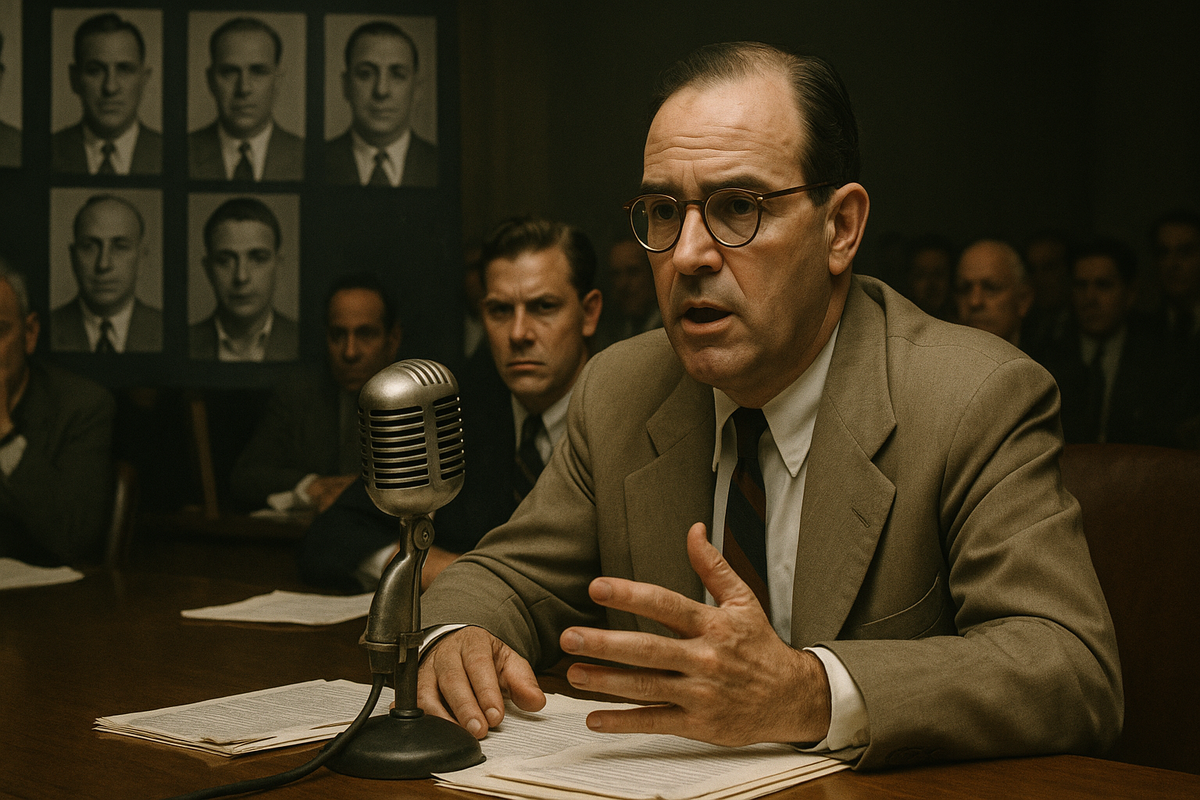
The Night America Watched the Mob on Television
Inside the April 7, 1951 Saturday Evening Post and Senator Kefauver's Battle Against the Underworld
On April 7, 1951, Senator Estes Kefauver's hands were still raw from shaking thousands of them. For fourteen months, his Special Committee to Investigate Crime in Interstate Commerce had crisscrossed America—from Tampa to Kansas City, Detroit to Los Angeles—dragging the nation's most dangerous men into the light. Now, in the pages of The Saturday Evening Post, Kefauver was ready to tell Americans what he had found.
The magazine hit newsstands during the final act of the Kefauver Hearings, those electrifying broadcasts that had transformed ordinary living rooms into jury boxes. Families who had purchased their first television sets months earlier now watched Frank Costello's hands fidget on camera—the only part of him NBC was allowed to show—as he dodged questions about murder, money, and the Mafia. An estimated 30 million Americans tuned in. They had never seen anything like it.
The Saturday Evening Post captured this fever pitch in real time. Its April 7 issue didn't just report on organized crime. It became part of the story itself—a printed indictment, complete with mugshots of the men Americans had been watching testify, evade, and occasionally crack under pressure.
This wasn't journalism as spectator sport. It was democracy fighting back.
Archive Details
Historical Figure: Senator Estes Kefauver (D-Tennessee)
Issue Date: April 7, 1951
Archive Source: The Saturday Evening Post
Featured Article: "Crime in the U.S.: What I Found in the Underworld"
Cover Artist: Stevan Dohanos
What Kefauver Saw in the Underworld
"Crime in the U.S.: What I Found in the Underworld" reads less like a Senate report and more like a field dispatch from enemy territory. Kefauver documented the architecture of a shadow government: gambling syndicates stretching from Saratoga Springs to the Mexican border, narcotics pipelines feeding American cities, labor unions hollowed out by racketeers who treated them like personal treasuries.
The article named names. Frank Costello, the so-called "Prime Minister of the Underworld." Tony Accardo, Al Capone's heir in Chicago. Joe Adonis, whose real name was Giuseppe Antonio Doto and whose influence reached into Brooklyn's docks and City Hall alike. Tony Gizzo, the Kansas City boss whose territory had just been stained by the shotgun murder of Charles Binaggio—a political fixer whose photograph appeared in the Post as a brutal reminder that this wasn't abstract criminology. Frank Erickson, the bookmaker who moved millions. Mickey Cohen, the Hollywood mobster who wore $60 silk shirts and carried a gun.
These weren't folklore villains. They were men who corrupted judges, controlled politicians, and treated violence as a business expense. Kefauver's committee had dragged them, one by one, before cameras and microphones. The Post gave readers a second look—this time in print, with the senator's own analysis of what their evasions meant.
The Magazine That Brought the Hearings Home
By 1951, The Saturday Evening Post commanded a circulation that rivaled small nations. It was the magazine of Main Street and the middle class, yes—but it was also the publication that had serialized F. Scott Fitzgerald and made Norman Rockwell a household name. Its blend of fiction, illustration, and hard-hitting reportage made it indispensable.
This issue demonstrated that range. Readers who opened to David Lamson's story "Old Enough to Marry" or Richard Macaulay's "Sneak Attack" found themselves a few pages away from Frank Costello's mugshot. The juxtaposition was deliberate. The Post understood that Americans needed both escape and engagement, sentiment and truth.
Kefauver's article fulfilled the magazine's civic mandate. In 1951, television was still an infant medium—unpredictable, unrecorded, fleeting. Daily newspapers were local. National magazines like the Post provided context, permanence, and reach. When Kefauver wrote for the Post, he wasn't just addressing Congress or law enforcement. He was speaking directly to the citizens whose taxes funded his investigation and whose votes would determine whether his reforms survived.
The magazine became the hearings' historical record. What millions saw live on television now existed in print, annotated by the man who had orchestrated the confrontation.
The Stevan Dohanos Cover: Freedom and Its Discontents
The cover featured Stevan Dohanos' illustration of "Tex" Keeler, a young Connecticut man leaning against his customized blue-and-silver motorcycle. At first glance, it had nothing to do with organized crime.
Look closer.
Motorcycles in 1951 America carried conflicting symbolism. They represented postwar mobility and individual freedom—the open road, the rejection of conformity. But they also hinted at danger. Youth culture was beginning to fracture from its elders. Marlon Brando's The Wild One was two years away, but the archetype was already forming: the rebel, the outsider, the American who played by different rules.
In an issue devoted to exposing men who operated outside the law, Dohanos' cover worked as visual irony. Here was the wholesome rebel, the kid with the custom bike and the clean-cut face. Inside were the real outlaws—older, richer, infinitely more dangerous.
The Post had always excelled at this kind of layered storytelling. Whether through Rockwell's tender Americana or Dohanos' edgier modernity, its covers reflected the nation's contradictions. This issue captured a country in transition: powerful, prosperous, and uneasily aware that democracy had enemies within its own borders.
Why Frank Costello's Hands Mattered
The hearings made Frank Costello famous for what the cameras couldn't show. When his lawyer insisted that his face not be televised, NBC obliged—and trained its lens on Costello's hands instead. For hours, millions of Americans watched those hands: smoothing papers, tapping the table, wringing together when questions turned sharp.
His hands told the story his voice obscured. They betrayed nervousness, calculation, frustration. Costello's reputation as the "gentleman gangster"—the mobster who preferred negotiation to violence, influence to intimidation—evaporated under the lights. The hearings revealed him as what he was: a fixer, a corrupter, a man who had bent cities to his will.
The Post's photographs restored what television had denied. Readers saw Costello's face, Adonis' smirk, Cohen's Hollywood swagger. These images transformed the hearings from spectacle into document. They gave the underworld faces, names, histories. They made it impossible to dismiss Kefauver's warnings as exaggeration.
The Assassination That Haunted the Hearings
On April 6, 1950—almost exactly one year before this Post issue appeared—Kansas City politician Charles Binaggio was shot to death in the Democratic Club headquarters. His associate Charles "Mad Dog" Gargotta died beside him. Four shotgun blasts. No witnesses. No arrests.
Binaggio had promised organized crime that he could deliver Missouri. He had failed. His murder wasn't just revenge. It was a message.
Kefauver's committee made Binaggio's death Exhibit A in the case that organized crime had penetrated electoral politics. The Post ran his photograph—a handsome man, still young, staring into the camera with the confidence of someone who believed he could broker power. The image served as the issue's memento mori: this is what happens when democracy makes deals with the underworld.
Tony Gizzo, the Kansas City boss linked to Binaggio, had already testified before Kefauver's committee by the time the Post went to press. His denials meant nothing. Binaggio's corpse spoke louder.
What the Hearings Changed
The Kefauver Hearings didn't destroy the Mafia. Organized crime adapted, evolved, and endured long past 1951. But the hearings accomplished something more fundamental: they made corruption visible.
Before Kefauver, organized crime existed in the American imagination as folklore—Prohibition-era legends, tabloid sensationalism, rumors. After the hearings, it existed as documented fact. Millions of citizens had watched mobsters squirm, senators press, and the machinery of investigation grind forward. Television had transformed governance into theater, and in doing so, had made accountability inescapable.
The political impact was immediate. States strengthened anti-racketeering laws. Robert F. Kennedy, then a young lawyer on Kefauver's staff, would spend the next decade pursuing organized crime with prosecutorial zeal. J. Edgar Hoover—who had long denied the Mafia's existence—was finally forced to acknowledge what Kefauver had proven.
The cultural impact went deeper. The hearings marked the moment when television stopped being a novelty and became a force. Americans had discovered that they could witness their government in action, that they could judge for themselves whether justice was being served. The medium would never be purely entertainment again.
Why This Issue Matters to Collectors
Historical Timing
This issue hit newsstands during the final weeks of the Kefauver Hearings, when public fascination peaked. It isn't a retrospective. It's a primary source, published while the story was still unfolding.
Iconic Imagery
The mugshots of Costello, Accardo, Adonis, Gizzo, Erickson, and Cohen make this one of the most visually striking crime-related publications of the era. These aren't stock photos. They're the faces Americans saw on television, now preserved in print.
Cultural Intersection
The issue captures the collision of media, politics, and organized crime—the moment when television, magazines, and government investigation converged to reshape public consciousness.
Archival Rarity
While mid-century Saturday Evening Post issues survive in reasonable numbers, those tied to major political events carry premium value. This isn't just a magazine. It's evidence of a turning point in American history.
For collectors of crime history, mid-century journalism, or television's early impact on democracy, this issue offers something increasingly rare: a tangible artifact from a moment that changed how Americans understood power.
Own a Piece of the Fight
The April 7, 1951 edition is part of a curated collection of original Saturday Evening Post magazines spanning decades of American life—from the Great Depression through World War II, from postwar prosperity to the Civil Rights movement. Each issue captures the concerns, hopes, and conflicts of its moment.
Browse The Saturday Evening Post Magazine CollectionThese aren't reprints or digital facsimiles. They're the actual pages that Americans read over breakfast tables and in living rooms, the ink-and-paper record of how the nation saw itself.
The Artifact Endures
Senator Estes Kefauver's investigation didn't end organized crime. But it ended America's willingness to look away.
The April 7, 1951 Saturday Evening Post stands as proof of what happens when journalism, politics, and new technology align in service of transparency. Its pages documented not just corruption but the will to confront it. The mugshots gave faces to the enemy. Kefauver's words gave citizens a framework for understanding the threat. And the magazine itself—delivered to millions of homes across the country—ensured that the fight against the underworld became a national conversation, not a whispered rumor.
For anyone who values the intersection of media and democracy, this issue is more than a collectible. It's a witness.