
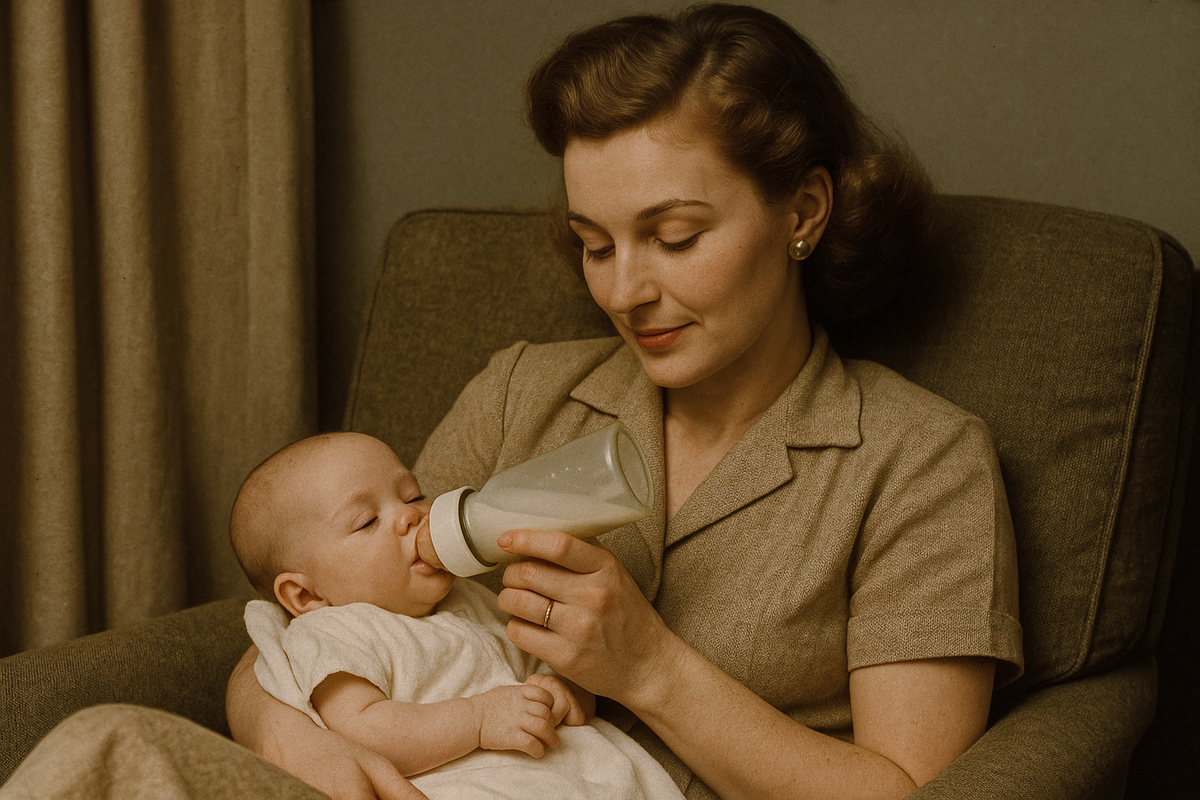
The Smile That Taught America How to Love
Dr. Spock's Radical 1955 Intervention in Ladies' Home Journal
In May 1955, between advertisements for Jell-O molds and sewing patterns, Ladies' Home Journal published what would become one of the most subversive pieces of parenting advice in postwar America. Dr. Benjamin Spock—already a household name from his blockbuster Common Sense Book of Baby and Child Care—told millions of mothers something their doctors, their hospitals, and their own mothers hadn't: Stop worrying about the method. Start worrying about the moment.
The article, "Dr. Spock Talks with Mothers," didn't just wade into the breast-versus-bottle debate. It dismantled it. In an era when formula companies were selling "scientific feeding" and hospitals were discouraging breastfeeding as old-fashioned, Spock made a case that now sounds obvious but was then revolutionary: babies don't need perfect nutrition schedules. They need to feel loved while they eat.
For women navigating the contradictions of 1950s domesticity—told simultaneously to be modern and maternal, efficient and nurturing—this was permission to trust themselves. It was also a turning point in how America thought about childhood itself.
Archive Details
Historical Figure: Dr. Benjamin Spock
Issue Date: May 1955
Archive Source: Ladies' Home Journal
Article Title: "Dr. Spock Talks with Mothers"
The Context: When Convenience Collided with Psychology
The mid-1950s were a strange time to be a mother. The baby boom was roaring. Suburbs were spreading. And the advice industry—magazines, pediatricians, formula manufacturers—was booming alongside it.
Breastfeeding was in steep decline. By 1955, the majority of American mothers were bottle-feeding, encouraged by hospitals that separated newborns from mothers immediately after birth and by advertising campaigns that framed formula as progress. Bottles were measurable, predictable, modern. Breastfeeding, by contrast, was increasingly seen as inefficient, even primitive.
But something else was shifting, too. The rigid parenting doctrines of the early 20th century—behaviorism, strict feeding schedules, warnings against "spoiling" babies with affection—were losing their grip. Psychologists and pediatricians were beginning to argue that emotional security mattered as much as physical health. Children, they suggested, needed warmth, not just discipline.
Spock had been making this case since 1946, when his first book sold out its initial print run in six months. By 1955, he'd sold millions of copies and become the most trusted voice in American parenting. When Ladies' Home Journal—a magazine that reached more households than almost any other publication—gave him a feature, they weren't just covering a trend. They were shaping one.
The Article: A Conversation, Not a Lecture
"Dr. Spock Talks with Mothers" was designed to feel intimate, not clinical. The title itself positioned Spock as a confidant rather than an authority figure. A black-and-white photograph showed him smiling—warm, bespectacled, approachable. The subheading cut straight to the anxiety: "Is the breast-fed baby more secure than the bottle-fed? Not necessarily, it depends on the mother."
This was the thesis, and it was radical.
Spock didn't dismiss breastfeeding. He acknowledged its benefits. But he argued that the emotional quality of feeding time mattered far more than the delivery mechanism. A bottle-fed baby held close, smiled at, and soothed could thrive. A breastfed baby treated as a feeding task—mechanical, distracted, emotionally distant—could suffer.
He cited research from the Rochester Child Health Institute, affiliated with the Mayo Clinic, which had studied infant development extensively. Their conclusion: affection and attention shaped emotional security more than feeding method.
Then Spock went further. He condemned bottle props—pillows or holders that allowed mothers to feed babies hands-free—calling them a form of emotional neglect. Babies needed presence, not convenience. They learned to associate the pleasure of eating with their mother's face, her voice, her touch. Without that connection, they were nourished but not loved.
One line, in particular, became memorable: babies learn to love through the joy of feeding connected with their mother's delighted smile.
The Philosophy: Trust Yourself, Love Your Child
The article reflected Spock's broader approach, which had already transformed American parenting. He believed in flexibility over rules, warmth over discipline, and parental instinct over expert diktat. Where earlier advice books had told mothers to ignore crying babies or feed on rigid schedules, Spock said: respond to your child. Be present. Enjoy them.
This wasn't just a rejection of behaviorism. It was a rejection of the anxiety that postwar mothers lived with—the fear that they were doing it wrong, that science had all the answers, that love alone wasn't enough.
Spock told them love was enough. Method didn't matter. Presence did.
He also gave practical advice: don't let babies drink themselves to sleep with bottles, watch for overfeeding, keep nipples and bottles clean. But these tips were secondary to the emotional argument. The article wasn't a manual. It was reassurance.
Love Over Method
Whether breastfeeding or bottle-feeding, babies thrive most when they feel love and security during feeding time.
Emotional Development
Feeding was described as a moment of bonding, where babies connect physical nourishment with maternal affection.
Against Bottle Props
Spock strongly advised against mechanical feeding aids, warning that babies needed presence, not convenience.
Security Through Touch
Babies learn to love through the joy they experience in feeding time connected with their mother's delighted smile.
The Magazine: Where Domesticity Met Cultural Debate
Ladies' Home Journal was more than a homemaking guide. By 1955, it was a cultural institution—one of the highest-circulation magazines in America, reaching millions of suburban households. Each issue blended fiction, fashion, beauty advice, and serious journalism. The May 1955 issue, for instance, included a serialized feature on Queen Elizabeth II ("Born to Be Queen"), a memoir by actress Ethel Barrymore, and fashion spreads alongside Spock's essay.
This mix wasn't accidental. The magazine understood that its readers weren't one-dimensional housewives. They were women navigating complex, overlapping roles—mothers, consumers, cultural citizens. They needed recipes and also needed to think about psychology. They cared about hemlines and also about whether their children would grow up emotionally healthy.
By placing Spock's voice in this context—alongside royal profiles and Hollywood memoirs—the magazine elevated parenting to the same level as culture and entertainment. It said: this matters. Your choices matter.
The Legacy: Why This Issue Still Resonates
Today, the May 1955 Ladies' Home Journal is prized by collectors for several reasons.
It captures a turning point. The postwar baby boom was at its peak. Debates about breastfeeding, formula, and women's roles were reshaping American life. This issue sits at the intersection of science, commerce, and culture.
It's a Spock artifact. His influence on a generation of parents cannot be overstated. This article extended his reach beyond book buyers to the broader magazine-reading public.
It's a time capsule. The advertisements alone—for appliances, beauty products, food—offer a window into mid-century consumer culture. The fiction, advice columns, and essays show how women were expected to live, and what they were beginning to question.
It's part of women's history. These magazines documented not just ideals but contradictions—the pressure to be modern and traditional, efficient and nurturing, scientific and instinctive. They're evidence of how women thought, what they read, and how they made sense of their lives.
Why It Still Matters
Spock's advice sounds almost quaint now. Of course emotional connection matters. Of course babies need affection. But in 1955, this wasn't obvious. It was a challenge to the medicalization of motherhood, to the idea that experts knew better than mothers, to the belief that science could replace instinct.
The debates he addressed haven't disappeared—they've just changed shape. We still argue about breastfeeding versus formula, about maternal presence versus work, about whether we're doing enough for our children. The specifics shift, but the anxiety remains.
What makes this article enduring isn't that Spock solved the debate. It's that he reframed it. He said: stop measuring yourself against rigid standards. Start paying attention to your child. Trust what you feel.
That message—radical in 1955, still necessary today—is why this issue belongs in the hands of collectors, historians, and anyone interested in how America learned to think about childhood.
Collector Significance
The May 1955 issue of Ladies' Home Journal represents more than editorial history. It's a primary source for understanding mid-century parenting culture, women's media, and the rise of psychological thinking in American life. Original copies are increasingly scarce, particularly in good condition, and demand among collectors—especially those focused on women's history, medical history, or mid-century Americana—continues to grow.
This isn't just a magazine. It's evidence of a cultural shift, preserved in newsprint.
Historical Significance
Documents a pivotal moment in American parenting philosophy and women's domestic life during the baby boom era.
Cultural Artifact
Preserves the intersection of medical advice, consumer culture, and women's media in mid-century America.
Research Value
Primary source material for scholars of women's history, pediatric medicine, and postwar American culture.
Explore Our Archive Collection
Discover decades of women's fashion, literature, home life, and cultural transformation preserved in authentic vintage magazines. Each issue is an artifact—not just of what women read, but of how they lived.
Browse Ladies' Home Journal Magazine Collection