
When Vogue Buried Its King
The May 1972 Issue That Marked the End of an Era
The fashion world doesn't often pause to mourn. But in the spring of 1972, it had no choice.
When Cristóbal Balenciaga died in March of that year, something more than a designer passed. The last architect of haute couture's golden age—the man who had refused every compromise, every trend, every concession to modernity—was gone. And Vogue, the arbiter of taste for half a century, knew it had to respond not with a routine obituary, but with a reckoning.
The May 1, 1972 issue of Vogue became that reckoning. What readers held in their hands wasn't just a magazine. It was a eulogy dressed as art criticism, a memorial shot through with quiet devastation, and a historical marker signaling the irreversible shift from couture's cathedral-like precision to the democratic chaos of ready-to-wear.
This issue didn't just report Balenciaga's death. It canonized him.
Archive Details
Historical Figure: Cristóbal Balenciaga (1895-1972)
Issue Date: May 1, 1972
Archive Source: Vogue Magazine
Photography: Henri Cartier-Bresson (1968)
Commentary: Violette Leduc (reprinted from 1965)
The Man Who Walked Away
Balenciaga's life in fashion reads like a fable about integrity. From the 1930s through 1968, he built an empire on a single principle: perfection or nothing. While his peers—Dior, Givenchy, Saint Laurent—flirted with licensing deals and ready-to-wear lines, Balenciaga held firm. His atelier was a monastery. His standards were absolute.
In 1968, he closed his house rather than bend. No farewell collection. No press release. Just silence.
Four years later, he was dead. And the fashion world realized what it had lost.
By 1972, the landscape had shifted seismically. Paris was no longer the sole capital of style. London's street rebellion, New York's sportswear pragmatism, and Milan's emerging luxury machine had redrawn the map. Yves Saint Laurent was putting women in tuxedos and selling them off the rack. The era of bespoke, hand-stitched couture—garments that took hundreds of hours and cost a year's salary—was fading into myth.
Balenciaga's death crystallized the moment. Vogue understood this. The tribute they published wasn't nostalgia. It was archaeology—an excavation of a vanished world before it disappeared completely.
Cartier-Bresson's Atelier: The Photographs That Define a Legacy
The images anchoring this feature are what elevate it from memorial to masterpiece.
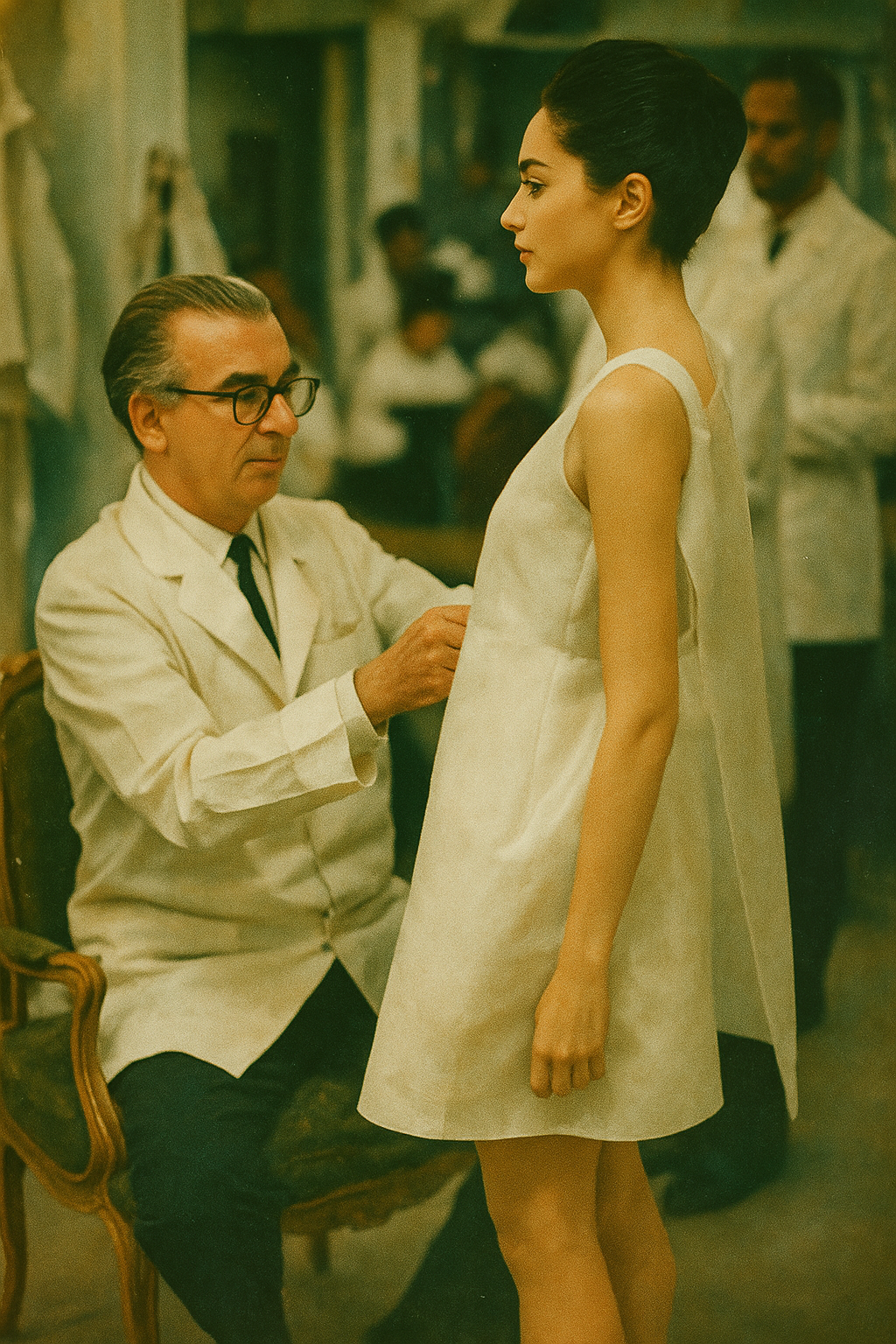
Henri Cartier-Bresson—the inventor of the "decisive moment," the poet laureate of 20th-century photojournalism—had photographed Balenciaga in 1968, during the designer's final months before retirement. These weren't fashion spreads. They were field notes from a dying art form.
In stark black and white, Balenciaga appears as craftsman, surgeon, sculptor. His hands adjust a sleeve with the precision of a watchmaker. His eyes—sharp, uncompromising—study the fall of fabric as if reading equations. The models are anonymous, their faces irrelevant. They exist only as armatures for his vision.
The atelier itself is stripped of glamour. No gilt mirrors. No champagne flutes. Just bolts of cloth, half-finished garments on dress forms, and the monastic concentration of a man who treated fashion as high art.
Cartier-Bresson captured something Vogue's glossy editorials never could: the labor, the obsession, the almost religious devotion required to make a Balenciaga gown. These images don't sell fashion. They document genius.
Violette Leduc's Mystical Portrait
Accompanying Cartier-Bresson's photographs was a passage by French writer Violette Leduc, originally published in Vogue in 1965 and reprinted here as liturgical text:
"Balenciaga sculpts, paints, writes in the act of making dresses. That is why he is above the others. To create dresses, beginning endlessly over and over again with the same model, the body, is to choose incessantly, without respite. As we breathe in order to live. To choose is to help the formless to breathe, to give life to what is unborn. In this, Balenciaga is supreme."
This is not fashion criticism. This is theology.
Leduc's language reframes Balenciaga not as a designer but as a kind of secular saint—a creator who brings form from void, life from fabric. For Vogue to reprint this passage in 1972, just weeks after his death, was a deliberate act of canonization. The magazine wasn't simply reporting news. It was shaping how history would remember him.
A Magazine at the Crossroads
The brilliance of this issue lies in its duality.
Flip through the May 1, 1972 Vogue and you'll find everything the early '70s promised: sleek summer styles, natural beauty editorials, the clean minimalism replacing the ornate excess of previous decades. The cover itself radiates effortless chic—a face scrubbed of heavy makeup, hair loose and unstyled, the image of a new, liberated femininity.
And then, buried inside, is Balenciaga.
The juxtaposition is deliberate. Vogue knew it was publishing a bridge issue—one foot in couture's gilded past, the other stepping toward fashion's democratic future. The Balenciaga feature isn't just a tribute. It's an acknowledgment that something irreplaceable had ended, and the magazine was duty-bound to preserve it before the world moved on entirely.
This is what separates Vogue from lesser publications. It understood that fashion isn't just commerce—it's cultural memory. And memory requires witnesses.
What Makes This Issue Essential
Cartier-Bresson's Archive
Rare photographs from 1968 capturing Balenciaga's final months in the atelier—documentary images that reveal the monastic precision of haute couture's greatest master.
Violette Leduc's Tribute
Reprinted from 1965, her mystical prose elevated Balenciaga from couturier to artist-philosopher, framing fashion as an act of creation comparable to sculpture or poetry.
Historical Timing
Published weeks after Balenciaga's death in March 1972, the issue served as real-time canonization—not hindsight, but immediate recognition of a vanished era.
Cultural Inflection Point
The issue bridges two worlds: haute couture's gilded past and ready-to-wear's democratic future, capturing fashion at a moment of irreversible transformation.
The Permanence of Paper
There's a reason collectors prize vintage magazines over digital ephemera.
These pages were meant to last. They were printed with permanence in mind, archived in personal libraries, passed down through generations. Unlike the disposable scroll of social media, each issue of Vogue from this era was curated, designed, and produced as if it mattered—because it did.
The May 1, 1972 issue embodies this. Balenciaga's presence on these pages isn't incidental. It's philosophical. The atelier photographs, Leduc's mystical prose, the quiet dignity of the layout—all of it argues that craftsmanship, whether in clothing or in publishing, is worth preserving.
In an age when fashion cycles turn over in weeks, this magazine reminds us that true artistry operates on a different timescale. It endures.
Why This Issue Endures
Historical Gravity
Published weeks after Balenciaga's death, it stands as one of the earliest and most authoritative tributes to the 20th century's greatest couturier. This isn't hindsight. This is real-time canonization.
Cartier-Bresson's Archive
These photographs alone justify ownership. Two titans of their respective fields—Balenciaga in fashion, Cartier-Bresson in photography—intersecting on the page. The images are documentary gold.
Cultural Inflection Point
The issue sits at the hinge between eras. Haute couture's dominance was over. Ready-to-wear had won. This magazine both mourns the old order and acknowledges the new.
Enduring Demand
Serious collectors of fashion history, photography, and 20th-century cultural artifacts recognize this issue as essential. It appreciates not just in monetary value, but in historical significance.
For the Collector, the Historian, the Believer
If you value the intersection of fashion, photography, and cultural memory, vintage Vogue is irreplaceable. Each issue is a time capsule—not just of hemlines and makeup trends, but of shifting values, gender roles, artistic movements, and the slow evolution of beauty itself.
Browse Vogue Magazine CollectionThe Final Word
The May 1, 1972 issue of Vogue remains essential for one simple reason: it understood the assignment.
When Cristóbal Balenciaga died, the magazine didn't rush out a celebrity obit or a sentimental fashion retrospective. It commissioned art. It reprinted philosophy. It paired the century's greatest fashion photographer with the century's greatest couturier and let their work speak across time.
The result is a magazine that functions as monument, memorial, and manifesto. It marks the end of haute couture's golden age with the gravity that moment deserved. And it preserves, in Cartier-Bresson's unflinching images and Leduc's devotional prose, a vision of fashion as something more than commerce—fashion as craft, as obsession, as art.
More than fifty years later, those pages still carry that weight.
For anyone who believes that style is inseparable from culture, and culture from history, this issue isn't optional. It's canon.