
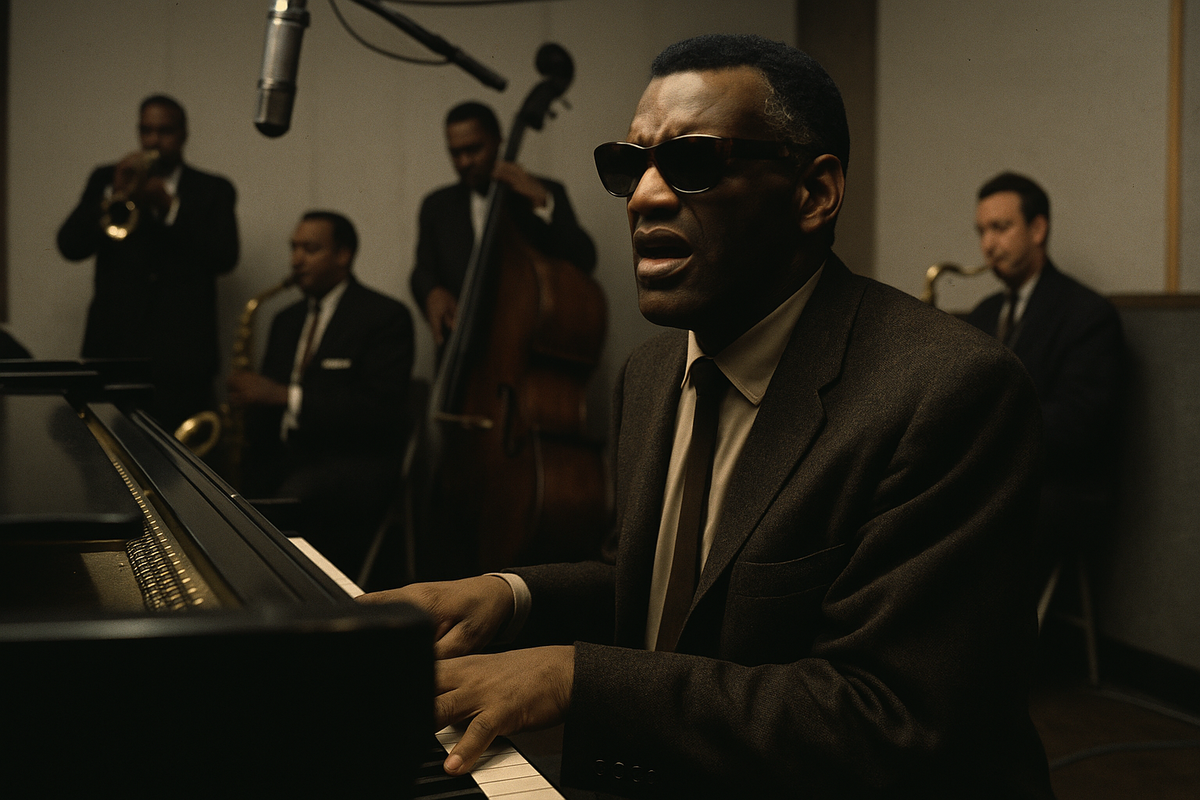
The $2 Million Man: When Ray Charles Rewrote the Rules of Black Business in 1963
The planes came first.
Not the music, not the fame—the planes. When Ebony Magazine's photographers arrived to document Ray Charles in the spring of 1963, they found a 32-year-old blind man from Georgia commanding a 50-passenger Marlin 404 aircraft, backup planes, a diesel bus, and a payroll of over 70 people. This wasn't a musician with a band. This was a corporation with a soundtrack.
The April 1963 issue of Ebony didn't just profile an entertainer. It documented a revolution.
Archive Details
Historical Figure: Ray Charles (Ray Charles Robinson)
Issue Date: April 1963
Archive Source: Ebony Magazine
Feature Title: "Blues Becomes Big Business" by Louie Robinson
Cover Story: Miriam Makeba (South African singer)
The Context That Made the Story Matter
Spring 1963 was the hinge point of American history. Students were staging sit-ins across the South. Freedom riders were boarding buses into danger. In four months, Martin Luther King Jr. would stand at the Lincoln Memorial before 200,000 people and reimagine the nation's future.
But revolutions aren't built on speeches alone. They're built on proof—tangible evidence that the system can be beaten, that barriers can be shattered, that a Black man born into poverty and blindness can become not just successful but powerful.
Ebony Magazine, founded by John H. Johnson in 1945, had made its mission clear from the start: show Black Americans thriving, not just surviving. Where white-owned publications reduced Black entertainers to novelty acts or background players, Ebony placed them on the cover, in boardrooms, behind the controls.
The April 1963 issue put Ray Charles alongside South African singer Miriam Makeba, who graced the cover. The pairing was deliberate—African and African American excellence in conversation, a statement about global Black culture at a moment when "global" and "Black" were rarely used in the same sentence by mainstream media.
"Blues Becomes Big Business"
Louie Robinson's feature article carried a title that doubled as a thesis: "Blues Becomes Big Business." Not "Ray Charles: The Genius" or "The Man Behind the Hits." Business. The word itself was radical.
Robinson traced the arc from Ray Charles Robinson, born in Albany, Georgia in 1930, losing his sight by age seven, to Ray Charles the institution. The Florida School for the Deaf and the Blind gave him musical training. By 15, he was playing professionally. By 17, he was earning a living. By 32, he had redefined what a Black musician could be.
The genius wasn't just in the music—though What'd I Say and Georgia on My Mind had already secured his reputation. The genius was in the business model.
While other musicians signed away their rights for quick cash, Charles demanded ownership of his master recordings. While others relied on major labels to dictate terms, Charles established Tangerine Records. While others toured as hired guns, Charles built Ray Charles Enterprises—a vertically integrated operation that included publishing companies, transportation infrastructure, and a self-sustaining ecosystem of employment.
His touring operation was staggering in its scope: a 16-piece orchestra, the Raelettes (his four-woman vocal group), three pilots, two band boys, lawyers, accountants, arrangers, and managers. Few entertainers of any race commanded such an operation. Charles didn't just employ people; he created an economy.
At the center of it all was Joe Adams, his trusted manager and executive assistant, helping Charles navigate an industry designed to exploit him.
The Photography as Manifesto
Ebony's visual storytelling was as important as its prose. The April 1963 issue deployed photography as argument.
A double-page spread showed Charles fronting his orchestra with the Raelettes—Gwen Berry, Margie Hendricks, Pat Lyles, and Darlene McCrea—their formation a study in professionalism and precision. These weren't backup singers shuffling in the shadows. They were integral to the sound, and Ebony made sure readers saw them as such.
Other images captured Charles in the studio, headphones on, listening to playback with his arrangers. Charles in business meetings. Charles directing sessions. Charles in motion.
Then came the planes. The buses. The infrastructure of mobility that allowed a Black entertainer to move through Jim Crow America on his own terms, in his own vehicles, answerable to no one but himself.
The message was clear: this was not a man being photographed. This was an executive being documented.
Where mainstream publications might have been content with a shot of Charles at a piano, Ebony insisted on showing the full machinery of his success. The effect was more than journalistic—it was political. It said: This is what power looks like. This is what independence looks like. This is what we can build.
Why This Issue Endures
For collectors and historians, the April 1963 Ebony represents a convergence of forces that makes it more than memorabilia.
The Timing
Published months before the March on Washington, it captures the momentum of a movement reaching critical mass. Civil rights activism and Black cultural achievement were rising in tandem, feeding off each other's energy.
The Subject at His Apex
Charles was 32, at the height of his creative and commercial power, having already transformed American music by blending gospel, blues, country, and jazz into something unprecedented.
The Dual Milestone
Miriam Makeba's cover story makes this issue a double landmark, connecting the African American freedom struggle to the broader anti-colonial movements reshaping the world.
The Economic Narrative
This wasn't just another profile of a talented performer. It was a case study in Black economic self-determination, a roadmap for what was possible when talent met business acumen met refusal to be exploited.
The artifact itself: Today, this issue is a primary source document—a window into how Black excellence was framed, celebrated, and preserved during one of the most transformative periods in American history. It's not just something to read. It's something to hold, to study, to pass down.
The Larger Architecture
Ebony was never just a magazine. It was infrastructure.
For Black Americans in the mid-20th century, representation wasn't a buzzword—it was oxygen. Mainstream media either ignored Black achievement or distorted it through the lens of stereotype and condescension. Ebony provided the counter-narrative: Black doctors, Black entrepreneurs, Black artists not as exceptions but as exemplars of what was always possible when barriers were removed.
The April 1963 issue demonstrates this mission in action. By chronicling Ray Charles as both artist and CEO, Ebony expanded the definition of Black success beyond performance into ownership, autonomy, and power.
That expansion mattered in 1963. It matters now.
The Bottom Line
The April 1963 issue of Ebony Magazine is a landmark not because it told Ray Charles's story, but because of how it told that story—as a narrative about control, dignity, and the assertion that African Americans could not only contribute to American culture but lead it, on their own terms, in their own planes.
For collectors, this issue is more than a purchase. It's an acquisition of history—a tangible piece of the moment when blues became big business and a blind man from Georgia proved that genius, when properly leveraged, could build an empire.
For readers today, it's a reminder that the most important stories are often told not in headlines but in the pages of magazines that refused to look away.
Collector Significance
Historical Timing
Released months before the March on Washington, this issue captures a pivotal moment when civil rights activism and Black cultural pride reached new heights simultaneously.
Ray Charles at Peak Power
Documents Charles at age 32, at the height of his influence, balancing artistic genius with unprecedented business acumen and autonomy.
Dual Cultural Milestone
Features both Ray Charles and cover subject Miriam Makeba, connecting African American and African excellence in a single groundbreaking issue.
Economic Power Narrative
One of the earliest mainstream documentations of Black economic self-determination in entertainment, showcasing ownership and enterprise building.
Primary Source Value
An authentic artifact from one of the most transformative decades in American history—not just to read, but to preserve and pass down.
Photographic Documentation
Features rare images of Charles's full business operation: planes, orchestra, staff, and infrastructure that few publications captured.
Explore the Archive
From the 1940s through the 1980s, Ebony chronicled decades of African American cultural history in real time. Each issue is a piece of heritage—a tangible artifact of progress, struggle, and triumph.
Browse Ebony Magazine Collection