
The Last Men Standing: Forbes' 1992 Autopsy of Corporate America
How the January 6, 1992 issue documented the moment efficiency, downsizing, and shareholder value became the dominant ideology of business
"Never fall in love with your assets. If you do, you're a goner." Joseph Williams didn't mince words when Forbes came calling in late 1991. As chairman of Williams Companies, he'd watched peers cling to dying divisions, bloated payrolls, and yesterday's strategies while their balance sheets bled red. Williams understood what many executives refused to accept: survival in the new economy required surgical detachment from sentiment.
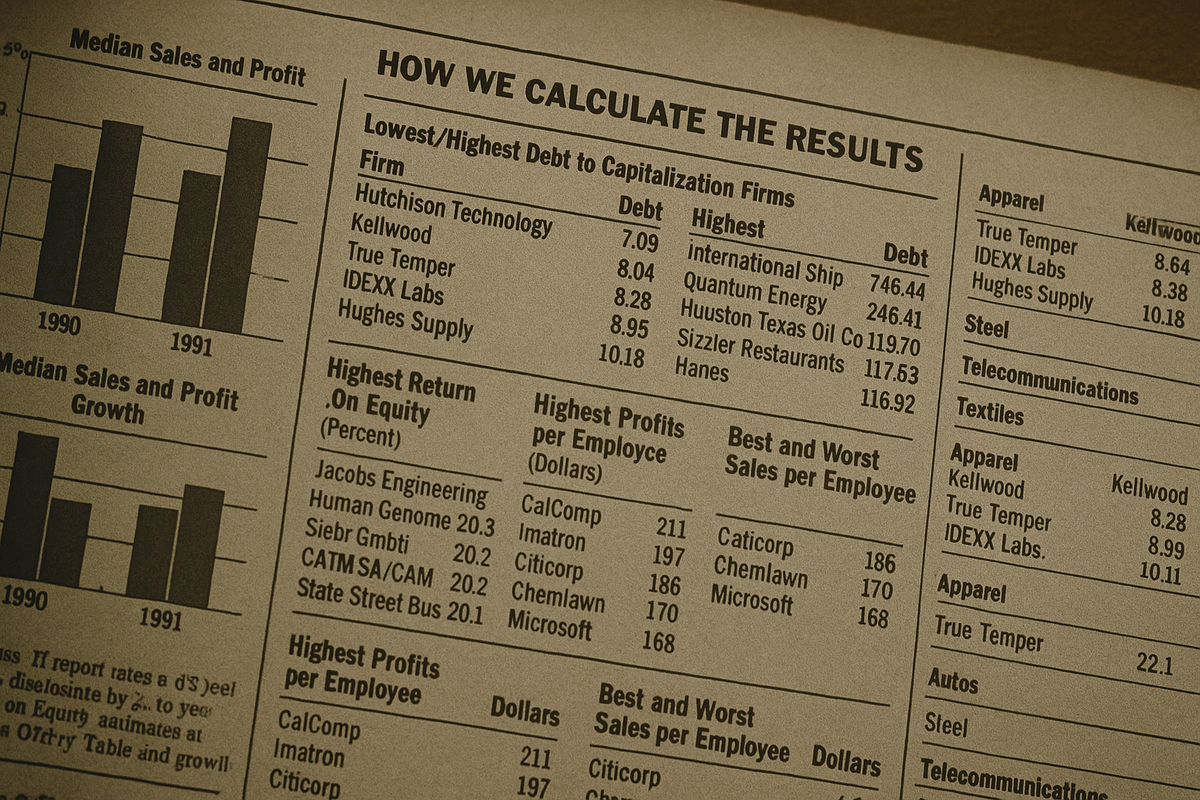
His quote landed on page 94 of the January 6, 1992 issue of Forbes Magazine—tucked inside "The 44th Annual Report on American Industry," a 21-sector dissection of Corporate America at its most vulnerable moment. The magazine's statisticians had crunched numbers on over 1,000 companies. The diagnosis was grim. Median sales growth had collapsed from 6.6% to 3.7%. Return on equity tumbled from 12.1% to 9.9%. Defense contractors were hemorrhaging contracts. Airlines were in freefall. Even with mortgage rates at 15-year lows, consumers had locked their wallets.
And yet, as Forbes' editors made brutally clear, some companies were thriving.
This wasn't a puff piece. It was a field guide to natural selection in business—a catalog of who adapted and who didn't. For anyone holding this issue today, it reads less like vintage journalism and more like a Rosetta Stone for understanding how American capitalism pivoted from Cold War certainty to globalized ruthlessness.
Issue Snapshot
Publication: Forbes Magazine
Issue Date: January 6, 1992
Feature: The 44th Annual Report on American Industry
Coverage: 21 industries, 1,000+ companies analyzed
Historical Context: Early 1990s recession, post-Cold War restructuring
Blood on the Factory Floor
The numbers told the story Forbes' prose merely annotated. By the time this issue hit newsstands, IBM had announced mass layoffs. Pan Am was circling the drain. Midway Airlines had already crashed. More than 12,500 workers lost their jobs in the final months of 1991 alone—and that was just the beginning.
The early 1990s recession wasn't a brief dip. It was a structural reckoning. Defense spending evaporated as the Cold War ended. Capital goods firms watched orders vanish. The median American company saw profits crater not because of poor execution, but because the entire economic landscape had shifted beneath their feet.
Forbes didn't offer comfort. Its coverage was clinical: industries ranked, metrics standardized, winners separated from losers with actuarial precision. The magazine's statisticians deployed formulas for return on equity, debt ratios, and profit-per-employee with the same rigor a pathologist brings to an autopsy.
This was business journalism as bloodsport.
The Forbes Formula: Data Meets Judgment
What separated Forbes' Annual Report from standard financial analysis was its methodology—a hybrid of quantitative firepower and editorial instinct.
The hard metrics were unforgiving:
Profits per Employee
Who was generating the most output with the leanest staff?
Sales per Employee
Which firms had eliminated organizational drag?
Return on Equity
Who delivered for shareholders despite the carnage?
Debt Levels
Which balance sheets could survive another year of contraction?
But Forbes layered something rarer on top of the spreadsheets: judgment. Beyond the numbers, the editors asked questions that couldn't be answered with ratios alone:
Does management understand its customers, or just its org chart?
Is this company cutting smart, or cutting blind?
Are they preparing for 1995, or just trying to survive 1992?
This editorial lens transformed raw data into strategic intelligence. It's why executives didn't just read Forbes—they feared being profiled badly in it.
The Survivors' Playbook
Three companies in the 1992 Annual Report embodied what Forbes called "lean, mean, and smart." They weren't the biggest. They weren't the oldest. But they had something their flailing competitors lacked: clarity.
King World Productions operated with fewer than 500 employees yet wielded outsize influence through savvy distribution deals with ABC. The company proved that dominance wasn't about headcount—it was about leverage. While bloated rivals drowned in overhead, King World stayed light and fast.
Jacobs Engineering posted a staggering 23% return on equity, setting the standard for profitability in a sector where most firms were barely breaking even. Their secret wasn't exotic—it was discipline. They bid strategically, executed efficiently, and refused projects that didn't meet their hurdle rates.
And then there was Joseph Williams and his unsentimental philosophy. Williams Companies thrived because its chairman treated assets like tools, not heirlooms. When a division stopped generating returns, he sold it. When overcapacity threatened margins, he exited. His willingness to walk away from sunk costs made him dangerous to competitors who couldn't.
These weren't feel-good profiles. They were case studies in Darwinian management—proof that focus, speed, and emotional detachment could overcome even the harshest economic conditions.
The Magazine as Artifact
The January 6, 1992 issue of Forbes didn't look like today's glossy business magazines. Its cover was stark, industrial, sober—a visual metaphor for the grinding reality inside. There were no celebrity CEOs grinning from the masthead. Just cold data, rendered in charts and tables that stretched across entire spreads.
Inside, a section titled "How We Calculate the Results" laid bare every formula. Forbes showed its work. Readers could see exactly how return on equity was derived, how debt ratios were standardized, how growth rates were adjusted for inflation. Transparency wasn't a courtesy—it was a challenge. If you think we're wrong, prove it.
This approach elevated Forbes beyond financial journalism into something closer to competitive intelligence. Investors used it to spot opportunities. Executives used it to benchmark performance. Business schools used it to teach strategy.
Holding an original copy today, you're not just handling a magazine. You're holding a primary source document—a snapshot of American capitalism at the moment it stopped pretending the old rules still applied.
What the Numbers Meant
The key findings from Forbes' 1992 Annual Report read like vital signs from a patient in critical condition:
Median Sales Growth: 3.7%
Barely ahead of inflation, signaling stagnation across most sectors.
Return on Equity: 9.9%
Down from 12.1% the prior year, marking one of the weakest performances in a decade.
Layoffs Accelerating
Tens of thousands of jobs eliminated as companies downsized to survive, not to optimize.
Standout Performers
Firms like Jacobs Engineering and King World Productions proved the recession wasn't universal.
These weren't abstract statistics. Each percentage point represented strategic choices: which divisions to shutter, which employees to terminate, which markets to abandon. Forbes translated those decisions into a language investors and executives could act on.
The Lessons That Lasted
Thirty-plus years later, the principles Forbes spotlighted in 1992 remain foundational to business strategy:
Efficiency scales. The leanest operations survived while bloated competitors collapsed under their own weight.
Downturn decisions compound. The companies that made hard choices in 1991-92 dominated the rest of the decade. Those that delayed faced irrelevance.
Globalization is permanent. By 1992, it was clear that American firms could no longer compete solely against each other. The arena had expanded, and so had the competitive intensity.
Forbes' Annual Report on American Industry wasn't prophecy—it was pattern recognition. The magazine identified which companies understood the new rules and which were still playing by the old ones.
That clarity is why this issue remains valuable decades later.
Why Collectors Covet This Issue
Historical Timing
Published at the nadir of a recession that reshaped corporate strategy for the next two decades, it captures American business at an inflection point.
Analytical Depth
The charts, rankings, and industry breakdowns make it a reference tool as much as a magazine—useful for researchers, historians, and strategists studying the early 1990s.
Quotable Wisdom
Joseph Williams' line about not falling in love with assets has been cited in business schools, boardrooms, and shareholder letters ever since.
Cultural Significance
This issue documents the moment when efficiency, downsizing, and shareholder value became the dominant ideology of Corporate America—for better and worse.
Why This Issue Matters Now
If you're a collector of business history, this Forbes issue belongs in your archive. It offers unfiltered insight into how corporate leaders responded to crisis—what worked, what failed, and what lessons became doctrine.
Browse Forbes Magazine CollectionWhether you're a seasoned collector, an investor studying market cycles, or a historian tracing the evolution of American capitalism, this issue is more than memorabilia. It's evidence. It's a time capsule. It's the moment when Corporate America learned to stop loving its assets and start loving survival.
Final Word
The January 6, 1992 Forbes wasn't just an annual report. It was a mirror held up to an economy in transformation—and a catalog of the companies smart enough, ruthless enough, or lucky enough to make it through.
For readers today, it's a reminder that recessions don't destroy industries. They reshuffle them. The firms that survive aren't necessarily the strongest or the oldest. They're the ones willing to adapt, to cut, and—as Joseph Williams understood—to let go.
That philosophy built the 1990s.
And this issue documented it in real time.