
When Wrestling Declared War
Inside the October 1991 PWI Issue That Turned Hulk Hogan Into a Soldier
The cover promised a championship match. What it delivered was propaganda.
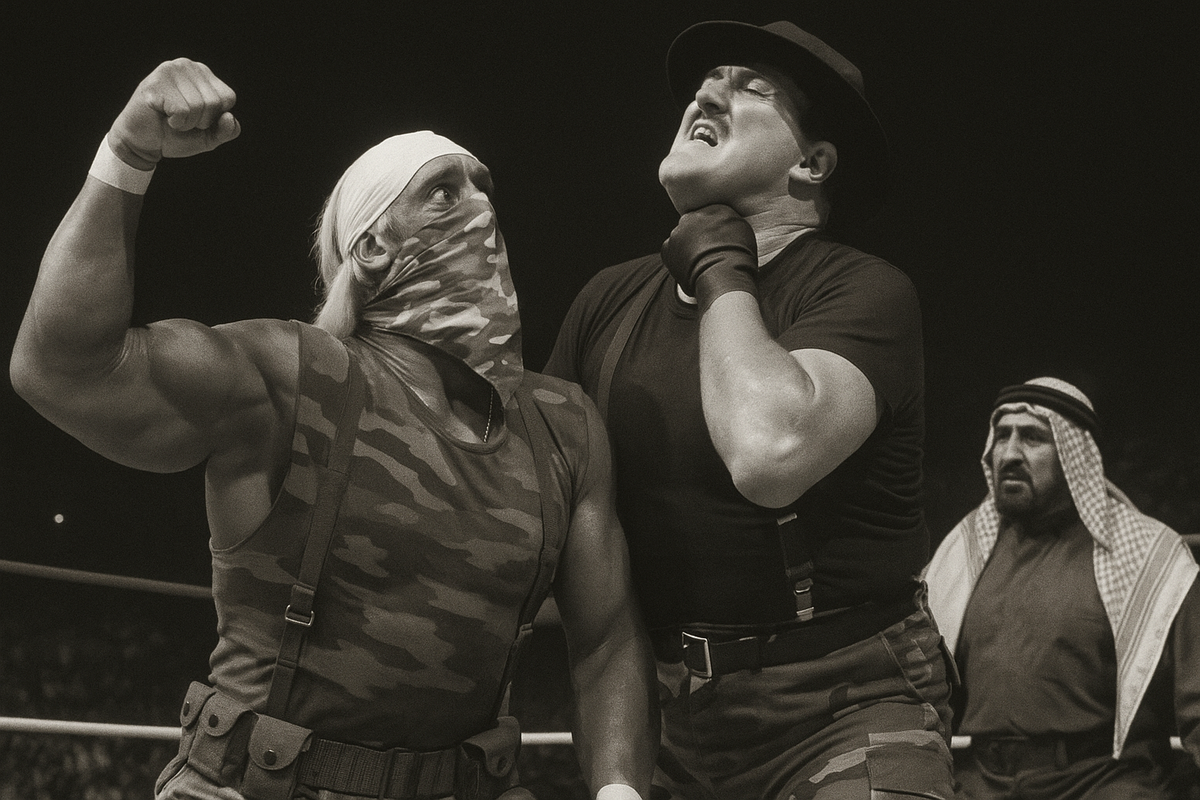
Open the October 1991 issue of Pro Wrestling Illustrated and you're not looking at sports journalism—you're holding a war dispatch. "The Desert Storm Rages On! Hulk Hogan Won't Stop Until Sgt. Slaughter Is Obliterated!" screamed the headline, printed over images of Hogan in camouflage fatigues, his face masked like a commando. This wasn't hyperbole. Six months after Operation Desert Storm ended, the WWF had weaponized the Gulf War, and PWI was embedding itself in the trenches.
For readers in 1991, the message was unmistakable: Hulk Hogan wasn't just fighting for a belt. He was fighting for America.
Archive Details
Publication: Pro Wrestling Illustrated
Issue Date: October 1991
Feature: "The Desert Storm Rages On! Hulk Hogan Won't Stop Until Sgt. Slaughter Is Obliterated!"
Author: Ed Maloney
Historical Context: Published six months after Operation Desert Storm concluded
The Politics of the Squared Circle
By 1991, professional wrestling had already mastered the art of stolen valor. The Cold War gave us Nikolai Volkoff and the Iron Sheik—foreign menaces designed to be destroyed by red-blooded American heroes. But the Hogan-Slaughter feud was different. It wasn't borrowing from history. It was hijacking the present.
Operation Desert Storm concluded in February 1991 with a swift Allied victory, but Saddam Hussein remained in power—a fact that gnawed at the American psyche. Vince McMahon saw an opening. Sgt. Slaughter, once the embodiment of Marine Corps grit, was repackaged as an Iraqi sympathizer. Paired with General Adnan—a character explicitly tied to Kuwait—Slaughter became the ultimate traitor, a man who abandoned his country during its hour of need.
The WWF positioned their WrestleMania VII main event as a referendum on loyalty itself. When Hogan defeated Slaughter in March 1991, it was framed as nothing less than America's second victory over Iraq. But McMahon wasn't finished. Slaughter remained in the WWF through the summer, a lingering villain who needed to be eradicated. This wasn't a wrestling feud. It was an occupation.
PWI's War Correspondence
Pro Wrestling Illustrated occupied a unique position in the wrestling ecosystem. Unlike the WWF's house publications, which functioned as glorified press releases, PWI operated with editorial independence. It maintained kayfabe—treating storylines as real—while offering the depth and analysis of legitimate sports journalism. For fans, PWI wasn't just coverage. It was canonization.
The October 1991 issue understood the assignment.
Author Ed Maloney opened his feature not with a ring bell, but with a ticker-tape parade. He described the June 1991 celebration in New York City—soldiers marching down Broadway, fireworks over the Hudson, flags snapping in the wind. America was honoring its Gulf War veterans. Then, in a single paragraph, Maloney pivoted: Hulk Hogan was still fighting his war.
The transition was seamless and deliberate. Maloney wrote Slaughter not as a heel, but as a war criminal. His "crimes" were described as "unforgivable." General Adnan was cast as a shadowy Iraqi operative manipulating events from ringside. Hogan, meanwhile, was portrayed as relentless, righteous, and unwilling to accept anything less than "complete victory"—the same phrase military analysts were using to critique the Gulf War's inconclusive ending.
The layout reinforced the theme. Action shots showed Hogan in military gear, Slaughter choking him with ropes, Adnan lurking like a foreign agent. The background featured a camouflage pattern. These weren't wrestling photographs. They were combat images.
The Illusion and the Industry
What made PWI dangerous—and valuable—was its refusal to wink. The magazine never broke character, never acknowledged the scripts or the stunts. It presented Hogan vs. Slaughter as a legitimate blood feud with geopolitical stakes. For young readers in 1991, many of whom had watched CNN's coverage of Desert Storm in real time, the line between wrestling and warfare dissolved entirely.
But PWI also provided context. Maloney acknowledged Slaughter's occasional disqualification victories, the crowd reactions, the ongoing drama playing out on WWF television. He didn't shatter the kayfabe, but he deepened it, positioning the feud within a larger cultural moment. The magazine treated wrestling as mythology—larger than life, but rooted in recognizable human emotions. Patriotism. Betrayal. Revenge.
This was PWI's genius. It functioned as both cheerleader and historian, amplifying the spectacle while documenting it for posterity.
The Artifact
Three decades later, the October 1991 issue of Pro Wrestling Illustrated reads like a Rorschach test. Some see a brilliant marketing gambit—wrestling at its most audacious, unafraid to exploit real-world tragedy for dramatic effect. Others see exploitation, a cynical cash grab that trivialized a war in which real soldiers died. Both readings are correct.
What's undeniable is the issue's historical weight. The Hogan-Slaughter feud remains one of the WWF's most controversial angles, a storyline so provocative that Slaughter reportedly received death threats. The decision to align a character with Iraq during an active conflict was unprecedented in mainstream entertainment. Disney wouldn't do it. Hollywood wouldn't do it. But Vince McMahon did, and PWI covered it like it was the most important thing happening in America.
For collectors, this issue is essential. It captures wrestling at a crossroads—still rooted in the territorial patriotism of the 1980s, but beginning to grapple with the media-saturated, morally ambiguous '90s. The photography is iconic: Hogan in fatigues, Slaughter in combat gear, both men playing soldiers in a war that was simultaneously fake and terrifyingly real. And the prose, particularly Maloney's opening gambit linking the feud to the ticker-tape parade, represents PWI at its editorial peak—unafraid to make grand statements, confident in its role as wrestling's paper of record.
The Legacy of the Page
Before the internet flattened access, wrestling magazines were sacred texts. Pro Wrestling Illustrated sat atop the hierarchy, its PWI 500 rankings treated as gospel, its features dissected by fans starving for information. In 1991, if you wanted to understand why Hulk Hogan was dressed like a Navy SEAL, you didn't Google it. You bought PWI.
The October 1991 issue is more than nostalgia. It's a document of how entertainment responds to war, how corporations monetize patriotism, and how fans—caught between spectacle and sincerity—navigate the space between. Wrestling has always been about selling illusions, but this issue sold something bigger: the idea that a man in spandex could finish what the U.S. military started.
That's not just wrestling history. That's American history.
For Collectors & Historians
Explore the Archives
Discover original Pro Wrestling Illustrated issues—including rare editions from wrestling's most controversial era—in the complete magazine collection. Each issue is a primary source, preserving the language, imagery, and cultural assumptions of its moment.
Browse PWI Magazine Collection