
Dinner for a Dollar: Thrift, Family, and Food Culture in 1950s America
How Nancy Paschall's 1952 article taught American housewives to perform abundance in an age of anxiety
The housewife who opened the September 1952 issue of Ladies' Home Journal and turned to Nancy Paschall's "Dinner for a Dollar" wasn't looking for inspiration. She was looking for survival.
Could you really feed a family—meat, vegetables, bread, dessert—for a single dollar? In 1952, when the average weekly wage hovered around $60 and inflation was squeezing single-income households, that wasn't a philosophical question. It was Tuesday night.
Paschall's answer was unequivocal: yes. And in delivering it, she created something more than a budget meal plan. She handed millions of American women a script for dignity in scarcity, a way to perform abundance when the cupboard was bare. This wasn't just food writing. It was domestic statecraft.
Archive Details
Featured Writer: Nancy Paschall
Article Title: "Dinner for a Dollar"
Publication: Ladies' Home Journal, September 1952
Historical Context: Early Cold War era, postwar domestic culture, mid-century food economics
Archive Value: Primary source for 1950s consumer culture, gender studies, and American food history
The Economic Landscape of 1952
America in 1952 wore two faces. The first was triumph—a nation barely seven years past V-J Day, its factories humming, its suburbs spreading. The second was anxiety. The Cold War had settled into permanence. Inflation was real. And for families living on one paycheck, prosperity was more aspiration than fact.
A dollar in 1952 carried the purchasing power of roughly eleven dollars today. Paschall's challenge, then, was the modern equivalent of feeding a family for ten or twelve dollars—not impossible, but requiring skill, planning, and no small amount of creativity.
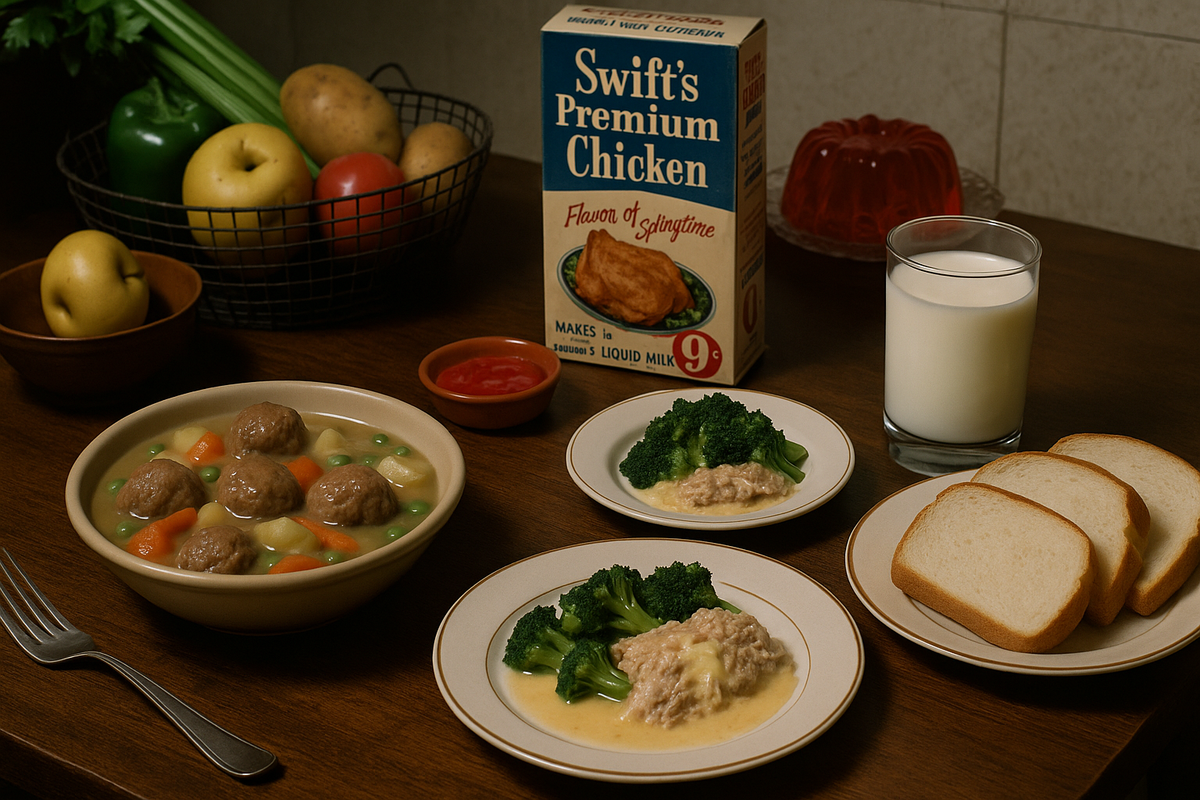
Food manufacturers understood the tension. Swift's Premium Chicken advertised itself as both wholesome and economical, its full-page spread promising "the flavor of springtime" at a price point working families could manage. Starlac Nonfat Milk pitched itself at nine cents a quart—thrift made patriotic. These weren't just ads. They were endorsements of the very ethos Paschall was teaching.
The cultural message was clear: a good housewife didn't complain about tight budgets. She conquered them.
Ladies' Home Journal as Cultural Authority
By 1952, Ladies' Home Journal had been shaping American domesticity for nearly seventy years. It wasn't a magazine. It was an institution—part advice column, part aspirational fantasy, part instruction manual for How to Be a Woman in Postwar America.
The visual language of the September 1952 issue reflected this. Inside, Paschall's article appeared alongside grocery counter illustrations—produce arranged just so, cuts of meat displayed with care. The adjacency wasn't accidental. The ads for Swift's chicken and Starlac milk didn't interrupt the editorial content; they reinforced it. Form and commerce moved in lockstep, teaching the same lesson: thrift is virtue, and virtue can be bought.
Paschall's piece followed the Journal's formula with precision:
Practical recipes: Meat-Ball Stew stretched a small amount of ground beef with potatoes, peas, carrots, and onions—affordable, filling, forgiving. Tuna-Broccoli Hollandaise elevated canned fish with vegetables and a homemade sauce, transforming pantry staples into something that felt, if not elegant, at least intentional.
Meal planning guidance: Not just what to cook, but how to think about shopping, portions, timing. Control as comfort.
Emotional resonance: Paschall shared her own stories of lean times, when work was scarce and budgets tighter still. The message wasn't "do as I say." It was "I've been where you are."
This wasn't instruction. It was communion.
What "Dinner for a Dollar" Taught America
Frugality as Empowerment
Paschall never framed tight budgets as failure. Feeding a family for a dollar wasn't settling—it was mastery. Women who could do this weren't victims of circumstance. They were household engineers.
Gender as Destiny
The entire article assumed its reader was female, the keeper of the family purse and the family stove. Men earned. Women stretched. The economic arrangement was presented not as policy but as natural law.
Canned Goods as Modernity
Tuna from a can. Starlac in a box. These weren't shortcuts or compromises—they were proof that American ingenuity had made good nutrition accessible. Convenience wasn't lazy. It was patriotic.
The Aesthetics of Abundance
Even on a dollar, meals included bread, butter, milk, fruit, gelatin. The meal had to look complete, feel generous. Scarcity could be real, but it couldn't be visible.
Paschall's article captured a moment when economic pressure and cultural expectation collided—and women were expected to absorb the impact without complaint.
Why "Dinner for a Dollar" Still Resonates
No one today is feeding a family for a dollar. But the principles Paschall articulated—stretch staples, reinvent leftovers, find pride in resourcefulness—have outlasted the price point.
As food costs climb and household budgets tighten again, the 1952 playbook feels less like history and more like prophecy. The specifics have changed. The math has changed. The anxiety hasn't.
This is why the September 1952 issue of Ladies' Home Journal matters. Not because it offers recipes we can still use, but because it reveals what American families were asked to carry—and how they were taught to carry it without breaking.
Why Collectors Seek the September 1952 Issue
Historical Specificity
Early 1950s America represents a cultural hinge point—postwar optimism meeting Cold War unease. These issues document the contradictions in real time.
Food History
"Dinner for a Dollar" is a primary source for understanding mid-century consumer behavior, nutritional standards, and the economics of the American table.
Advertising as Artifact
The Swift's and Starlac ads aren't just sales pitches—they're windows into mid-century graphic design, brand positioning, and the way corporations spoke to housewives.
Gender Studies
This issue is required reading for anyone studying women's labor, domestic expectations, or the cultural construction of the "ideal housewife."
Condition Matters
Well-preserved copies—cover intact, pages clean, food features legible—command attention from serious collectors.
Cultural Evidence
Owning the September 1952 issue isn't nostalgia. It's holding evidence of how an entire generation was taught to live.
Explore the Archive
Nancy Paschall's "Dinner for a Dollar" is one piece in a decades-long conversation between Ladies' Home Journal and American women. For nearly a century, the magazine delivered advice, fashion, fiction, recipes, and cultural commentary—each issue a cross-section of its moment.
Browse Ladies' Home Journal Magazine CollectionWhether you're a collector tracking cultural history, a scholar researching domesticity and gender, or simply someone drawn to the material culture of mid-century America, these issues offer something rare: the chance to hold the documents that once held a nation's attention.