
When Vogue Photographed Fashion in Finland
The April 15, 1970 Issue That Redrew the Map
A model in a python-print coat kicks her leg high against Helsinki's modernist marble steps. Another strides through winter light in a checkerboard skirt, her silhouette stark against wooden sauna interiors. The year is 1970, and Vogue Magazine has just done something unprecedented: it pointed its cameras north—far north—to a country the fashion establishment had barely whispered about.
Finland.
Not Paris. Not Milan. Not even London.
For readers opening the April 15, 1970 issue, "Finn-Lights on Fashion" wasn't just another editorial spread. It was a declaration: the language of style no longer belonged to a handful of European capitals. And if Vogue could find modernity, beauty, and bold design in the frozen clarity of Nordic light, fashion's center of gravity had shifted forever.
The World Fashion Forgot to Notice—Until Now
By 1970, the fashion establishment was fracturing. Paris and London had owned the 1960s, but the new decade arrived restless. Designers were hunting for textures, geographies, and identities beyond the predictable circuits. The women's liberation movement was dismantling old codes of femininity. Youth culture had torched formality in favor of eclecticism. Fashion needed new coordinates.
Finland offered them.
The country's textile houses—Marimekko chief among them—had already earned quiet respect for bold prints and functionalist restraint. Finnish design spoke a language of sleek practicality shaped by brutal winters and endless summer light. It was modernism with a pulse. And in 1970, as fashion sought escape from its own clichés, Vogue sent photographers to capture what happened when cutting-edge clothing collided with Scandinavian austerity.
The result was twenty looks photographed by Seija Tyni and her collaborators across Helsinki and beyond—a feature that treated architecture, light, and space as essential characters in the fashion narrative.
Issue Details
Publication: Vogue Magazine
Issue Date: April 15, 1970
Feature: "Finn-Lights on Fashion"
Editorial Director: Diana Vreeland
Primary Photographer: Seija Tyni
Archive Source: Original Magazine Collection
Diana Vreeland's Gamble: Vogue Goes Global
Under Diana Vreeland's editorial command, Vogue had become the most daring fashion authority on the planet. Vreeland didn't just publish trends—she manufactured fantasy, drama, and internationalism. The April 15 issue was her vision made tangible.
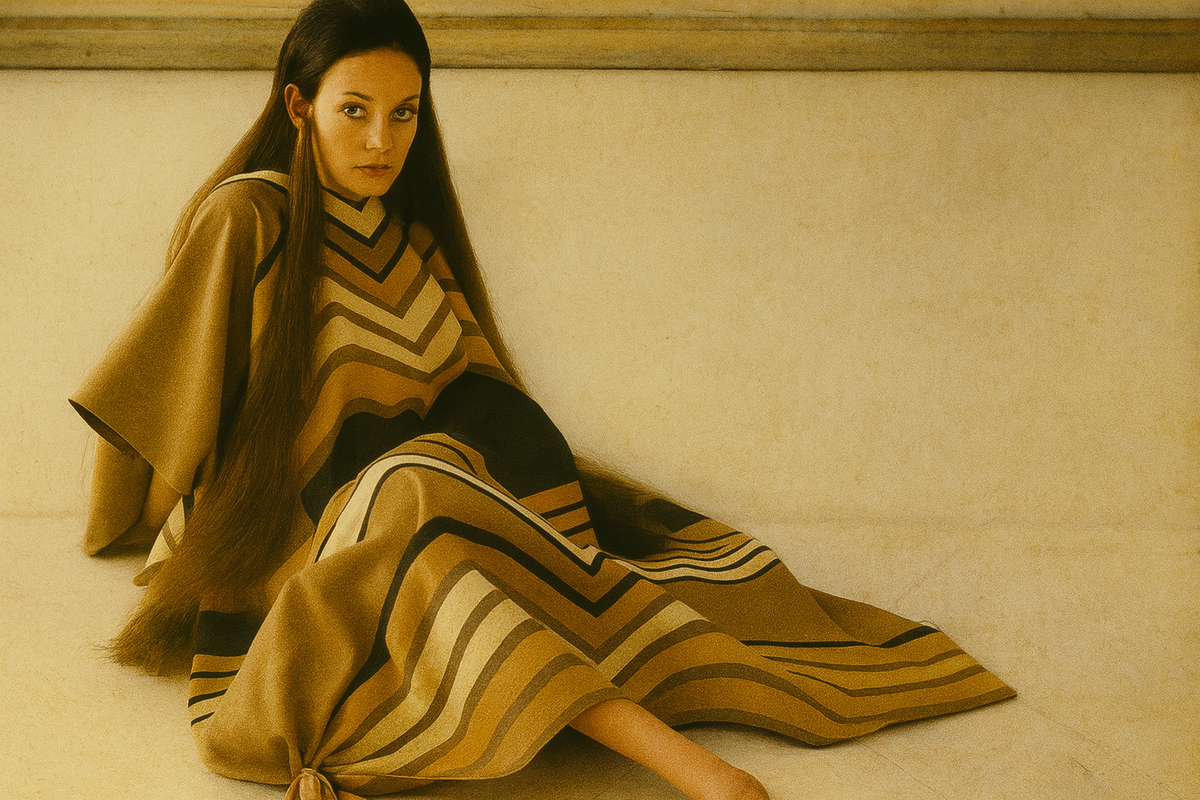
"Finn-Lights on Fashion" rejected the stale glamour of studio backdrops. Instead, it staged fashion as kinetic sculpture. Models didn't pose—they moved. One woman lunges forward in a cape that billows like a sail. Another reclines in a poncho against raw wooden beams. The compositions are geometric, almost Brutalist in their precision. Black-and-white photography strips away distraction, leaving only form, shadow, and the interplay between fabric and environment.
The captions grounded the fantasy in commerce: Anne Klein, Frank Adams, Bloomingdale's, Saks Fifth Avenue. These weren't museum pieces. You could walk into a department store and buy your way into this vision. But the artistry elevated each garment beyond transaction—this was fashion as cultural statement, not catalog.
Other magazines printed clothes. Vogue printed manifestos.
What Made the Finland Feature Revolutionary
The Light Itself Was a Designer
Finnish winter light—pale, diffused, unforgiving—turned every garment into sculpture. Shadows carved hard edges. The stark environment amplified rather than softened the clothing's drama.
Patterns That Screamed
Python prints. Checkerboards. Bold stripes on ponchos. This wasn't minimalism—it was maximalist geometry deployed with surgical precision.
The Cape's Triumphant Return
Full-length capes paired with high boots dominated the editorial. Theatrical silhouettes were back, and Vogue was leading the revival.
Motion Over Stillness
Models kicked, strode, spun. The spreads rejected static beauty in favor of energy—a visual argument that fashion belonged to living, moving women, not mannequins.
Architecture as Co-Star
Helsinki's modernist staircases, brutalist concrete, and wooden interiors weren't backdrops—they were design arguments in dialogue with the clothing. Form spoke to form.
A Transatlantic Design Dialogue
European and American labels shared the pages, proof that 1970s fashion was a conversation across continents, not a monologue from Paris.
The Universal Boot
Nearly every look ended in high boots. By spring 1970, they weren't accessories—they were foundational.
The Radical Geography
Featuring Finland wasn't tokenism. It was Vogue asserting that style could ignite anywhere, in any climate, under any light. Fashion had gone global, and there was no reversing course.
Women as Forces, Not Objects
The models' stances—confident, bold, unapologetic—mirrored seismic shifts in how women saw themselves and demanded to be seen.
Together, these elements delivered a message louder than any headline: fashion was no longer governed by tradition or geography. It belonged to anyone brave enough to claim it.
Why Vintage Vogue Matters Beyond Fashion
These magazines endure because they're more than style guides—they're historical witnesses.
Every page carries the ambitions, anxieties, and aspirations of its moment. Unlike digital content that evaporates in hours, these issues remain fixed in time, offering fashion historians and cultural researchers a permanent record of how societies saw themselves. The paper itself—the weight, the print quality, the advertisements—tells stories about material culture, printing technology, and consumer desires.
For collectors, they're beautiful objects. For historians, they're primary sources. For enthusiasts, they're portals to vanished worlds.
Why Collectors Hunt This Issue
It Captures a Hinge Moment
This issue stands at the threshold of the 1970s, documenting the decade's visual language as it crystallized. The aesthetics, the confidence, the global ambition—it's all here, preserved in ink and paper.
It's Rare in Focus
Vogue shot countless editorials in Paris, Rome, and New York. Finland? Almost never. That geographic specificity makes this issue a needle in the haystack for serious collectors.
The Photography Holds Up
Strip away the vintage appeal, and these images still work. The stark contrasts, the compositional rigor—this is photography as enduring art, not disposable editorial.
It Documents a Commercial Ecosystem
The mentions of Anne Klein, Bloomingdale's, and Saks Fifth Avenue offer a snapshot of early 1970s fashion retail—who mattered, what sold, where taste was made.
It Embodies Vreeland's Vision
For collectors tracking Diana Vreeland's editorial tenure, this issue is essential proof of her willingness to shatter convention and remake fashion coverage as high-stakes cultural journalism.
To own this issue is to hold physical proof of the moment Vogue looked north and found the future.
Explore the Archive
Thousands of original Vogue magazines—spanning the 1930s through the 1970s—are available for collectors, historians, and enthusiasts. Each issue is a time capsule, documenting decades of fashion, politics, and cultural transformation as they unfolded in real time.
Browse Vogue Magazine CollectionWhether you're building a research library, curating a collection, or simply drawn to vintage style, these magazines offer more than nostalgia—they offer evidence. Evidence of how we dressed, what we valued, and who we aspired to be.
Final Frame
The April 15, 1970 issue of Vogue Magazine remains a landmark—not just of fashion, but of editorial courage. "Finn-Lights on Fashion" delivered a vision of style as global, kinetic, and inseparable from its environment. It proved that bold design could emerge from any latitude, that light and space were as crucial as fabric and cut.
To hold this issue today is to hold a moment when fashion broke its own rules and won. The prints are still bold. The light is still stark. And the vision—that beauty belongs everywhere—still resonates five decades later.