
When Vogue Sold the Future
Inside the August 1970 Issue That Turned Apartments Into Statements
In August 1970, Vogue didn't just show you what to wear. It showed you how to live.
Tucked between fashion editorials and perfume ads was a spread called "Fashions in Living: Living Young"—a manifesto disguised as a shopping guide. Here were molded fiberglass chairs photographed like sculpture. Geometric fabrics presented as Op Art. A Swiss fold-down bed-and-bar system for $750 that promised to transform cramped urban apartments into experiments in modern living. This wasn't interior decoration. It was identity architecture.
The August 1, 1970 issue arrived at a hinge moment in American culture. The counterculture had cracked open the 1960s; now came the question of what to build in its place. Women were claiming financial independence and their own apartments. Plastics and modular design suggested that the future could be affordable, not just aspirational. And Vogue—sharp, sophisticated, unafraid—understood that fashion had escaped the closet. Style now colonized every surface of daily life.
This issue remains one of the most sought-after artifacts in vintage magazine collecting. To understand why is to understand how a glossy publication became a historical document.
Archive Details
Publication: Vogue Magazine
Issue Date: August 1, 1970
Cover Photographer: David Bailey
Key Feature: "Fashions in Living: Living Young"
Historical Context: First year of the 1970s decade, intersection of counterculture and mainstream design innovation
The Cultural Crossroads of 1970
The summer of 1970 didn't belong to one movement. It belonged to their collision.
The "Youthquake" Vogue had declared in the mid-1960s still reverberated. Bold prints and mini-skirts had normalized what was once radical. But by 1970, youth culture wasn't just about rebellion—it was about redesigning everyday life from scratch.
The women's movement accelerated this shift. As more women pursued careers and controlled their own finances, Vogue's editorial lens widened. A reader might not only choose her wardrobe but also furnish her first solo apartment. The "Living Young" feature acknowledged this reality without fanfare, treating independent living as fait accompli rather than novelty.
Technology fed the optimism. Plastics, fiberglass, and space-age polymers flooded the market, promising convenience and modernity at democratic prices. A French aerosol spray called Defroisse could remove wrinkles from fabric. Curtains could mimic handwoven linen while being entirely synthetic. Innovation wasn't confined to laboratories—it lived in your living room.
Urban spaces were shrinking, too. Young professionals packed into studio apartments needed furniture that worked harder: chairs that stacked, beds that folded, desks that doubled as storage. Vogue's curated selection spoke directly to this generation, offering sleek solutions that didn't sacrifice style for practicality.
Fashion, once confined to the body, now dressed entire rooms.
Vogue's Editorial Gambit: Making Life a Design Problem
By 1970, Vogue had evolved beyond fashion journalism into something more ambitious: cultural curation. Its editors grasped that readers wanted coherence between how they looked and how they lived. The "Fashions in Living" spread made this philosophy explicit.
The photography was stark, modernist, deliberately anti-domestic. A molded Mini-Tub Chair appeared against neutral backgrounds, isolated like a Brancusi sculpture. Fabric bolts were shot as graphic statements, not swatches. The Swiss modular furniture system was presented with clinical precision, emphasizing its geometric purity. These weren't products in living rooms—they were objects in conceptual space, awaiting the buyer's imagination.
The editorial voice matched the visual rigor. Descriptions were concise, pointed, presuming intelligence. A chair wasn't described as "comfortable" but as "foam-padded molded shell"—technical language that elevated shopping into an act of cultural participation. Readers weren't decorating; they were making aesthetic choices with philosophical weight.
Other lifestyle magazines compartmentalized fashion and interiors. Vogue fused them, arguing that a woman who understood line and proportion in clothing could apply the same principles to furniture, stationery, even kitchen tools. Style became portable, applicable, total.
This was radical. And it worked.
The David Bailey Cover: Youth Culture Through a Master's Lens
David Bailey shot the cover—a detail that matters. Bailey had helped define the 1960s visual language: direct, unsentimental, soaked in youth energy. His subjects weren't untouchable icons but modern, alive, immediate. By 1970, his aesthetic had become Vogue's aesthetic.
The cover image projected sleek beauty and clean geometry, a visual thesis for everything inside. It signaled that this issue wasn't interested in fussy nostalgia or old-money formality. It was about freshness, clarity, the shock of the new.
Inside, the "Living Young" spread continued Bailey's visual philosophy. Black-and-white photography stripped away distraction, letting form and function speak. Each object became an icon of modernity, deserving attention not because of tradition but because it represented the future.
This was Vogue as art direction, not just journalism.
The Products: A Portrait of 1970 in Objects
The spread's power lay in specificity. These weren't generic "modern chairs"—they were exact objects with prices, sources, and design philosophies.
Miniprint Notepaper from Bloomingdale's: Navy insignia on pale blue, $2 a box. Stationery as fashion accessory, personalizing communication in an era before email turned correspondence disposable.
Fiberglass Curtains: Striped to look handwoven, entirely synthetic, $17 a pair. The illusion of craft made efficient through chemistry.
Mini-Tub Chair: Molded shell with foam padding, $40. Sculptural seating that acknowledged small apartments and tight budgets.
Defroisse Spray: A French aerosol miracle that banished wrinkles. Technology as domestic convenience, bottled modernity you could hold.
Geometric Fabrics by Charles Meryon: Bold cotton prints channeling Op Art and psychedelia. Interiors absorbing visual culture from galleries and rock posters.
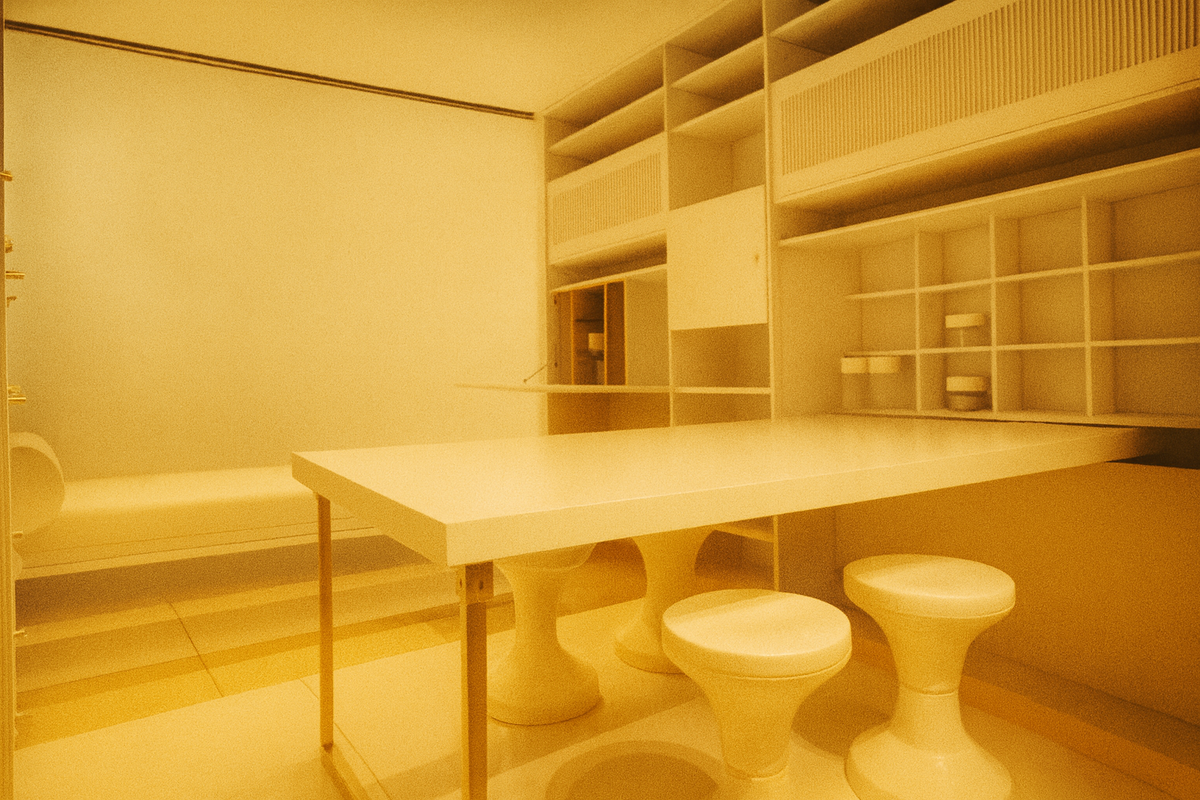
Swiss Modular Furniture System: Fold-down bed and bar, $750. Expensive but transformative, collapsing boundaries between public and private space in studio apartments.
Carousel Plastic Stools by Daniel: Glossy, futuristic, space-age seating that looked imported from 2001: A Space Odyssey.
Polyform Desk and Chair: Lacquered wood meets molded ABS polymer, $75 at Bloomingdale's. Hybrid design marrying tradition with synthetic innovation.
Each object was a cultural marker. Together, they mapped what "living young" meant in 1970: adaptable, optimistic, unafraid of plastic, allergic to formality.
What Vogue Was Really Selling
Beneath the product shots lay a set of arguments about modern life.
On Beauty
Natural makeup and unstructured hair replaced the lacquered perfection of previous decades. Authenticity—or its simulation—became the new glamour.
On Gender
By depicting women actively designing their spaces, Vogue endorsed female autonomy without making speeches. The subtext was independence; the text was a chair.
On Aspiration
The spread mixed $2 notepaper with $750 modular systems, suggesting that style was democratic, a matter of choices rather than income. You could enter Vogue's world at any price point.
On Visual Culture
By photographing household objects as art, Vogue argued that aesthetics belonged everywhere. Readers weren't just consumers—they were curators of their own lives.
This was Vogue's genius: selling not products but a vision of selfhood. The magazine offered not just what to buy, but who to become.
Why This Issue Still Speaks
Vintage Vogue magazines endure because they offer what digital archives cannot: the physical artifact. Original issues carry the weight of their era—the paper stock, the printing quality, the advertisements for products long extinct. Holding one is tactile time travel.
The "Living Young" spread resonates unexpectedly today. Urban apartments are still small. Modular furniture is still necessary. Bold geometric prints have cycled back into fashion. The problems Vogue addressed in 1970—how to live stylishly in compact spaces on limited budgets—remain contemporary.
More broadly, this issue reminds us that fashion journalism was once cultural criticism. Vogue didn't just report trends; it shaped conversations about identity, modernity, and aspiration. Every issue was an argument about how to live.
The August 1970 issue made that argument with clarity and conviction. And half a century later, it still wins.
Why Collectors Covet This Issue
Historical Timing
Captures the first year of a new decade, bridging the experimental 1960s and the design pluralism of the 1970s. Styles here both extend and anticipate.
The Bailey Cover
Legendary photographers increase collectibility. Bailey's work from this period is extensively documented; his Vogue covers are trophies.
Material Culture Archive
Fiberglass curtains, molded polymer chairs, aerosol fabric treatments—these objects tell the story of 1970s innovation better than any museum label.
Scarcity
Magazines were ephemeral by nature, meant to be read and discarded. Survivors in good condition are rare. Most copies that escaped recycling are now fragile or incomplete.
Investment Logic
Collectors pursue issues tied to iconic photographers, cultural turning points, and strong visual identities. This issue delivers on all counts.
Archival Value
This issue is a time capsule, preserving not just fashion but the texture of a moment—how people thought about progress, gender, space, and style when the 1960s dream met 1970s reality.
Explore the Archive
If the cultural and design history preserved in the August 1970 Vogue speaks to you, there's more to discover. Each issue is both style guide and historical document, capturing the intersection of fashion, identity, and cultural ambition.
Browse Vogue Magazine CollectionWhether you're a serious collector, a design historian, or simply someone drawn to the elegance and authority of mid-century print culture, these magazines offer something irreplaceable: direct access to the past, preserved in ink and paper.