
Eisenhower's Burden: Politics, War, and Leadership in the Crucial Years of World War II
How The Saturday Evening Post revealed the invisible battlefield that nearly consumed the Allied Commander
Three months after Tokyo Bay, Americans learned the truth: Eisenhower had fought two wars.
The first war was visible—tank columns rolling across North Africa, landing craft hitting Normandy beaches, armies converging on Berlin. The second war was invisible, conducted in coded cables and late-night negotiations, where Admiral Darlan's loyalties mattered as much as artillery placements and Winston Churchill's imperial ambitions complicated every strategic decision.
When readers opened the December 22, 1945 Saturday Evening Post, Captain Harry C. Butcher's account—"My Three Years with Eisenhower"—revealed what newspapers hadn't reported and newsreels hadn't filmed: the general who commanded Allied forces in Europe had spent more time navigating French political factions than inspecting front-line positions.
For families whose sons had fought in North Africa, Italy, and France, this was jarring. They had imagined Eisenhower as a battlefield commander. Butcher showed them a different figure: a diplomat in uniform, exhausted by coalition politics, longing to visit the troops but trapped behind conference tables.
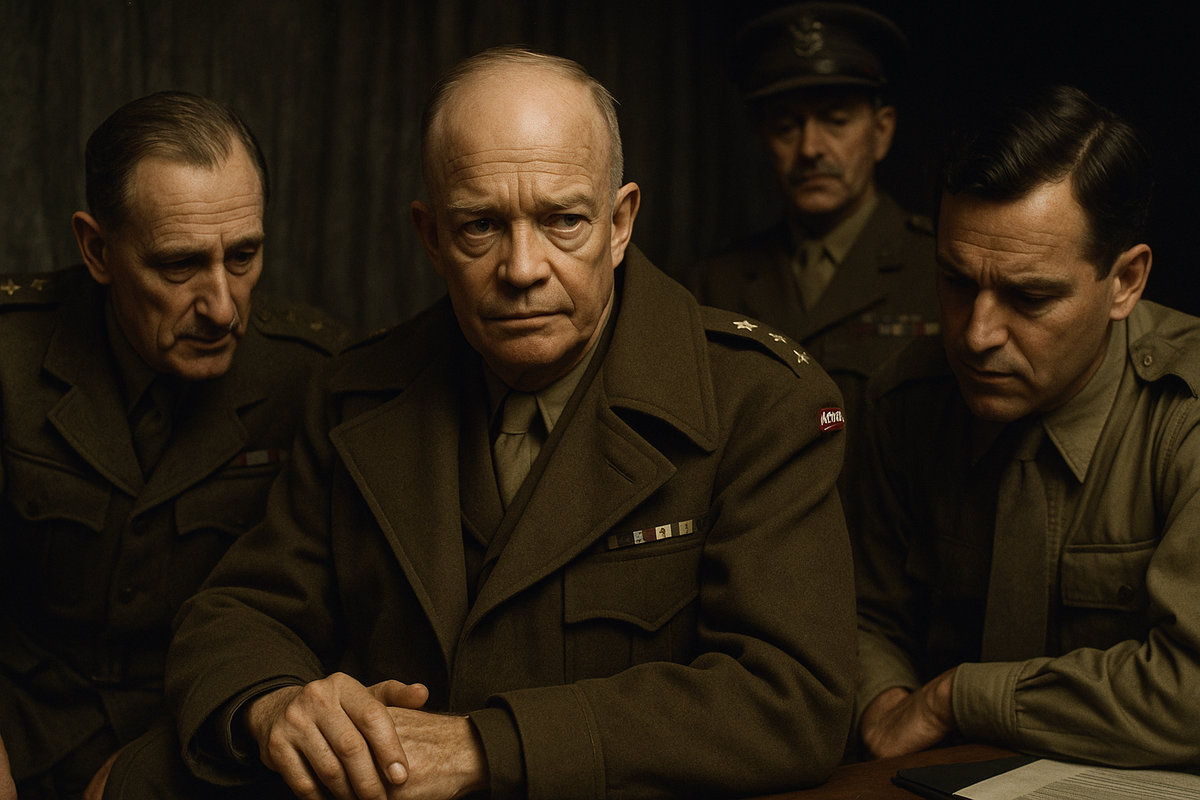
The photograph said everything. Eisenhower sat with his coat collar turned up, face lined with fatigue, eyes fixed on something beyond the camera's frame. The caption: "Ike peeping to the front. He found that politics and policy left him too little time for the field."
Archive Details
Publication: The Saturday Evening Post, December 22, 1945
Feature Article: "My Three Years with Eisenhower" by Captain Harry C. Butcher, USNR
Author Role: Naval Aide and confidant to General Dwight D. Eisenhower
Primary Focus: Operation Torch (North Africa invasion, November 1942)
Cover Artist: James R. Bingham
Historical Context: Published three months after Japan's surrender aboard USS Missouri
December 1945: Peace Without Clarity
Japan had surrendered aboard the USS Missouri in September. By December, veterans were returning home, war plants were retooling for civilian production, and Americans were grappling with a question that had no simple answer: what now?
The atomic bomb had ended the Pacific war in a flash of unprecedented violence. The Soviet Union—America's wartime ally—was tightening control over Eastern Europe. The United Nations was still being organized. The full scope of the Holocaust was emerging in war crimes trials at Nuremberg.
Into this moment of uncertainty, The Saturday Evening Post delivered Butcher's insider account of Operation Torch—the November 1942 invasion of North Africa that had launched America's ground war against the Axis.
The timing was deliberate. Three years had passed since Torch. Secrecy restrictions were lifting. Americans wanted to understand how victory had been achieved, and Butcher offered details that had been classified during the war: the diplomatic maneuvering with Vichy French officials, the gamble on Admiral Jean Darlan's cooperation, the tension between General Henri Giraud and Charles de Gaulle, the endless cables between Eisenhower and Churchill and Roosevelt.
For readers in 1945, this wasn't ancient history. It was recent memory, still raw, still being processed.
Why The Saturday Evening Post Commanded Attention
By 1945, The Post had become something rare in American media: a publication trusted across regions, classes, and political divisions. Its circulation numbered in the millions. Families in Manhattan apartments and Kansas farmhouses read the same stories, saw the same Norman Rockwell covers, absorbed the same blend of entertainment and serious journalism.
The magazine's genius was its range. A single issue might contain short fiction by established literary voices, humor pieces and cartoons, cover illustrations celebrating domestic life, hard-hitting reportage on politics and war, and first-person accounts from military leaders.
The December 22, 1945 issue exemplified this blend. The cover, painted by James R. Bingham, showed a modest house with fresh siding and a new entrance—a homeowner's pride in postwar improvements. The accompanying article dryly noted that "if Santa Claus himself could not make a rocking horse look anything else than cheap," no remodel could disguise a building's essential character.
The humor was gentle, the message pointed: America's postwar optimism was real but tempered by reality.
Then readers turned the page and entered Eisenhower's world of strategic compromise and political calculation.
The juxtaposition wasn't accidental. The Post understood that Americans wanted both—reassurance about domestic renewal and honesty about what the war had demanded.
What Butcher Revealed About Operation Torch
Operation Torch remains one of World War II's most complex operations, not because of tactical difficulty but because of political fragility.
The military challenge was substantial: land American and British forces simultaneously at three points along the North African coast—Casablanca, Oran, and Algiers—without alerting Axis intelligence. Coordinate timing across thousands of miles. Secure beachheads before German reinforcements arrived.
The political challenge was worse.
The French Question: Vichy France controlled North Africa. Marshal Philippe Pétain's collaborationist government had signed an armistice with Germany in 1940, but French colonial forces in Africa occupied an ambiguous position. Some officers remained loyal to Vichy. Others harbored Free French sympathies. Many simply wanted to survive without committing to either side.
Eisenhower needed these French forces to stand down—or better, to join the Allied cause—without triggering German occupation of the rest of France or provoking a protracted battle that would delay the campaign.
The Darlan Deal: Admiral Jean Darlan, commander of Vichy French forces, happened to be in Algiers when the invasion began. After brief resistance, he ordered a ceasefire. Eisenhower, desperate to avoid prolonged fighting, negotiated with Darlan and recognized him as the civil and military chief of French North Africa.
The decision triggered outrage. Darlan was a collaborator, a man who had worked with the Nazis. Free French leaders, particularly Charles de Gaulle, were furious. American and British newspapers denounced the arrangement as morally bankrupt.
Eisenhower defended it as military necessity. Lives were saved. The campaign could proceed. Politics could be sorted out later.
Butcher's account laid bare the pressure Eisenhower faced. Churchill wanted one outcome. Roosevelt wanted another. De Gaulle demanded recognition. General Henri Giraud expected authority. And Eisenhower, conducting an invasion across the Atlantic while trying to hold together an alliance that barely functioned, had to make decisions knowing any choice would provoke criticism.
The Invisible Battlefield: What Butcher revealed—and what stunned many readers—was how much of Eisenhower's time was consumed by these negotiations. The general longed to visit front-line units, to see troops in action, to command in the field. Instead, he spent nights reviewing diplomatic cables, balancing competing demands from London and Washington, managing prima donna generals who resented Allied command structures.
One photograph in the article showed Eisenhower at his desk, surrounded by papers, face drawn with exhaustion. The war Americans had imagined—generals studying maps, issuing orders, leading charges—looked nothing like this reality of bureaucratic warfare.
Churchill, Roosevelt, and the Weight of Alliance
Eisenhower's burden was compounded by the fact that he served two masters: Winston Churchill and Franklin Roosevelt.
Churchill, leading a nation that had fought alone for a year before America entered the war, pursued strategies shaped by British imperial interests. He wanted Mediterranean operations that would protect British positions in Egypt and secure access to Middle Eastern oil. He worried about Soviet expansion and hoped Anglo-American forces would occupy as much European territory as possible before the Red Army arrived.
Roosevelt, commanding a nation with limited patience for protracted war, wanted direct confrontation with Germany. He pushed for a cross-Channel invasion—what would eventually become D-Day—and resisted operations he viewed as peripheral to defeating Hitler.
Eisenhower had to navigate between them, executing strategies that satisfied neither completely while maintaining an alliance essential to victory.
Butcher captured this tension through small details: the timing of cables, the tone of Churchill's demands, the careful phrasing in Eisenhower's responses. The general couldn't simply issue orders. He had to persuade, negotiate, compromise.
This was leadership of a different order—less dramatic than battlefield command but equally essential.
The Personal Cost
Butcher's account included glimpses of Eisenhower as a person, not just a commander.
The general retained his sense of humor, cracking jokes to relieve tension during crisis meetings. He smoked heavily. He worked late into the night, catching sleep when he could, often rising before dawn to review overnight developments.
He worried constantly about the troops under his command, men whose lives depended on decisions made in conference rooms thousands of miles from the fighting.
The photograph of Eisenhower with his collar turned up—eyes tired, expression worn—captured this human dimension. The war had aged him visibly. The responsibilities had taken their toll.
For readers in 1945, many of whom had experienced the war's costs personally, this image resonated. Eisenhower had carried burdens they were only beginning to understand.
Collector Significance
The December 22, 1945 Saturday Evening Post represents several converging historical threads:
Immediate Postwar Documentation: Published just three months after Japan's surrender, the issue captures America at a unique moment—no longer at war but not yet at peace, still processing what had happened, still learning what victory had required.
Eisenhower's Rise: Within a decade, Eisenhower would be President. Contemporary accounts of his wartime leadership offer insights into the qualities that would carry him to the White House: patience, diplomatic skill, ability to manage competing interests, willingness to absorb criticism for decisions he believed necessary.
Cultural Artifact: The blend of holiday cheer on the cover and hard truths inside reflects the contradictions Americans navigated in late 1945—relief at survival, pride in victory, anxiety about the future, grief over losses.
Butcher's Access: As Eisenhower's Naval Aide and confidant, Butcher had access few others enjoyed. His firsthand observations, written while memories were fresh, constitute primary source material unavailable elsewhere.
Visual Record: The photographs, particularly that image of the exhausted general, provide visual documentation of wartime leadership that complements written accounts.
Collectors value this issue not just as a magazine but as a historical document—a window into how Americans understood their war while it was still immediate, still personal, still unresolved.
The Post as Cultural Institution
The Saturday Evening Post occupied unique cultural space in mid-twentieth-century America. It wasn't a news magazine like Time or Life. It wasn't purely literary like The Atlantic. It wasn't partisan like newspaper editorial pages.
It was, instead, a venue where Americans encountered their own values, anxieties, and aspirations reflected back through fiction, illustration, humor, and reportage.
Norman Rockwell's covers—or covers in his style, like Bingham's December 22, 1945 illustration—presented an idealized America of small towns, intact families, and shared traditions. The stories and articles inside complicated that image without entirely rejecting it.
This issue demonstrated the pattern perfectly. The cover promised domestic renewal. The Eisenhower article delivered uncomfortable truths about political compromise and moral ambiguity. The humor pieces offered relief. The advertisements sold consumer goods tied to postwar prosperity.
The Post didn't demand readers choose between optimism and realism. It offered both, trusting them to navigate the contradictions.
The Long Shadow
Butcher's account foreshadowed debates that would define the rest of the twentieth century.
Coalition Warfare: The difficulties Eisenhower faced coordinating Allied operations in North Africa prefigured challenges in Korea, Vietnam, and every subsequent conflict involving multinational forces.
Moral Compromise: The Darlan deal raised questions Americans would revisit repeatedly: when does military necessity justify cooperation with morally compromised actors? Where is the line between pragmatism and principle?
Civil-Military Relations: Eisenhower's experience navigating between political leaders and military objectives shaped his later presidency, particularly his warnings about the military-industrial complex.
The Burdens of Leadership: Butcher showed that command meant isolation, exhaustion, and responsibility for decisions that had no good options—only least-bad ones.
For readers in 1945, these themes were immediate and personal. For readers today, they remain disturbingly relevant.
Explore the Original Archives
From wartime journalism to postwar reflection, decades of cultural commentary to Norman Rockwell covers, vintage Saturday Evening Post magazines preserve American history as it unfolded.
Browse Saturday Evening Post CollectionThe December 22, 1945 Saturday Evening Post captured America at the threshold of a new era—still processing the war that had just ended, beginning to glimpse the challenges that lay ahead. Through Captain Butcher's account of Eisenhower's wartime leadership, readers learned that victory had required not just military might but diplomatic skill, political compromise, and personal sacrifice. These magazines aren't just collectibles—they're time capsules of American resilience, uncertainty, and hope.