
When American Women Learned to Dress Like Strategists
How the October 1953 Ladies' Home Journal invented the capsule wardrobe and redefined postwar femininity through five perfect pieces
October 1953. A housewife in Cincinnati opens her mailbox and pulls out the newest Ladies' Home Journal. Between the advertisements for Crisco and General Electric refrigerators, she finds something revolutionary disguised as fashion advice: a mathematical formula for elegance.
Five pieces of clothing. Fifteen different outfits. One wardrobe that could carry her from morning carpool to evening cocktails without a single wasted dollar or a moment of indecision.
The capsule wardrobe had arrived in America—decades before minimalists would rebrand it, before Marie Kondo would make "joy" a verb, before sustainability became a selling point. In 1953, it was simply called smart dressing. And it was taught to millions of women through the glossy pages of the most influential women's magazine in postwar America.
Editorial Archive
Featured Subject: Mrs. Anthony A. Bliss, Locust Valley, New York
Issue Date: October 1953
Publication: Ladies' Home Journal
Key Feature: "There's Something About Her" + Capsule Wardrobe Editorial
Historical Context: Peak of postwar suburban expansion and consumer culture
The Woman Who Embodied the Formula
Mrs. Anthony A. Bliss of Locust Valley, New York, was the human proof of concept.
The Journal profiled her not as a fashion plate but as a case study in restraint. She wore tweed skirts with cashmere in the country. Uncluttered evening wear in black and white. Soft pinks and grays for daytime. Her wardrobe wasn't large—it was precise. Each piece earned its place through versatility and quality.
But the profile did something crucial: it positioned Mrs. Bliss as more than stylish. She was a mother of three, a community volunteer, a woman whose clothing choices reflected civic virtue. The subtext was unmistakable—dressing well wasn't vanity. It was a form of household management, a visible expression of middle-class competence.
Style, the article suggested, was inseparable from character.
The Anatomy of Efficiency
The capsule wardrobe feature itself read like an engineer's blueprint translated into fabric.
A black broadcloth suit that moved from day to night. A red wool skirt with Spanish-inspired tassels, paired with off-shoulder blouses. A blue velvet coat-and-dress set anchored by bold accessories. A yellow cardigan softening a cotton skirt. A slim evening dress transformed by jewelry and attitude.
This wasn't about owning less—it was about thinking differently. The wardrobe became a system. Women were being taught to approach their closets the way they approached meal planning or grocery budgets: with foresight, creativity, and an eye toward maximizing resources.
The genius was in the framing. These weren't limitations. They were opportunities for women to demonstrate competence in yet another domestic domain. You could be thrifty and chic. Practical and feminine. The capsule wardrobe reconciled contradictions that 1950s women navigated daily.
Fashion as Social Architecture
The October 1953 issue didn't just show clothes—it constructed an entire social world.
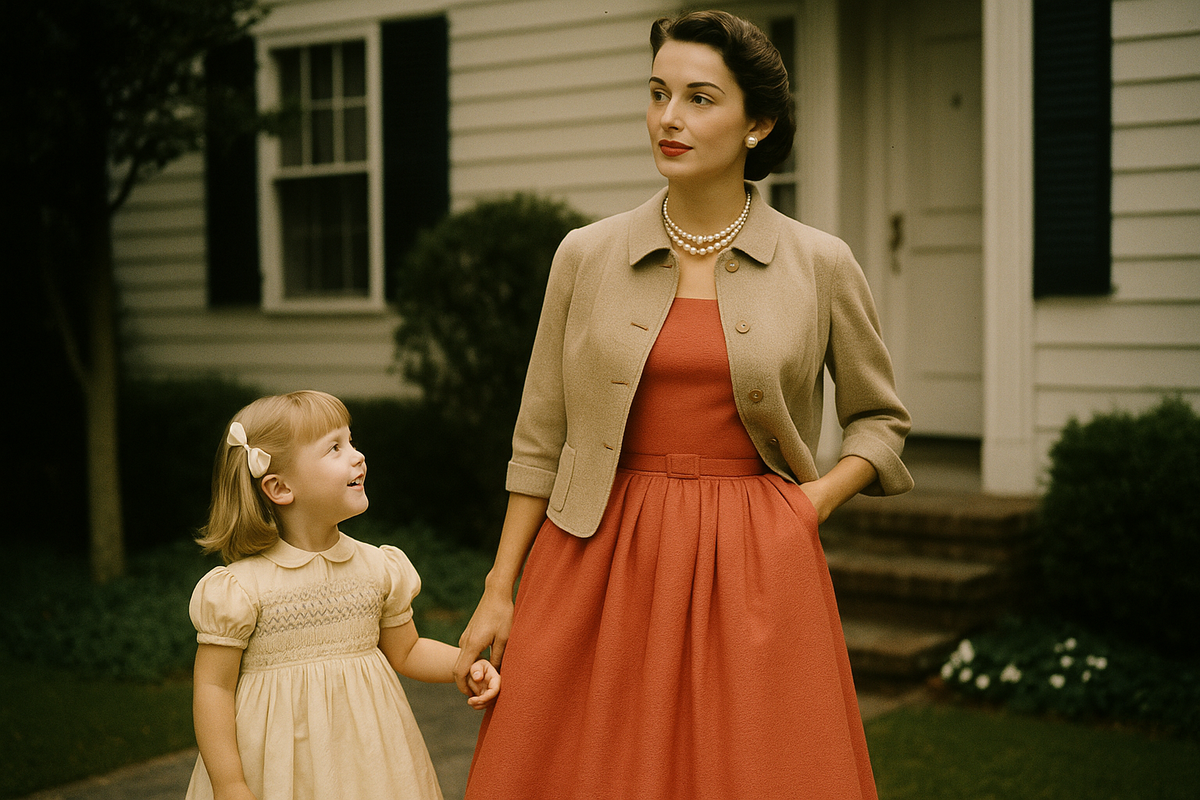
Mothers and daughters photographed in complementary outfits, their coordinated hemlines suggesting family unity extended to fabric choices. Color became code: coral and pink signaled domestic warmth, while black-and-white evening wear announced sophistication. Settings mattered as much as garments—Colonial homes, manicured lawns, polished interiors that anchored fashion firmly within upper-middle-class aspiration.
This was distinctly American fashion, defined by what it wasn't. Not Parisian haute couture with its inaccessible price points and avant-garde experimentation. Not working-class utility. The Journal's vision occupied a sweet spot: accessible enough to inspire, elevated enough to aspire toward. Clothing that worked for car rides and garden parties, that looked expensive without requiring wealth.
The photography itself became an argument. Shot in vivid color—still a relative luxury in magazine printing—these spreads made the lifestyle feel attainable. Women could see themselves in these roles because the images felt tactile, real, achievable with the right choices and careful planning.
What the Magazine Understood About Its Moment
By 1953, America had completed its psychological shift from wartime scarcity to peacetime abundance. The suburbs were expanding. Families were growing. Consumer goods flooded the market. But the shadow of the Depression still lingered in collective memory, and Cold War anxieties made excess feel unpatriotic, even dangerous.
The capsule wardrobe resolved this tension beautifully. It celebrated consumption—yes, buy these clothes—while encoding restraint. It promised abundance through careful curation rather than accumulation. Women could participate in postwar prosperity without appearing wasteful or frivolous.
The editorial positioned women as decision-makers, gatekeepers of family resources who demonstrated their competence through strategic purchases. This was empowerment within acceptable boundaries—authority over aesthetics and household economics, not political or professional domains.
And the formula worked because it addressed a real problem. Women in 1953 were managing complex lives—children, homes, social obligations, community involvement—often on carefully managed budgets. A wardrobe system that reduced decision fatigue while maintaining social expectations wasn't just aspirational. It was practical survival.
Cultural Themes in the October 1953 Issue
Family Unity Through Fashion
Mother-daughter coordinated outfits reinforced the postwar ideal of family cohesion expressed through visual harmony and shared aesthetic values.
Color as Moral Code
Pink and coral signaled feminine domesticity; black and white announced sophisticated restraint. Color choices carried social meaning beyond personal preference.
Efficiency as Virtue
The capsule wardrobe elevated practical household management to an art form, positioning strategic consumption as a demonstration of feminine competence.
American Exceptionalism
Distinctly non-European fashion emphasized accessibility and versatility over haute couture exclusivity, defining American style through democratic ideals.
Class Aspiration
Colonial homes and manicured settings anchored fashion within upper-middle-class aesthetics while suggesting these standards were achievable through smart choices.
Photography as Proof
Vivid color printing made aspirational lifestyles feel tangible and real, transforming fashion editorials into roadmaps for identity construction.
Why This Issue Matters Now
For collectors, the October 1953 Ladies' Home Journal is more than vintage ephemera. It's a primary source document on the construction of postwar femininity.
The fashion photography is museum-quality: sharp images of tailored suits, velvet coats, and coordinated family ensembles that preserve 1950s silhouettes with remarkable clarity. The editorial content reveals the ideological scaffolding supporting those images—the assumption that women's identity flowed from domestic competence, that efficiency and elegance were complementary virtues, that consumption required moral justification.
But the capsule wardrobe concept itself is the through-line that makes this issue feel contemporary. When modern fashion writers promote "10x10 wardrobes" or sustainable capsule collections, they're echoing ideas the Journal codified seventy years ago. The language has changed—we talk about environmental impact rather than household budgets, personal branding rather than civic virtue—but the underlying appeal is identical: control through curation, freedom through limits.
The issue also captures a specific cultural moment that wouldn't last. Within a decade, youth culture would explode, hemlines would rise, and the carefully coordinated mother-daughter aesthetic would start to fracture. The assumption that all women wanted the same things—suburban homes, family-centered lives, restrained elegance—would face serious challenge.
That makes this issue a perfect specimen of its era: polished, confident, utterly convinced of its own vision of American womanhood. It's fascinating precisely because that vision now looks both aspirational and constrictive, innovative and conservative, timeless and deeply dated.
For the Serious Collector
Historical Timing
A perfect snapshot of mid-century America at the height of suburban expansion, capturing the psychological transition from wartime scarcity to peacetime abundance.
Fashion Documentation
Museum-quality color photography preserves tailored suits, velvet coats, and capsule wardrobe systems with vivid clarity—essential for fashion historians and design researchers.
Cultural Artifact
The combination of fashion innovation, gender ideology, and consumer culture makes this issue invaluable for scholars studying postwar American femininity.
Market Value
Issues with strong visual content and forward-thinking editorial commentary command premium prices. This edition's capsule wardrobe feature makes it especially sought-after.
Explore the Archive
Original issues of Ladies' Home Journal spanning the 19th and 20th centuries document how American women's lives, aspirations, and identities shifted decade by decade.
Browse Ladies' Home Journal Magazine CollectionThe Long Shadow of Five Perfect Pieces
The capsule wardrobe persists because it solved a problem that transcends eras: how to present yourself to the world when resources—whether time, money, or mental energy—are finite.
In 1953, that problem was framed as household efficiency. Today, it's sustainability, minimalism, conscious consumption. The vocabulary changes, but the appeal of a strategic wardrobe remains.
The October 1953 Ladies' Home Journal didn't invent this idea—women have always made do with what they had—but it gave it a name, a visual language, and cultural permission. It made efficiency glamorous. It made restraint aspirational.
And in doing so, it created a template that fashion editors are still copying, one capsule wardrobe at a time.