
When Miami Proved Rock Festivals Could Change America
How a 1969 Rolling Stone feature documented the blueprint for Woodstock—eight months before it happened
Eight months before half a million people descended on a muddy farm in upstate New York, another gathering was already writing the blueprint. December 1968. Miami's Gulfstream Park. 100,000 young Americans converging under palm trees while the nation burned around them.
The February 1, 1969 issue of Rolling Stone knew what it was witnessing. Ellen Sander's feature—titled "The Most Festive Festival of 1968"—didn't just review a concert. It documented the moment rock festivals proved they could be something more than music: laboratories of peace in a country tearing itself apart.
Archive Details
Publication: Rolling Stone Magazine
Issue Date: February 1, 1969
Featured Writer: Ellen Sander
Historical Context: Miami Pop Festival, December 28-30, 1968
Significance: Primary documentation of the first major East Coast rock festival
The Year Everything Broke
To understand why Miami mattered, you have to remember 1968. Martin Luther King Jr. and Robert F. Kennedy assassinated within months of each other. Cities in flames. Vietnam body counts climbing. The Democratic National Convention erupting into violence on Chicago streets.
Rock music had become the sonic language of resistance, and festivals were its gathering places. Monterey in 1967 had shown the West Coast could pull it off. But the East Coast—America's cultural establishment—remained unconvinced that 100,000 young people could assemble without chaos.
Miami would prove them wrong.
The First East Coast Experiment
Promoter Richard O'Barry, backed by Concert Hall Publications and Capitol Records, chose December 28-30 for a reason. The timing was deliberate: a year-end statement, a rejection of traditional holiday conformity, a declaration that this generation would spend its time differently.
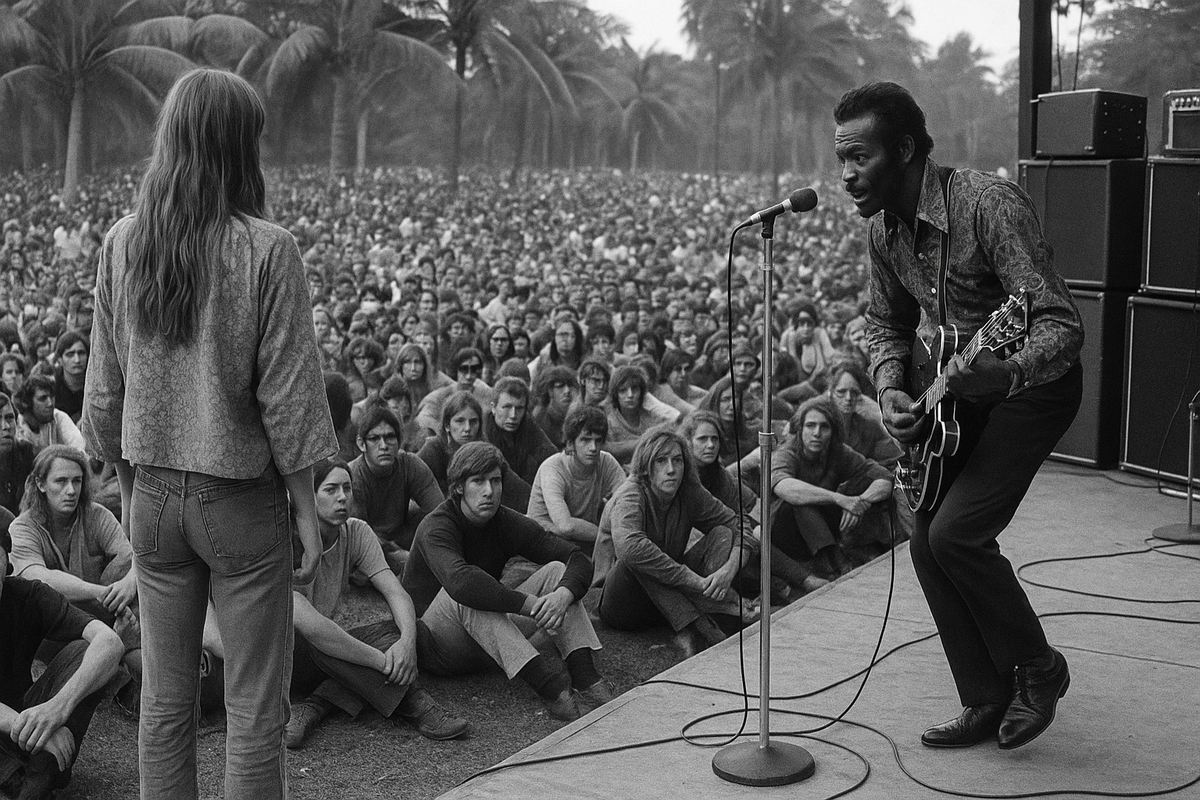
The festival's genius was its refusal to be categorized. Where other events catered to narrow scenes, Miami Pop offered Marvin Gaye sharing a stage with Iron Butterfly. Chuck Berry—rock's founding father—performing for an audience raised on his riffs but transformed by psychedelia. Richie Havens bringing folk authenticity. Wayne Cochran delivering flamboyant theatricality that predicted glam rock's coming explosion.
This wasn't genre tourism. It was a manifesto: youth culture contained multitudes.
Musical Diversity
From R&B to psychedelic rock, from folk to soul—Miami's lineup transcended genre boundaries and proved rock festivals could showcase the full spectrum of youth culture.
East Coast Legitimacy
As the first major rock festival on the East Coast, Miami expanded the festival model beyond California and signaled rock's nationwide cultural dominance.
Peaceful Assembly
Nearly 100,000 attendees with zero major incidents directly challenged establishment fears about youth gatherings and "riots."
Commercial Viability
Sold-out tickets at $6 per day demonstrated that large-scale festivals could be both culturally significant and financially successful.
Rolling Stone as Cultural Historian
Founded barely a year earlier, Rolling Stone understood its assignment. While mainstream media framed festivals as potential riots, Sander's coverage treated them as the cultural earthquakes they were.
Her reporting captured specifics that mattered: Country Joe and the Fish opening with anti-war anthems that made the festival's politics unmistakable. The crowd's peaceful disposition despite its size—a direct rebuke to establishment fears. The logistical triumph of what Sander called the festival's "intelligent" layout and "spectacular" organization.
The magazine's stark black-and-white newsprint design matched its seriousness. These weren't glossy lifestyle features. They were field reports from a revolution in progress, complete with wide-angle shots of mass gatherings and close-ups of performers bridging rock's past and future.
The Woodstock Rehearsal
History remembers Woodstock. But Miami proved the concept first: that massive crowds could self-govern through shared values, that rock festivals could serve as temporary autonomous zones where the counterculture's ideals—peace, diversity, communal experience—actually functioned.
The logistics alone were groundbreaking. Tickets at $6 per day sold out, demonstrating commercial viability. Nearly 100,000 attendees generated zero major incidents, shattering predictions of violence. And by choosing Miami—neither California cool nor New York establishment—promoters signaled that this movement belonged to all of youth America, not just coastal elites.
Eight months later, Woodstock would become mythology. But Miami was the proof of concept.
The Through-Line to Now
Modern festival culture—Coachella's influencer economy, Glastonbury's muddy pilgrimages, Lollapalooza's branded ubiquity—descends directly from Miami, Monterey, and Woodstock. But something was lost in professionalization.
The 1968 Miami Pop Festival wasn't a lifestyle brand. It was young Americans insisting their values could create temporary worlds that worked better than the one their parents built. Rolling Stone's coverage preserved that sincerity—the belief that music could unite rather than just entertain.
This February 1, 1969 issue remains powerful because it captured belief before it calcified into nostalgia.
Why This Issue Commands Collector Premium
Primary Documentation
This isn't retrospective analysis—it's contemporary reportage when the significance was still unfolding. Sander couldn't know Woodstock was coming. She was simply recording what felt historically important.
Visual Archive
The photography captures Chuck Berry mid-performance and crowds that stretched to horizons—images that have become shorthand for late-'60s youth culture.
Cultural Pivot Point
This issue sits between Monterey's proof-of-concept and Woodstock's apotheosis. It documents the moment rock festivals evolved from experiments into institutions.
Institutional Legitimacy
Rolling Stone in 1969 was establishing itself as the counterculture's paper of record. Reading this issue means accessing how that generation understood itself in real-time, before nostalgia softened the edges.
Explore the Archive
From documenting Miami's proof-of-concept to chronicling Woodstock's mythology, vintage Rolling Stone issues preserve the moment when youth culture realized its power.
Browse Rolling Stone Magazine Collection