
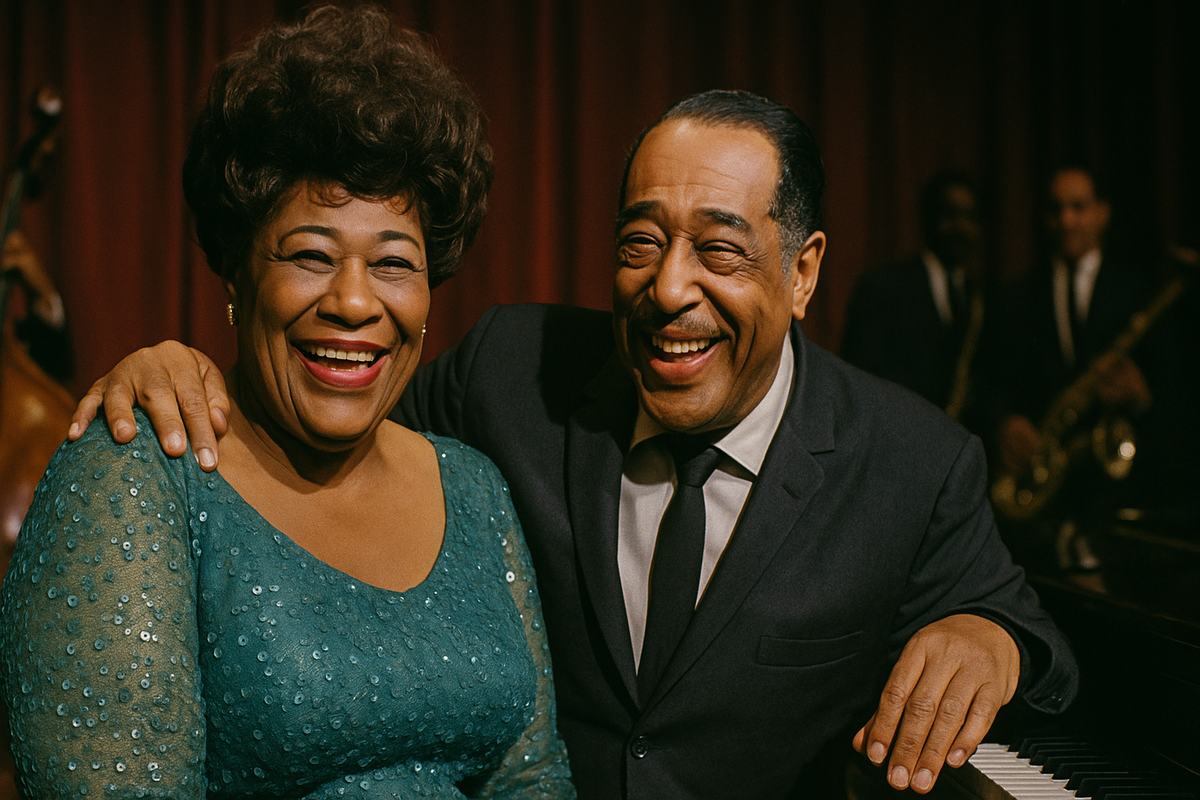
When Ella Met Duke: The 1967 Jet Magazine That Captured Black Excellence at Its Apex
How a pocket-sized publication documented two legends conquering the world while America was still debating civil rights
On April 6, 1967, newsstand browsers across Black America reached for their weekly copy of Jet Magazine and found themselves holding evidence of something the Civil Rights Movement had been arguing for years: that African American artistry didn't just deserve a seat at the table—it owned the table.
Against a crimson cover, Ella Fitzgerald and Duke Ellington smiled back at readers with the ease of two people who had already conquered the world. The headline promised "Ella and Duke Begin New Dates," but what lay inside those pocket-sized pages was bigger than tour announcements. It was documentation of cultural supremacy at a moment when supremacy of any kind felt hard-won.
While Newark and Detroit burned that summer and Stokely Carmichael's "Black Power" rallied a generation, Fitzgerald and Ellington were receiving standing ovations in Paris, Milan, and Carnegie Hall. The irony wasn't lost on Jet's editors or its readers: Black Americans were fighting for dignity at home while their greatest artists were already being treated as royalty abroad.
This magazine didn't just report on jazz. It reported on inevitability.
Archive Details
Historical Figures: Ella Fitzgerald, Duke Ellington
Issue Date: April 6, 1967
Archive Source: Jet Magazine
Historical Context: Civil Rights Movement, height of African American cultural achievement
The Pocket-Sized Weapon
By 1967, Jet had spent sixteen years doing what mainstream publications wouldn't: making Black achievement the lead story, not the footnote. While Life and Time occasionally featured African American subjects when tragedy or controversy demanded it, Jet made Black excellence its entire editorial mandate.
The magazine's compact format—small enough to fit in a jacket pocket or purse—belied its cultural heft. Jet reached millions of readers weekly, delivering hard-edged civil rights journalism alongside coverage of entertainers, athletes, and entrepreneurs who proved what was possible. It was both mirror and manifesto.
The April 6, 1967 issue exemplified this duality. Fitzgerald and Ellington weren't just entertainers to profile. They were living counterarguments to every claim of Black inferiority, performing at a level that rendered such claims absurd.
Two Legends, One Tour, Global Domination
The feature story chronicled a collaboration that had already made history. Fitzgerald and Ellington's partnership had deepened following The Duke Ellington Song Book, the landmark album that paired her interpretive genius with his compositional mastery. Now they were taking that chemistry on the road.
Their 1966-1967 European tour lasted five weeks and read like a conquest. Paris. Stockholm. Copenhagen. Hamburg. Rotterdam. Munich. London. In each city, audiences gave standing ovations—not the polite kind, but the extended, roaring kind that stops shows.
Back in the United States, their "Jazz at the Philharmonic" package brought them to Carnegie Hall alongside Oscar Peterson, Clark Terry, Coleman Hawkins, and Benny Carter. It wasn't just a concert. It was a showcase of Black musical intellectualism at its most refined, performed in one of America's most prestigious venues.
Jet captured the critical praise that followed them everywhere. Duke called Ella a singer "beyond category"—high praise from a man who despised limiting labels. Critics across Europe treated their performances not as entertainment but as artistic events worthy of serious cultural commentary.
The article didn't explicitly invoke politics, but the symbolism blazed through every paragraph. While African Americans faced police dogs and literacy tests at home, Fitzgerald and Ellington commanded respect in the cultural capitals of the world. The dissonance was deliberate, and Jet's readers felt it.
Inside the Issue: What Jet Documented
Musical Partnership
Jet reported how Ella and Duke's collaboration blossomed after The Duke Ellington Song Book, proving they could complement one another's genius on stage as well as in recordings.
European Triumphs
Their five-week European tour covered Paris, Milan, Rotterdam, Munich, and London, with standing ovations demonstrating universal respect for their artistry.
Carnegie Hall Premiere
Their joint performance at New York's Carnegie Hall featured them alongside Oscar Peterson, Clark Terry, Coleman Hawkins, and Benny Carter—a showcase of Black excellence at the highest level.
Enduring Respect
Duke praised Ella as a singer "beyond category," while critics hailed their collaboration as one of the greatest pairings in modern jazz.
The Archive Speaks
What makes vintage Jet magazines invaluable isn't just what they reported—it's how they reported it. These weren't stories filtered through the editorial judgment of white America. They were direct transmissions from the Black community to itself, written with clarity, urgency, and zero apology.
The April 6, 1967 issue endures because it captures a truth that transcends its moment: culture moves faster than politics. While lawmakers debated civil rights legislation, Fitzgerald and Ellington were already demonstrating what equality looked like in practice—on stage, on record, and in the standing ovations that followed them across continents.
This magazine is proof that excellence doesn't wait for permission.
Why This Issue Endures
The Timing
Published during the Civil Rights Movement's most volatile phase, this issue documents Black cultural achievement thriving in parallel to—and sometimes in spite of—political struggle. It's a snapshot of community pride when pride felt like resistance.
The Pairing
Fitzgerald and Ellington rank among the most important American musicians of the 20th century, regardless of genre or race. Their joint billing captures a moment when Black artistry had reached undeniable global stature.
The Source
Jet wasn't archiving history for posterity. It was reporting news to a living, breathing community that needed to see itself reflected with dignity. These magazines were read, passed around, and often discarded—making surviving copies primary source documents.
The Demand
Jazz-focused issues of Jet, particularly those featuring household names, command serious attention from collectors, historians, and families preserving cultural heritage. This issue checks every box.
Access the Archive
Thousands of original Jet magazines spanning the 1950s through 1980s are available in our collection. Each issue documents decades of Black culture, politics, leadership, and entertainment as events unfolded—not as they were later remembered or revised.
Browse Jet Magazine CollectionCoda
The April 6, 1967 Jet Magazine remains essential not because Fitzgerald and Ellington needed validation—they were already legends. It matters because it shows a community celebrating its own while the rest of America was still figuring out whether to grant basic rights.
This issue is a monument in newsprint: proof that Black artistry was conquering the world while Black citizens were still fighting for the vote. For anyone who understands that culture is history's most honest record, this magazine isn't just collectible.
It's evidence.