
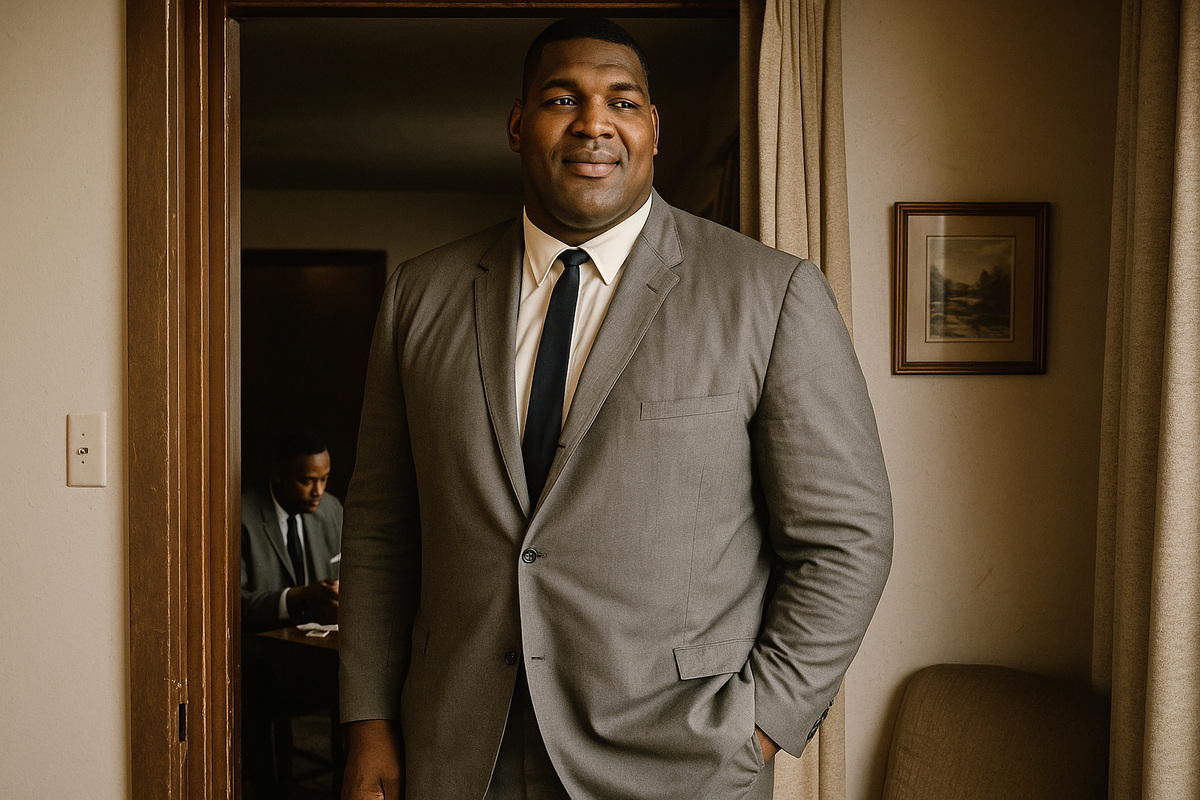
The Doorway Photo: How Ebony Magazine Turned Ernie Ladd Into a Symbol of Black Power Before the Movement Had a Name
Inside the January 1962 issue that redefined representation in American sports journalism
There's a photograph in the January 1962 issue of Ebony that stops you cold.
Ernie Ladd—six-foot-nine, 315 pounds, the largest man in professional football history—stands in a hotel doorway. Not near it. In it. His shoulders brush both sides of the frame. His head nearly scrapes the top. The doorway, built for normal men, becomes a visual punchline. But the joke has teeth.
Because in 1962, Black men weren't supposed to take up this much space.
And Ebony knew exactly what it was doing.
The Calculus of Visibility
When John H. Johnson founded Ebony in 1945, he wasn't launching a magazine. He was engineering a psychological intervention. Mainstream media had two modes for portraying Black Americans: invisible or menacing. Ebony offered a third option—present, dignified, and undeniable.
By January 1962, the magazine had perfected its formula. Each issue was a controlled detonation of aspiration: senators and singers, doctors and dancers, civil rights warriors and fashion models. The message was surgical: We are here. We are excellent. Deal with it.
The Ernie Ladd feature—"The Biggest Man in Pro Football"—landed in this context like a guided missile.
James Meredith was fighting to integrate the University of Mississippi. Martin Luther King Jr. was preparing for the Birmingham campaign that would galvanize a nation. The nation was lurching toward a reckoning it didn't want to have. And Ebony put a 315-pound Black man from rural Louisiana on a pedestal, daring America to look away.
They couldn't.
Archive Details
Historical Figure: Ernest "Ernie" Ladd
Issue Date: January 1962
Archive Source: Ebony Magazine
Feature Title: "The Biggest Man in Pro Football"
Historical Context: Published during the height of the Civil Rights Movement, one year before the Birmingham Campaign and the March on Washington
The Grambling Pipeline
Ladd's origin story reads like mythology. Born in Orange, Texas. Raised in Louisiana. Forged at Grambling State under Eddie Robinson, the coach who would become a legend for producing NFL talent from an underfunded HBCU.
The genetics were absurd: his father stood 6'4" and weighed 265 pounds. His mother was 6'0". Ladd didn't just grow—he emerged, a biological inevitability.
At Grambling, the stories multiplied. Fifty-two pancakes in one sitting. A pregame ritual of two steaks, eight eggs, sixteen slices of bacon, toast, and orange juice. A 54-inch chest. A 40-inch waist. Twenty-inch biceps. Twenty-inch calves. The numbers piled up like folklore, each one more preposterous than the last.
But Robinson taught him something more important than size: discipline. The Ebony photographers captured Ladd hitting tackling sleds under the watchful eye of Chuck Noll, the Chargers' line coach who would later architect the Pittsburgh Steelers dynasty. The images weren't casual. They were instructional—proof that size without craft meant nothing.
When the AFL's San Diego Chargers and the NFL's Chicago Bears both came calling, Ladd chose the upstart league. The money was better—around $10,000 annually, decent for a rookie in 1962. But more than that, the AFL was hungrier. It needed stars. It needed spectacle.
It needed Ernie Ladd.
The Visual Language of Power
Ebony's photography team understood something fundamental: representation isn't just about being seen. It's about how you're seen.
The action shots showed Ladd as elemental force—"doom-dealing," the caption read, as he bulldozed through offensive lines like they were made of papier-mâché. These images did the obvious work: they proved his dominance.
But the off-field photos did something subtler.
Ladd playing cards with teammates. Ladd listening to jazz records in his dormitory. Ladd signing autographs for Black children whose eyes went wide at his size. Ladd eating—always eating—with the kind of appetite that became part of his legend.
These weren't accidental choices. Ebony was coding him as relatable. Not a freak. Not a spectacle. A man—outsized, yes, but fundamentally human. Gentle. Humble. Disciplined.
The magazine's editorial gaze was revolutionary because it came from inside the Black community. Life and Look covered Black athletes through a white lens, often exoticizing or patronizing them. Ebony had no such filter. Its message was unambiguous: Ernie Ladd belongs here. At the center. Taking up space.
And you will respect him.
Physical Dominance
At 6'9" and 315 pounds, Ladd was the largest man in professional football history—a statistic Ebony weaponized to challenge assumptions about Black athletic excellence.
Cultural Dignity
The magazine's photography showed Ladd as both powerful and gentle, dismantling stereotypes while affirming Black humanity in the public sphere.
Strategic Representation
Ebony documented Black success not reactively, but strategically—claiming heroes before mainstream media could define them.
HBCU Excellence
Ladd's journey from Grambling State under Eddie Robinson highlighted the pipeline of Black talent emerging from historically Black colleges.
"The Big Son-of-a-Gun Is Coming"
Ladd's self-description was perfect in its simplicity: "The big son-of-a-gun is coming. If they bring me down, I keep crawling forward."
It wasn't poetry. It didn't need to be. It was threat and promise rolled into one—a declaration that size, will, and persistence would eventually win. For Black readers in 1962, the metaphor was impossible to miss.
The Civil Rights Movement operated on the same principle. Keep coming. Keep crawling forward. Eventually, the wall breaks.
Ladd's football career bore this out. He became a four-time AFL All-Star, a terror on the defensive line, and later—improbably, brilliantly—a professional wrestling superstar billed as "The Big Cat." His wrestling persona leaned into every stereotype opponents tried to weaponize, then owned them. Size as spectacle. Size as power. Size as choice.
But in January 1962, he was still just a rookie with potential. Ebony bet on that potential. The magazine understood that documenting Black excellence wasn't reactive—it was strategic. By the time mainstream America noticed Ernie Ladd, Ebony readers had already claimed him.
The Artifact Economy
Vintage Ebony magazines occupy a strange position in the collectibles market. They're not as expensive as first-edition Hemingways or original Superman comics. But they're rarer than people think.
Many issues were read to pieces, passed between families, stored in basements that flooded. The survival rate is lower than you'd expect. And the cultural hunger for these artifacts has only intensified. Historians want them. Families want them. Collectors want them.
The January 1962 issue—with its Ernie Ladd feature, its Civil Rights context, its snapshot of Black aspiration at a crossroads moment—checks every box.
It captures sports history: Ladd at the beginning of a Hall of Fame-worthy career. It captures cultural history: Ebony at peak influence, doing the work of representation before anyone called it that. It captures visual history: photography that was as stylish as it was substantive.
For collectors, it's a trifecta. For families preserving heritage, it's a link to grandparents' worlds. For scholars, it's primary source material about how African Americans saw themselves in the early 1960s—not through white media's distortions, but through their own lens.
These magazines aren't just paper. They're archaeology.
The Long View
The genius of Ebony was its refusal to wait for permission. It didn't ask if America was ready to see African Americans as senators, surgeons, and superstars. It simply showed them, month after month, year after year, until the accumulated weight of that evidence became irrefutable.
The Ernie Ladd feature was one thread in that larger tapestry—proof that Black excellence existed in every arena, even one as physically brutal as professional football. The magazine positioned him not as novelty, but as inevitability. Of course a Black man from Grambling could dominate the AFL. Of course he could fill a doorway. Of course children would flock to him.
Of course.
That confidence—that unshakeable certainty in Black potential—was Ebony's greatest editorial achievement. And it's why these issues still matter.
Collector Significance
Historical Timing
Published during a pivotal year of the Civil Rights Movement, this issue captures the intersection of sports, culture, and social change in 1962 America.
Sports Legacy
Documents Ernie Ladd at the beginning of his legendary career—before his AFL stardom and professional wrestling fame as "The Big Cat."
Cultural Documentation
Represents Ebony at peak influence, when the magazine served as the definitive chronicler of Black excellence and achievement.
Visual Archive
Features iconic photography that demonstrates Ebony's distinctive editorial voice—stylish, substantive, and unapologetically Black-centered.
Primary Source Value
Serves as essential material for scholars studying African American self-representation during the Civil Rights era.
Heritage Preservation
Connects contemporary families to their grandparents' world—a tangible link to how Black Americans saw themselves in 1962.
Explore the Full Archive
Own a piece of living history. Browse our curated collection of original Ebony magazines spanning the 1940s through the 1990s—from civil rights milestones to cultural revolutions in music, fashion, and sports.
Browse Ebony Magazine Collection