
The New American Boom: Confidence, Automation, and the Exuberant Economy of 1963
How Time Magazine captured the zenith of postwar prosperity—and the moment America stopped feeling invincible
On May 31, 1963, Time Magazine published a cover story that read less like economic reporting and more like a national manifesto. "The Economy: New & Exuberant" declared what millions of Americans already felt in their bones: the country was unstoppable.
The evidence was everywhere. Detroit assembly lines rolled out gleaming Chevrolets faster than dealers could stock them. Pittsburgh steel furnaces poured molten iron around the clock. In Boston, brides-to-be crowded bridal shops, buying gowns on credit they were certain they could repay. This wasn't just prosperity—it was a reimagining of what prosperity could mean.
But beneath the triumphalism, Time captured something more fragile: a nation at the apex of its industrial power, aware that the rules were changing. Automation threatened jobs even as it boosted profits. Europe and Japan were no longer ruins to be pitied but rivals to be feared. And the Kennedy administration's bold experiment with deficit spending was rewriting the social contract between Washington and Wall Street.
For readers today, this issue is a time capsule from the last moment America felt economically invincible.
Archive Profile
Publication: Time Magazine
Issue Date: May 31, 1963
Cover Story: "The Economy: New & Exuberant"
Historical Context: Published during the Kennedy administration, six months before JFK's assassination
Significance: Captured the zenith of postwar American industrial confidence and the dawn of consumer-driven capitalism
The Forces Reshaping the American Century
The early 1960s marked the end of one economic era and the violent birth of another. After a decade of postwar adjustments and the stuttering recessions of the 1950s, the Kennedy White House gambled on a new formula: spend now, grow forever.
The Kennedy Boom. Washington injected nearly $70 billion annually into the economy—the largest peacetime federal outlay in American history. Tax reforms, deficit spending, and public works projects weren't debated as necessary evils. They were celebrated as engines of growth. Time framed Kennedy's economic advisors as architects of a new capitalism, one where government didn't just regulate markets—it created them.
The Automation Paradox. Steel mills installed oxygen furnaces that tripled output with half the workforce. Textile factories replaced seamstresses with automated looms. Car plants deployed robotic welders. Efficiency soared. So did anxiety. Time acknowledged the contradiction: machines were making America richer and Americans more expendable.
The Consumer Insurgency. For the first time, household spending—not industrial investment—became the primary driver of GDP. Americans bought cars on 36-month loans, furnished homes with credit cards, and financed weddings with installment plans. Time didn't moralize about debt. It celebrated consumers as patriots, spending their way to national strength.
The End of Isolation. Europe's factories were rebuilt. Japan's exporters were undercutting U.S. prices. The postwar monopoly on manufacturing was over. Time warned that American dominance was no longer destiny—it was a daily fight.
This issue captured a singular truth: 1963 was the year optimism and vertigo became indistinguishable.
How Time Turned Economics Into Spectacle
By 1963, Time had mastered the alchemy of making balance sheets cinematic. The May 31 issue didn't just report on the economy—it made readers feel it.
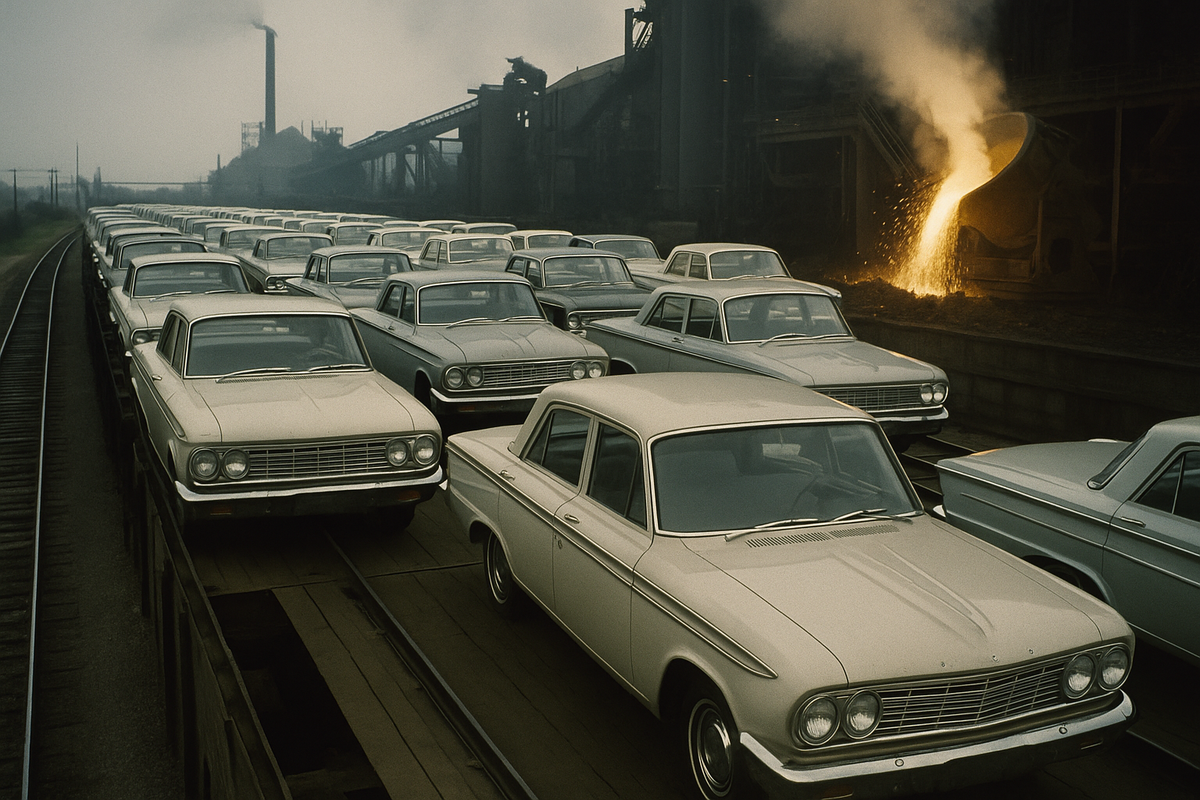
The Imagery. A freight train snaked across the cover, its flatcars stacked with hundreds of new 1963 sedans, chrome glinting in industrial sunlight. Inside, a two-page spread showed molten steel cascading from a blast furnace, liquid fire frozen in black-and-white. Another photo: young women in Boston, hands on silk and tulle, shopping for wedding gowns they'd pay off over months. Each image was a psalm to production, consumption, and the marriage of the two.
The Data, Dramatized. Where other magazines buried statistics in tables, Time weaponized them. A bold graph charted consumer spending, federal outlays, and capital investment as three arrows climbing in parallel—visual proof that Kennedy's gamble was working. The numbers became narrative.
The Voice. Time's prose bristled with authority. Sentences snapped. Paragraphs built to crescendos. The economy wasn't described—it performed. Factories "hummed." Shoppers "surged." Markets "roared." This wasn't neutral journalism. It was literature in service of optimism.
The magazine understood what economists often miss: people don't connect with GDP. They connect with the train full of Chevrolets, the bride with a credit card, the steelworker watching his job automated away.
What Time Got Right—and What It Missed
The feature's core arguments have aged remarkably well, even as some of its assumptions now read as period artifacts.
The Consumer as Engine
Time was correct: household spending had become the foundation of American growth. The magazine predicted that this shift would define capitalism for generations. It did.
Automation's Double Edge
The piece wrestled honestly with the cost of efficiency. Yes, machines boosted productivity. Yes, they also eliminated livelihoods. Time didn't offer solutions, but it named the problem decades before "deindustrialization" entered the lexicon.
Government as Partner
The Kennedy administration's willingness to run deficits was treated as statesmanship, not recklessness. Time praised federal spending on highways, education, and defense as investments in the future. This framing—radical in 1963—became orthodoxy by the 1970s.
The Intellectual Reframing
The article audaciously claimed that Adam Smith, Karl Marx, and Alexander Hamilton were all obsolete. Modern America, Time argued, had invented something new: a hybrid system of mass production, mass consumption, and managed capitalism.
What the magazine couldn't foresee: the stagflation of the 1970s, the dismantling of New Deal liberalism, the gutting of the industrial Midwest. In 1963, the idea that America's manufacturing base could collapse seemed absurd. Within 20 years, it was reality.
But reading this issue today isn't an exercise in spotting errors. It's a study in confidence—the kind a nation has when it believes the future is a problem it has already solved.
The Enduring Power of Print Archives
Digital headlines vanish. Tweets evaporate. But a vintage Time magazine endures as material history. The paper yellows. The ink fades. The advertisements—for Oldsmobiles, Marlboros, General Electric—become unintentional time capsules of desire and design.
These issues don't just record what happened. They preserve how it felt to live through it. The May 31, 1963 edition captures a mood—bullish, jittery, certain—that no retrospective analysis can fully reconstruct.
You cannot skim this issue on a screen and feel the weight of its moment. You have to hold it.
Why This Issue Belongs in Your Collection
Historical Pivot Point
Published six months before Kennedy's assassination, this issue captures "Camelot" at full strength—a fleeting moment when optimism felt rational, when government and business seemed aligned, when growth appeared infinite.
Cultural Crossroads
This issue is a bridge artifact. It stands between the factory-floor capitalism of the 1940s and the credit-card consumerism of the 1970s. It shows the hinge moment when production gave way to consumption as the defining national act.
Visual Archaeology
The photography alone justifies ownership. The train of cars, the molten steel, the shopping brides—these images are iconography of an era. They don't just illustrate the economy. They are the economy, distilled into light and shadow.
Market Demand
Economic milestone issues consistently outperform celebrity covers in the collector market. Serious buyers seek tangible records of transformative moments. This issue qualifies.
Owning it means holding a 60-year-old bet that America had cracked the code. We know now that the bet was half-right. That makes the artifact more valuable, not less.
Add This Artifact to Your Archive
If you collect turning points in American economic history, the May 31, 1963 Time Magazine is non-negotiable. It offers authoritative reporting, striking visual journalism, and a window into the last era when growth felt guaranteed.
Browse Time Magazine CollectionFrom the Great Depression through the stagflation of the 1970s, these magazines let you trace the arc of American capitalism exactly as it unfolded—not as it was later remembered, but as it was first understood.
The Boom Before the Reckoning
The May 31, 1963 issue of Time Magazine stands as one of the sharpest economic portraits of its decade. It documented a nation in love with its own momentum, confident that automation, consumption, and federal spending had unlocked permanent prosperity.
History would complicate that confidence. But in 1963, doubt was a luxury no one wanted.
Holding this issue today is holding the last chapter of American economic exceptionalism before the world grew more complicated. For collectors and historians alike, it is not simply journalism—it is evidence of a bet the nation made on itself.
And for one shining spring, it looked like a sure thing.