
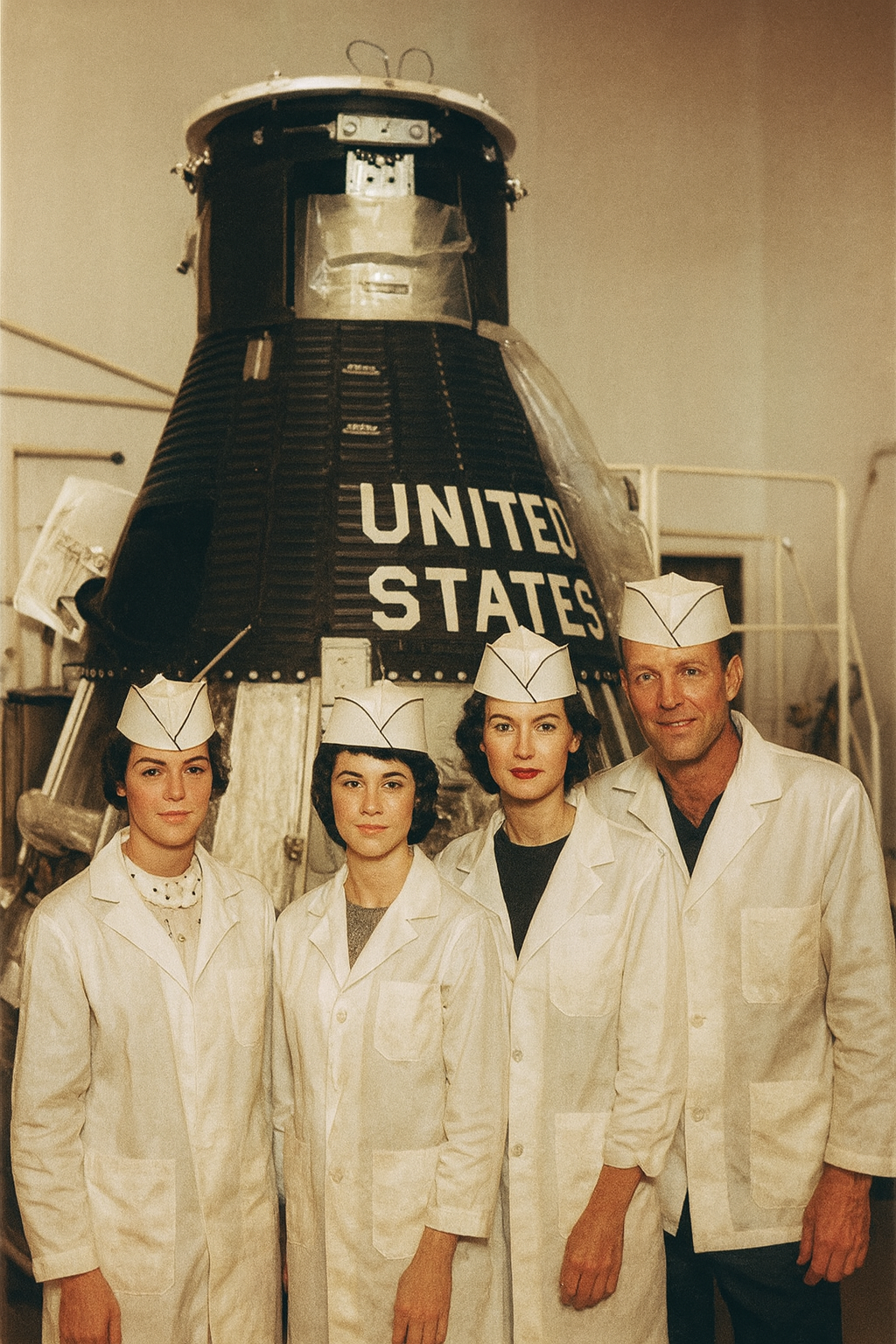
Faith 7, Gordon Cooper, and the Magazine That Captured America's Leap Toward the Stars
How Life Magazine's May 17, 1963 issue transformed a Space Race milestone into an intimate portrait of American ambition
The astronaut stood shirtless in his Texas backyard, cradling the family cat.
Within days, Major Gordon Cooper would be strapped into a capsule no larger than a phone booth, hurtling through space at 17,500 miles per hour. But on this spring afternoon in 1963, Life Magazine's cameras found him exactly where he wanted to be: home, ordinary, unheroic in all the ways that mattered most.
This was Life's genius. The May 17, 1963 issue didn't just document the final Mercury mission—it made readers feel what it meant to send a neighbor into orbit.
For collectors and historians today, this issue stands as one of the most significant artifacts of the Space Race. Not because it predicted Cooper's flight would succeed, but because it captured the precise moment when America stopped asking if we belonged in space and started asking how far we could go.
Archive Details
Historical Figure: Major Gordon Cooper, Mercury Seven Astronaut
Issue Date: May 17, 1963
Mission: Faith 7 – Final Mercury Program Flight (22 orbits, 33+ hours)
Archive Source: Life Magazine Photojournalism Collection
The Stakes: May 1963 and the Race America Couldn't Afford to Lose
Two years into the Space Race, the scoreboard was brutally clear. The Soviets had launched the first satellite, sent the first man into orbit, and kept cosmonauts aloft longer than any American astronaut. John Glenn's triumphant three-orbit flight in February 1962 had restored national pride, but it hadn't closed the gap.
Gordon Cooper's Faith 7 mission was designed to leapfrog Soviet endurance records. Twenty-two orbits. Thirty-three hours in space. No American had been aloft that long. Cooper would test whether astronauts could sleep in weightlessness, transmit the first live television from orbit, and gather the medical and engineering data that would unlock the Gemini and Apollo programs.
This wasn't science fiction. This was an Oklahoma test pilot about to prove that Americans could survive—and work—in the void.
And Life had the only story that mattered: the man behind the mission.
What Life Understood That Other Publications Didn't
In 1963, newspapers printed NASA press releases. Television offered grainy launch footage. But Life Magazine practiced something closer to anthropology.
Their photographers embedded with the Cooper family for weeks. The resulting May 17 feature gave readers not a hero, but a husband teaching his daughters the difference between apogee and perigee while they planted carrots in the garden.
The images were methodical in their intimacy:
Cooper in the cockpit of his private plane with his wife Trudy—the only astronaut's wife who was also a licensed pilot. The caption didn't need to say "partnership." The photograph made it visceral.
The family at Cape Canaveral, pointing skyward at the Atlas rocket—not as spectators, but as co-conspirators in something enormous.
Cooper leading grace at the dinner table—the gesture that explained why he'd named his spacecraft Faith 7. Not NASA's choice. His.
Daughters Jan and Cam on horseback, answering the phone with "Major Cooper's residence"—children learning to navigate celebrity while still earning pocket money through chores.
These weren't filler photographs. They were the argument Life was making: space exploration wasn't happening to America. It was happening because of Americans—ordinary people who happened to be doing extraordinary things.
The Daughters Who Thought Space Was Simple
One detail from the article cuts deeper than any mission schematic: Cooper's daughters initially believed space travel was "just a matter of sticking a man on a rocket and sending him up."
After watching their father train—centrifuge runs that crushed him at 7Gs, water survival drills, endless systems simulations—they understood. Jan joked that she wanted to be a bride "because the groom goes around the earth and is so graceful," confusing astronauts with figure skaters. Cam briefly considered becoming an astronaut herself before admitting she might be too nervous.
Life gave these moments full weight. The Space Race wasn't an abstraction. It was two girls in Houston learning words like "trajectory" before they learned algebra, building a high fence around their home to keep tourists at bay, watching their father prepare to do something no one was certain could be done.
Houston, 1963: A City Remaking Itself in Real Time
The Cooper family had just moved to Houston, where NASA's new Manned Spacecraft Center was transforming the city into "Space City U.S.A." Local restaurants served "The Gordon Cooper Special"—scrambled eggs and bacon, astronaut fuel for earthbound dreamers.
Life captured this cultural shift with the same rigor it applied to the Coopers themselves. The Space Race wasn't just a geopolitical contest. It was rewriting American geography, creating new cities, new industries, new mythologies.
Cooper himself resisted the mythology. Despite the upcoming 22 orbits, he told Life he disliked fame and would have preferred no parades or media coverage afterward. His "Huck Finn grin" and Oklahoma drawl reminded readers that even America's newest legends were still recognizably, stubbornly human.
The Power of Life's Photojournalism Philosophy
The May 17, 1963 cover embodied Life's editorial DNA. Unlike The Saturday Evening Post or other illustrated magazines, Life insisted on photographic realism. The camera was its instrument. America's unfolding history was its subject.
Inside, the Cooper feature operated as visual narrative. Full-page spreads invited readers to linger. Captions provided context without overwhelming the images. The layout moved fluidly between technical mission briefings and backyard family scenes, creating a rhythm that felt cinematic.
At a time when television coverage remained limited and newspapers were static, Life provided immersion. Readers didn't just learn about the Faith 7 mission—they inhabited the world surrounding it.
This is why the magazine's space-era issues remain collectible six decades later. They weren't reporting history. They were preserving it, frame by frame.
Why This Issue Commands Collector Attention
Faith 7 closed the Mercury program. Every mission afterward would be more complex, more collaborative, less individual. This was the last time a solo American astronaut would orbit Earth in Project Mercury.
Few issues devoted this much space to both technical mission architecture and family intimacy. The Cooper feature spans multiple spreads, each photograph earning its real estate.
May 1963 sits at a hinge point in American history. Birmingham's civil rights protests dominated headlines. Cold War tensions simmered. Yet Life showed a nation also pushing forward, carrying its aspirations skyward.
Collectors prize issues with original advertisements intact. The May 17 edition includes period treasures: Rotunda oil filters, Krylon spray paint, Roto-Rooter service ads. These aren't ephemera—they're windows into 1963's material culture.
More than a magazine, this is an object families studied around kitchen tables as America prepared to reach the Moon. Holding one means touching the same pages that shaped how an entire generation understood the space program.
What Endures
The May 17, 1963 Life Magazine works because it trusted its audience. It didn't simplify Gordon Cooper into a cardboard hero. It didn't reduce the Space Race to propaganda. It showed Americans what was true: exploration requires not just rockets and engineers, but families willing to live with uncertainty, communities willing to transform themselves, and a nation willing to believe that the impossible was merely difficult.
Unlike today's instant, disposable media, vintage Life magazines are permanent. They slow us down. They ask us to absorb history as it was first absorbed—deliberately, in print, with pages meant to be kept.
This is why collectors, historians, and enthusiasts continue seeking these artifacts. They aren't just stories from another time. They're evidence of how we once saw ourselves.
Own the Original
If Gordon Cooper's story and the Space Race era resonate with you, there's no substitute for holding the original magazine.
Browse Life Magazine CollectionFrom the 1930s through the 1970s, explore decades of American cultural history: war and peace, politics and art, fashion and exploration—all documented as it happened.
The May 17, 1963 Life Magazine remains a defining publication of the Space Race. Its portrait of Gordon Cooper and Faith 7 captured a nation's aspirations and anxieties, blending family intimacy with scientific ambition.
Holding this issue today means holding that moment—when America looked skyward, when astronauts were both heroes and neighbors, and when Life Magazine turned history into images that endure across generations.
For anyone passionate about 20th century media, these magazines aren't simply collectibles. They're living documents that let us revisit the past exactly as it was first witnessed.