
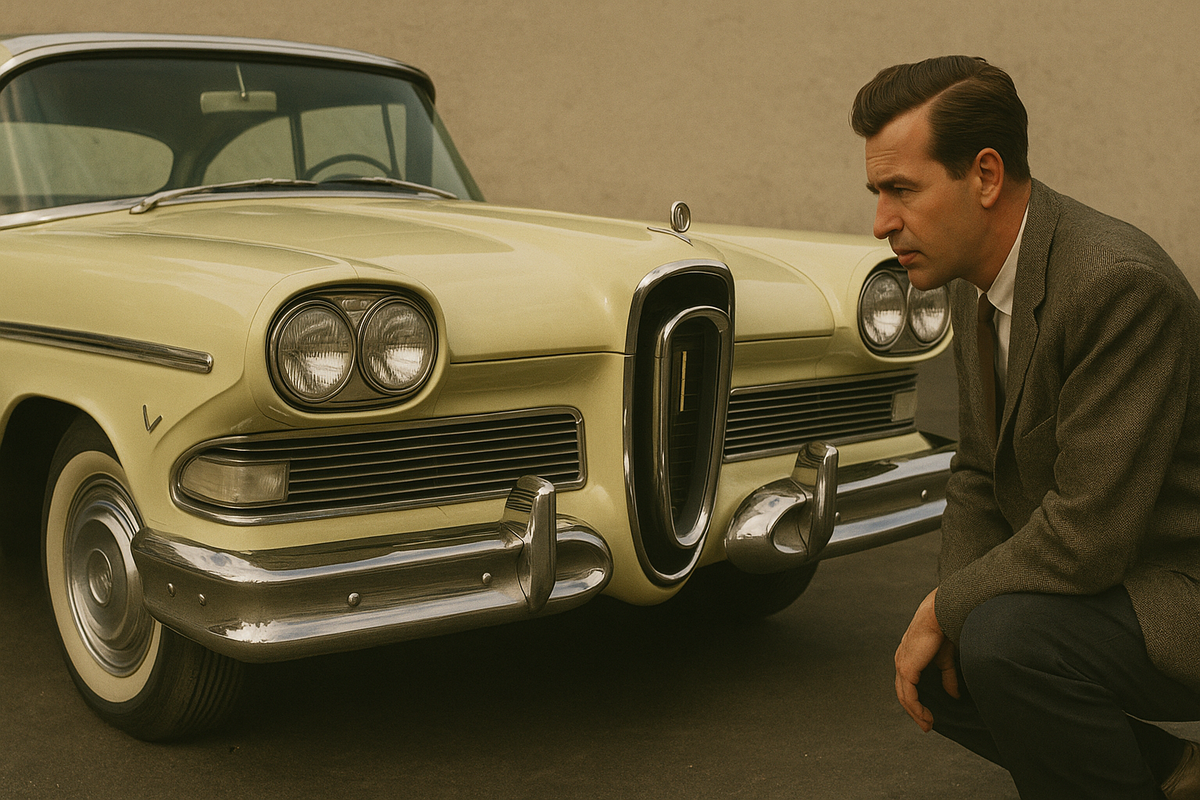
When America's Mightiest Automaker Built a $250 Million Punchline
How The New Yorker's December 3, 1960 issue captured the spectacular collapse of the Edsel—and redefined corporate failure in postwar America
December 3, 1960. Readers settling into their armchairs with that week's New Yorker had no idea they were holding a postmortem—not of a person, but of an idea. An idea that cost Ford Motor Company over $250 million. An idea that three years earlier had been hailed as the future of American motoring. An idea now reduced to two syllables of cultural shorthand: Edsel.
The magazine's Annals of Business feature that week, "The Edsel – Heir-Poom," wasn't just corporate journalism. It was a cultural dissection—a razor-sharp examination of how the most powerful industrial nation on earth could produce its most spectacular commercial failure. For a readership navigating the contradictions of postwar prosperity, the Edsel story landed like a parable: even titans stumble. Even abundance breeds its own casualties.
This wasn't ancient history. The car had launched in September 1957—barely three years before The New Yorker performed its autopsy. The wound was still fresh. The lessons, still forming.
The Fault Line in the American Dream
Context matters. The late 1950s weren't simply prosperous—they were paradoxically prosperous. Suburbia sprawled. Consumer credit flowed. Detroit's Big Three—Ford, General Motors, Chrysler—churned out chrome-laden fantasies on wheels, each more extravagant than the last.
Yet beneath the optimism, fissures appeared. Sputnik orbited overhead in 1957, puncturing American technological supremacy. Cold War anxieties simmered. Intellectuals questioned conformity. Consumers, wealthier than ever, grew skeptical of marketing's grand promises. They wanted authenticity, not just aspiration.
Ford missed the shift entirely.
The company's market researchers identified what they called a "gap"—a pricing tier between Ford's entry-level models and the upscale Mercury line. Fill that gap, they reasoned, and profits would follow. The Edsel would be the bridge: innovative engineering, bold styling, a name evoking prestige (borrowed from Henry Ford's son, Edsel Bryant Ford).
What they built instead was a case study in cultural misalignment.
"E-Day"—September 4, 1957—arrived with theatrical fanfare. Dealers unveiled the Edsel simultaneously across America, expecting stampedes. What they got was polite bewilderment. The car's vertical "horsecollar" grille, intended to distinguish it from competitors, became an object of ridicule. Mechanical problems surfaced immediately. Quality control faltered. Word spread.
By 1960, the Edsel wasn't just a commercial failure. It was a punchline—a symbol of hubris meeting reality at high speed.
Issue Archive Details
Publication: The New Yorker
Issue Date: December 3, 1960
Featured Article: "The Edsel – Heir-Poom" (Annals of Business)
Cover Artist: Abe Birnbaum
Historical Context: Published three years after the Edsel's 1957 launch and during its final production year
The New Yorker's Surgical Precision
What makes The New Yorker's coverage definitive isn't its proximity to events—it's the magazine's refusal to treat the Edsel as mere business news. This was cultural criticism disguised as corporate reportage.
The article asked uncomfortable questions. What does it mean when a nation built on success produces such conspicuous failure? What happens when advertising—the engine of consumer culture—can't overcome consumer instinct? How does a company spend a quarter-billion dollars and misread the national mood so completely?
These weren't rhetorical flourishes. They were genuine inquiries into the American psyche at a pivotal moment. The Edsel's collapse suggested something unsettling: the postwar boom couldn't insulate corporations from the consequences of arrogance. Scale didn't guarantee wisdom. Marketing couldn't manufacture desire.
The New Yorker understood that its readers—urbane, educated, culturally attuned—would see themselves in this story. They too navigated a society drowning in choices, promises, and carefully constructed images. The Edsel's failure was their vindication: consumers could still think for themselves.
The Cover's Quiet Irony
Abe Birnbaum's cover illustration that week offers its own commentary. Red cars wind through snow-dusted evergreens, their forms simplified to elegant geometry. It's seasonal, whimsical—classic New Yorker visual wit.
But paired with the Edsel feature inside, the image deepens. Those stylized automobiles navigating a winter landscape become metaphor: American industry threading through uncertain terrain, its confidence tested by forces beyond its control.
This juxtaposition—playful art meeting serious analysis—defined The New Yorker's editorial genius. The magazine never lectured. It observed, with raised eyebrow and sharpened pencil, trusting readers to make connections.
Four Lessons Carved in Chrome
The New Yorker's dissection revealed failures that transcend automotive history:
Overconfidence as Vulnerability
Ford believed its size and marketing budget could impose success. The market proved otherwise. Consumer desire moves on currents too subtle for boardrooms to map.
Design's Double Edge
The Edsel's aggressive styling, meant to capture attention, repelled buyers who found it garish. Distinctiveness without elegance is just noise.
Advertising's Limits
Despite one of history's largest automotive ad campaigns, marketing couldn't paper over cultural skepticism or mechanical flaws. Trust, once fractured, doesn't respond to slogans.
The Permanence of Symbol
The Edsel became more than a failed product. It entered the language as shorthand for corporate miscalculation—a fate worse than obscurity.
Each lesson resonated in 1960. Each remains instructive now.
The Permanence of Print
Digital archives offer convenience. But they can't replicate the tactile experience of handling the actual pages read by 1960 audiences. The paper quality, the ink, the advertisements surrounding the Edsel article—these contextual elements don't survive digitization.
Vintage New Yorker issues function as time capsules. They capture not just individual stories but the entire cultural ecosystem: what products were advertised, which books reviewed, whose theater received coverage. The whole magazine is the artifact.
This is why serious collectors seek original issues rather than reprints or PDFs. History has texture. Context has weight.
Why Collectors Covet This Issue
Proximity to Events
Published just three years after the Edsel's launch, the article captures contemporary reaction, not hindsight. This isn't academic analysis written decades later—it's journalism wrestling with fresh failure.
Cultural Artifact Status
The issue bridges multiple collecting categories: business history, automotive culture, mid-century design, and literary journalism. Few single magazines span such territory.
Birnbaum's Cover
The seasonal illustration embodies The New Yorker's visual identity at its zenith—sophisticated, witty, layered with meaning.
Enduring Relevance
Because "Edsel" remains synonymous with corporate disaster, this issue retains research value for historians, business scholars, and economists studying innovation failure.
For Collectors and Cultural Historians
If you study American business, postwar culture, or the evolution of consumer society, the December 3, 1960 New Yorker deserves space in your collection.
Browse The New Yorker Magazine CollectionWhether you're building a research library, pursuing a comprehensive run of The New Yorker, or simply drawn to artifacts that illuminate American ambition and failure, these issues offer something irreplaceable: direct connection to the moment when history was news.
The Edsel's Final Lesson
More than six decades after Ford pulled the plug on the Edsel, the car's legacy endures—not in showrooms but in language and memory. We still invoke its name when ambition outpaces judgment. We still study its failure in business schools.
The New Yorker's 1960 dissection understood what made the story endure: it wasn't about cars. It was about the fragility of certainty in an age of abundance. About the distance between what corporations promise and what consumers want. About the moment when America's industrial might met its own limitations.
The magazine didn't mourn the Edsel. It examined it—with precision, wit, and an eye for the larger truths hiding in corporate wreckage.
That examination, preserved in these pages, remains as sharp as the day it was printed. Some artifacts don't age. They accumulate meaning.