
When America Saw the Future—and It Was Godless
How a 1949 Saturday Evening Post cover of a dog in a raincoat concealed one of the Cold War's most chilling exposés
The dog wore a raincoat.
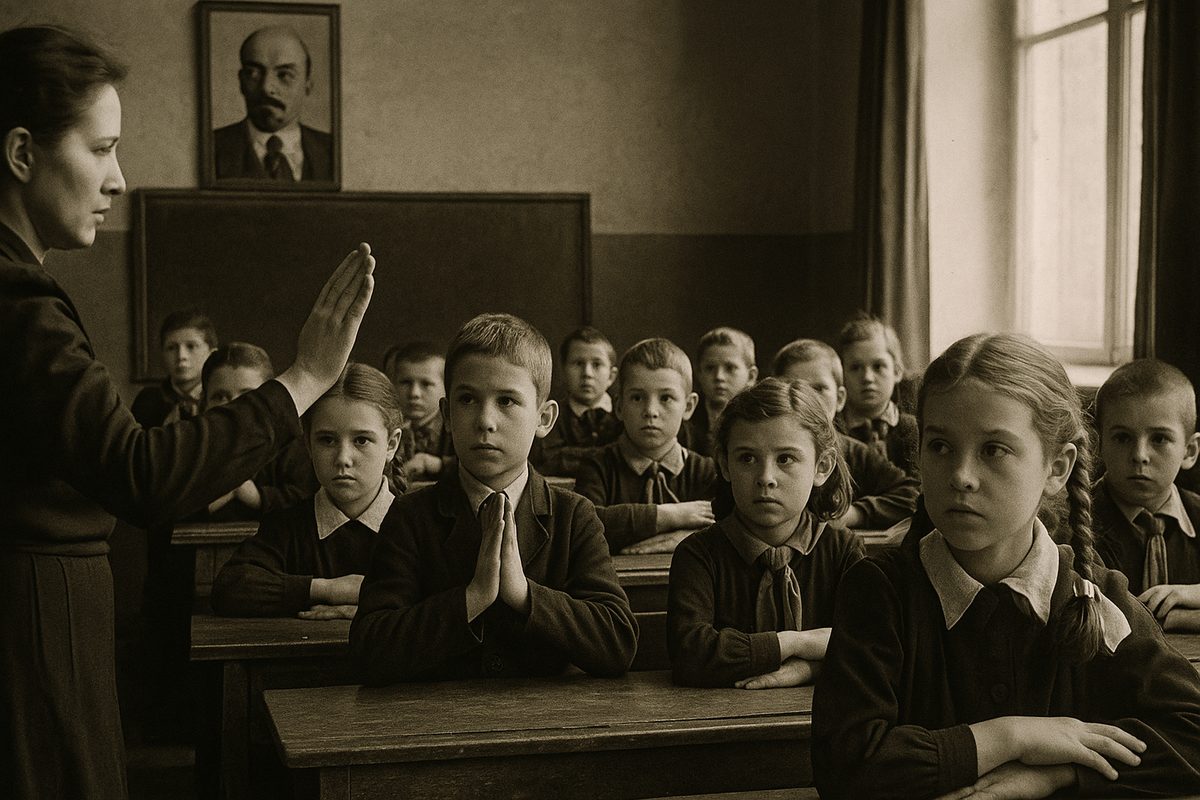
On the cover of the April 2, 1949 Saturday Evening Post, Albert Staehle's illustration showed a cocker spaniel dressed for spring showers—charming, domestic, quintessentially American. Flip past that cover, though, and readers encountered something far darker: Nina Alexeieva's "How Russian Children Lost Their God," a firsthand account of how Soviet schools systematically stripped children of faith and replaced it with Communist doctrine.
For families in postwar America, the juxtaposition was devastating. While their own children played safely under illustrations of dogs in raincoats, Soviet children were being reshaped into ideological instruments of the state.
This wasn't propaganda. It was journalism—and it arrived at the exact moment Americans needed to understand what the Cold War would actually cost.
The Moment the Peace Broke
Four years after V-J Day, 1949 should have been a victory lap. Instead, it became the year Americans realized the war had never really ended—it had simply changed shape.
The Berlin Blockade had just been lifted in May. NATO was forming. The Soviets were consolidating control over Eastern Europe. And somewhere in the American psyche, a new fear was taking root: this wasn't going to be a conflict of armies and battlefields. It was going to be a war for minds, souls, and the future itself.
The Saturday Evening Post understood this shift instinctively. The magazine had built its reputation by blending Norman Rockwell's vision of American life with hard-hitting reportage that millions trusted. When Alexeieva's article appeared, it did exactly what great journalism should: it made the abstract personal and the distant immediate.
Religion wasn't just a cultural difference between America and the USSR. It was the frontline.
Archive Details
Featured Article: "How Russian Children Lost Their God" by Nina Alexeieva
Issue Date: April 2, 1949
Cover Artist: Albert Staehle
Historical Context: Cold War Ideological Conflict, Post-WWII America
Archive Source: The Saturday Evening Post
"Religion Is the Enemy of the People"
Alexeieva's account reads like a field report from occupied territory—because that's essentially what it was.
She described how Soviet schools replaced church with the Young Leninists and Pioneers, youth organizations that functioned as secular congregations. Instead of hymns, children learned chants:
"Lenin, Trotsky, Lunacharsky—Defend the people, proletariat."
Teachers didn't simply ignore religion—they attacked it. Classrooms became stages for mockery, where faith was dismissed as backward superstition and children were urged to confront their own families' beliefs. Alexeieva recalled the quiet agony of watching her grandmother pray at home while knowing she was supposed to report such "counter-revolutionary" behavior.
The psychological architecture was brilliant and brutal: join the Pioneers and gain acceptance, status, safety—but only by publicly renouncing God. Refuse, and face isolation, suspicion, and punishment.
For American readers in 1949, this wasn't distant sociology. It was a vision of what happens when the state claims ownership of childhood itself.
The Dog and the Devil
Staehle's cover wasn't just whimsical—it was strategic.
The Saturday Evening Post excelled at this kind of tonal control, balancing Americana with hard truths. The dog in the raincoat represented everything the magazine's readers cherished: innocence, humor, domestic warmth, the freedom to laugh at small things. Inside, Alexeieva's article showed what happened when those freedoms disappeared.
The contrast wasn't accidental. It was editorial commentary in visual form—a reminder that the liberties Americans took for granted were being systematically eliminated elsewhere. The magazine served as both mirror and warning: Look at what you have. Look at what they're doing. Understand the difference.
It's why this issue resonates decades later. The cover invites you in with a smile. The content makes you grateful you can still smile freely.
The Architecture of Indoctrination
Alexeieva provided granular detail that elevated her account beyond mere testimony:
Each detail was a revelation. American readers understood religious freedom as a natural right, something so fundamental it didn't require defense. Alexeieva showed them a world where that right had been hunted to extinction within a single generation.
The Post as Time Machine
What makes The Saturday Evening Post invaluable as a collectible isn't just individual articles or covers—it's the totality. Each issue preserved a complete cultural moment: the humor, the art, the fears, the values, the contradictions.
The April 2, 1949 issue captures this with particular clarity. It shows an America confident enough to put a dog in a raincoat on its cover and anxious enough to publish warnings about atheist indoctrination inside. Both impulses were authentic. Both were necessary.
For modern readers, these magazines function as portals. They let us experience how previous generations understood their world—not through the lens of hindsight, but through the immediacy of the moment.
Why This Issue Matters to Collectors
Owning this issue means holding an artifact from the moment America looked across the Iron Curtain and understood that the real battle would be fought in schools, homes, and hearts.
The Weight of Paper
The April 2, 1949 Saturday Evening Post holds both charm and gravity. Staehle's dog makes you smile. Alexeieva's account makes you think. Together, they create something more powerful than either could alone: a document of American consciousness at the dawn of the Cold War.
This is what great magazine journalism accomplished in its prime—it made history immediate and ideology personal. It brought distant struggles into living rooms and forced readers to confront uncomfortable truths alongside comforting illustrations.
For anyone who values history, faith, art, or the fragile nature of freedom, vintage Saturday Evening Post magazines aren't nostalgia. They're evidence. They're testimony. They're pieces of the American century, preserved in ink and paper, waiting to tell their stories again.
Building a Collection That Matters
If you're drawn to Cold War history, vintage illustration, or the cultural architecture of mid-century America, issues like this one aren't just interesting—they're foundational.
They're original artifacts of art, journalism, and ideological warfare. They capture the texture of daily life alongside world-historical conflict.
Browse The Saturday Evening Post Magazine Collection