
When 100,000 Voices Spoke Louder Than Armies
How The Saturday Evening Post's February 17, 1940 profile of the Quakers became one of the most significant acts of conscience journalism on the eve of World War II
February 17, 1940. Europe is burning. Poland has fallen. The "Phony War" won't stay phony much longer. Americans are glued to their radios, bracing for the inevitable—yet still clinging to neutrality like a life raft in a storm.
And what does The Saturday Evening Post, the most widely read magazine in America, choose to put before millions of readers in living rooms from Boston to Bakersfield?
Not generals. Not battleships. Not Roosevelt's latest maneuvering.
A profile of 100,000 Quakers.
Stanley High's article "100,000 Quakers May Be Right" wasn't filler between fiction and soap ads. It was a calculated provocation—a mirror held up to a nation about to abandon its principles and asking, quietly but insistently: What if the people who refuse to fight are the ones who see most clearly?
This single issue captures American conscience at its most conflicted moment, and for collectors of cultural history, it remains one of the most significant artifacts of pre-war journalism.
Archive Details
Publication: The Saturday Evening Post
Issue Date: February 17, 1940
Featured Article: "100,000 Quakers May Be Right" by Stanley High
Historical Context: Published 5 months after the outbreak of World War II, 22 months before Pearl Harbor
Archive Significance: Rare documentation of mainstream American pacifist discourse immediately preceding U.S. entry into WWII
The Magazine That Defined Middle America
By 1940, The Saturday Evening Post had perfected something no digital platform will ever replicate: ubiquity without uniformity. Its weekly circulation topped 3 million—reaching factory workers and bank presidents, prairie schoolteachers and Park Avenue socialites. You couldn't claim to understand America without understanding what the Post was printing.
The formula was deceptively simple. Serialized fiction from the era's best writers. Norman Rockwell covers that turned ordinary life into iconography. Political commentary that provoked without alienating. And advertising—so much advertising—for Delco batteries, Tender Leaf Tea, and every modern convenience a Depression-weary nation was finally beginning to afford again.
But the Post's real genius lay in juxtaposition. A screwball comedy story might run opposite an essay on European fascism. A wholesome Rockwell illustration of a soda fountain could share the issue with photographs of Dust Bowl migrants. The magazine didn't talk down to its audience or talk past them—it trusted readers to hold complexity, to move between entertainment and ethical reckoning within the same sitting.
The Quaker feature exemplified this editorial confidence. Readers expecting lighthearted escapism instead confronted a 17th-century religious radical named George Fox, a community that refused military service on principle, and an uncomfortable question about whether peace was cowardice or courage.
A People Apart in a World Mobilizing for Total War
Stanley High's article opened with a portrait of radical otherness. Here was a community of 100,000 American Quakers—part of only 160,000 worldwide—whose entire existence rejected the premises of modern statecraft. They would not swear oaths. They would not bear arms. They would not participate in the theatre of power that governments demanded.
George Fox's 17th-century vision of the "inner light"—the belief that every person could encounter the divine without priests, ritual, or coercion—had spawned a tradition of uncomfortable witness. Quakers dressed plainly when fashion signaled status. They spoke truth when politeness demanded silence. They fed enemies when patriotism demanded hatred.
High traced this through centuries: Quaker abolitionists who sheltered fugitive slaves when it was treason. Quaker prison reformers who saw humanity in the condemned. Quaker relief workers who crossed battle lines during World War I to feed German and French children alike, asking nothing about nationality, only about hunger.
By 1940, the American Friends Service Committee was already in Europe, navigating the chaos of refugee flows and civilian suffering. While nations stockpiled weapons, Quakers stockpiled medical supplies and grain. Their humanitarian service during the Spanish Civil War—tending to wounded on both sides—had drawn international recognition.
High's central argument was elegant and subversive: Maybe 100,000 people are right and 2 billion are wrong. Maybe the community that seemed marginal, impractical, and naïve had access to moral clarity that eluded the powerful. Maybe their refusal to kill wasn't weakness but the most demanding form of strength.
For readers in early 1940, this wasn't abstract philosophy. It was personal. Sons and brothers would soon face conscription. The machinery of war was already spinning up. And here was a major magazine suggesting that a tiny religious sect—ridiculed for centuries as impractical dreamers—might be the ones holding the moral compass.
The Creed of George Fox
High recounted the witness of George Fox, the 17th-century founder whose conviction that each person could encounter God through the "inner light" formed a tradition that resisted coercion and hierarchy.
Humanitarian Service
From abolition and prison reform to World War I relief work and Spanish Civil War aid, Quakers offered food, shelter, and medical care where governments failed.
A People Apart
Numbering only 100,000 in the U.S., their refusal to swear oaths, serve in armies, or adopt ostentation made them a community whose smallness magnified their distinctiveness.
The Voice of Conscience
High described Quakers as society's moral mirror—forcing nations to consider whether might alone could define right in an era when global powers were mobilizing for war.
The Visual Language of Simplicity
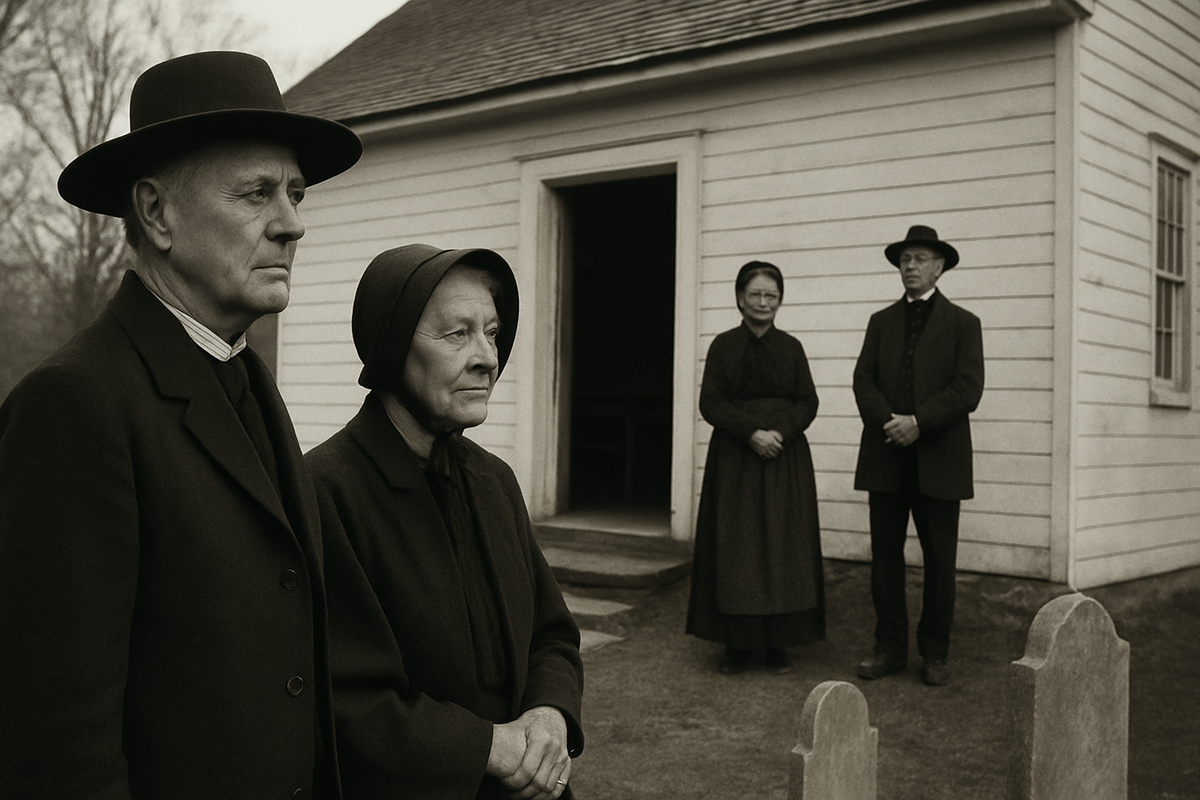
The issue's photographs delivered their own sermon. Quaker meetinghouses, stripped of ornamentation. Cemeteries with plain headstones, no angels or elaborate monuments. Friends in traditional dress—dark fabrics, no jewelry, nothing to announce wealth or rank.
These images worked as counterpoint to everything else in the magazine. Turn one page and you're staring at Quakers sitting in silence, waiting for the Spirit to move them. Turn another and there's a full-page ad for Studebaker's latest model, chrome gleaming, promising speed and status.
The contrast wasn't accidental. The Post understood its readers lived in both worlds—they wanted washing machines and radios, but they also sensed something hollow in pure materialism. The Depression had taught them that prosperity could evaporate overnight. Now war was teaching them that nations could incinerate their own futures.
The Quaker photographs offered an alternative ledger of value: conscience over consumption, community over competition, eternal principles over temporal power. For a nation about to pour its wealth into bombers and battleships, these images whispered a heretical question: What if we're building the wrong things?
The Post's Enduring Achievement
The Saturday Evening Post succeeded because it refused simplicity. It never pretended America was one thing—not purely idealistic, not purely commercial, not purely isolationist or interventionist. It was all of it, simultaneously, wrestling with contradictions every week.
The February 17, 1940 issue embodies this complexity perfectly. Between the battery ads and the Quaker meditation, between the humor columns and the war commentary, between Rockwell's visual myths and High's textual challenges, the magazine created space for Americans to think.
Today's media ecosystem—fractured, algorithmic, optimized for engagement over contemplation—makes the Post's achievement look almost impossible. A single publication holding the attention of millions across educational, economic, and ideological divides? Trusted by both readers who wanted escape and those who wanted enlightenment? It seems as distant as Quaker plain dress.
But the issues remain. Yellowed, fragile, increasingly rare—but readable. Tangible connections to the moment when Americans had to decide what they believed about power, violence, conscience, and sacrifice.
Why Collectors Pursue This Issue
Historical Pivot Point
This appears just months after September 1939, when most Americans still believed they could avoid European entanglement. Within eighteen months, Pearl Harbor would render that hope obsolete. The issue captures American idealism at its zenith—and on the edge of its destruction.
Religious & Social History
Mainstream publications rarely devoted serious space to small religious movements. High's article treats Quakerism not as curiosity but as legitimate moral challenge, making this essential source material for scholars of American religion, pacifist movements, and conscientious objection.
Complete Cultural Snapshot
Every page—ads, fiction, cartoons, commentary—reflects February 1940's assumptions about gender, race, class, and national identity. It's a time capsule sealed just before the world changed forever.
Cross-Disciplinary Appeal
Military historians want it for pre-war sentiment analysis. Peace studies scholars need it for pacifist discourse. Collectors of religious Americana prize it. Advertising historians study its consumer messaging. The issue satisfies multiple collecting categories simultaneously.
Original copies in good condition command premium prices precisely because they bridge the gap between mass circulation and historical significance. They were everywhere in 1940. Most were read to pieces, discarded, used for scrap drives. The survivors become increasingly valuable as primary sources.
The Conscience That Wouldn't Be Silenced
Stanley High's "100,000 Quakers May Be Right" should have been forgotten. A feature about a tiny religious minority, published on the eve of the largest military mobilization in human history—what possible relevance could it have?
But conscience has a way of outlasting armies. The Quakers High profiled went on to establish relief operations across war-torn Europe, rescue refugees, and rebuild shattered communities. Their witness to peace survived the war that was supposed to prove them wrong.
The magazine that carried their story to millions of Americans has also survived—not in libraries alone, but in private collections, antique shops, and estate sales. Each preserved copy represents someone who kept it, who saw in those pages something worth saving.
Maybe they saw what High saw: that the smallest voices sometimes speak the deepest truths. That faith can be stronger than firepower. That 100,000 people, armed with nothing but conscience, might indeed be right when empires are wrong.
In a world still wrestling with violence, still debating when war is necessary and when it's catastrophic, this 1940 issue continues to ask its subversive question: What if peace isn't weakness? What if it's the hardest thing of all?
For Collectors and Students of History
If you collect 20th-century Americana, World War II home front materials, religious history, or vintage journalism, the February 17, 1940 Saturday Evening Post belongs in your archive. It represents one of the last moments when a major publication could ask Americans to consider pacifism seriously—not as punchline, but as prophetic witness.
Whether you're building a research library, preserving family heritage, or assembling a collection that captures American culture at its most revealing moments, these magazines deliver something no database or PDF can match: the weight, texture, and immediacy of history as it was first recorded.
Browse The Saturday Evening Post Magazine Collection