
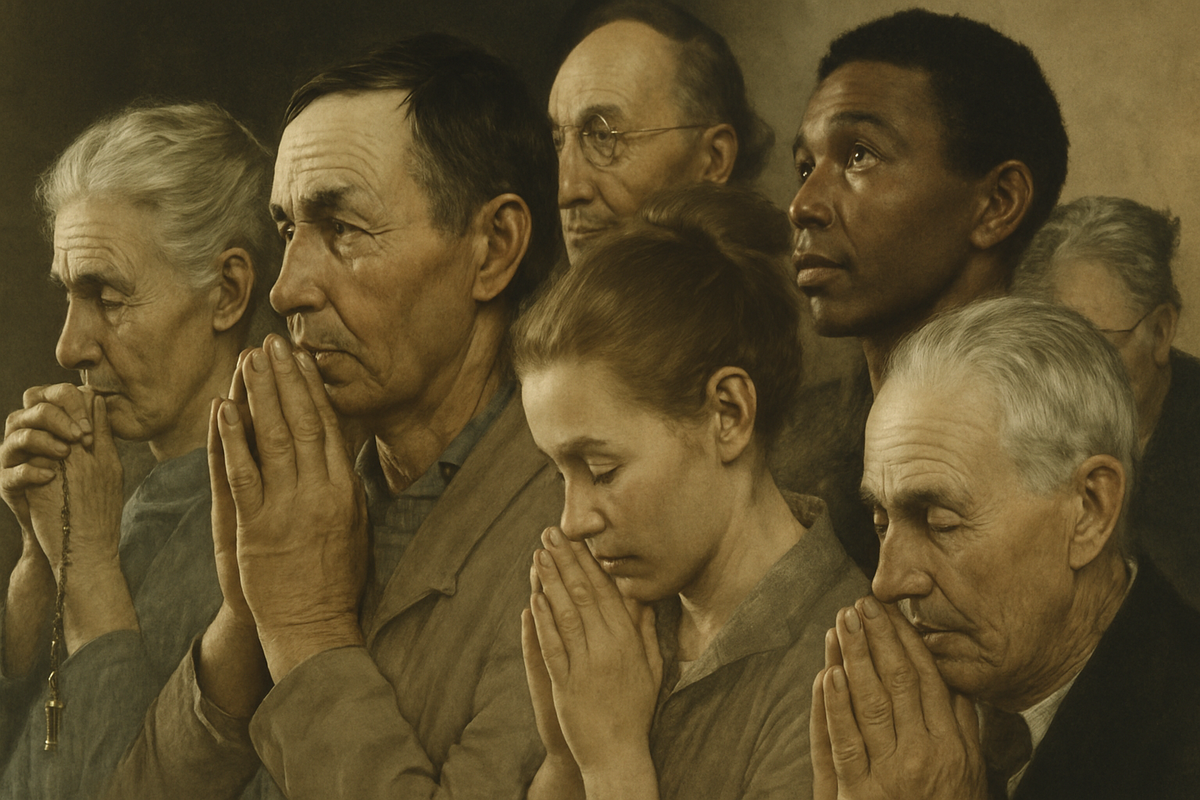
When America Held Its Conscience in Its Hands
Norman Rockwell's "Freedom of Worship" and the Saturday Evening Post issue that defined a nation at war
February 27, 1943. The magazine hit doorsteps across America while Soviet forces were still clearing rubble in Stalingrad, while Marines bled through Guadalcanal's jungles, while Jewish families vanished into the machinery of the Holocaust. That morning, millions of Americans opened The Saturday Evening Post and found themselves staring at something quieter than war news, yet somehow more urgent: Norman Rockwell's "Freedom of Worship."
No flags. No pulpits. No stained glass. Just faces—ordinary American faces bowed in prayer, each according to the dictates of their own conscience.
This was the second installment of Rockwell's Four Freedoms series, inspired by Franklin D. Roosevelt's 1941 State of the Union address. Paired with an essay by historian Will Durant, the issue arrived at a pivot point in the war—not just militarily, but morally. Nazi Germany was systematically erasing religious minorities. Authoritarian regimes worldwide were crushing dissent. Against that darkness, Rockwell and Durant offered a single, luminous proposition: that America's strength lay not in uniformity of belief, but in its protection of all belief.
The painting would become one of the most reproduced images in American history. But first, it was just ink on paper, delivered to kitchen tables on a cold winter morning in 1943.
Archive Details
Publication: The Saturday Evening Post
Issue Date: February 27, 1943
Featured Artist: Norman Rockwell
Featured Essay: Will Durant
Series: Four Freedoms (Second Installment)
Historical Context: World War II, Stalingrad aftermath, Holocaust
The War That Demanded Moral Clarity
By February 1943, the abstractions of 1941 had hardened into brutal reality. Americans endured rationing books, blackout curtains, and the ache of empty chairs at dinner tables. The war's outcome remained uncertain. What kept the nation's resolve wasn't just hatred of the enemy—it was Roosevelt's Four Freedoms, the ideals that gave shape to sacrifice.
Freedom of Worship carried particular weight. The Nazi regime had moved beyond persecution to industrialized extermination. In occupied territories, faith became grounds for execution. Meanwhile, The Saturday Evening Post—a magazine whose covers usually depicted small-town humor and Thanksgiving dinners—published an image that said: This is what we're defending. Not territory. Not economics. The right of a woman to clutch her rosary, of a man to bow his head, of another to clasp his hands in whatever manner his conscience dictates.
The juxtaposition was deliberate. While newsreels showed tanks and bombers, Rockwell showed stillness. While headlines screamed of casualties, his painting whispered of dignity. Durant's essay reinforced this: humanity's eternal search for meaning was under attack, and America's diversity of faith was not a liability to be managed but a strength to be celebrated.
The Saturday Evening Post: Mirror and Maker of America
Founded in 1821, The Saturday Evening Post had evolved into something unprecedented by 1943—a cultural force that reached into nearly every American home. Unlike newspapers chasing breaking news or literary journals serving intellectual elites, the Post spoke to the vast middle: factory workers and farmers, teachers and shopkeepers, the people whose sons were dying in North Africa and the Pacific.
The magazine's genius lay in its blend. Fiction from F. Scott Fitzgerald and Agatha Christie. Essays on politics and culture. Humor columns. And Rockwell's covers, which had been chronicling American life since 1916 with a precision that made the ordinary sacred.
The February 27, 1943 issue exemplified this alchemy. Readers didn't encounter propaganda—they encountered themselves. The faces in "Freedom of Worship" weren't celebrities or politicians. They were neighbors. The woman with the rosary could have been the Catholic schoolteacher down the street. The man with clasped hands might have worshipped at the Baptist church or the synagogue or nowhere at all.
This was the Post's particular magic: it made Roosevelt's Four Freedoms—grand presidential rhetoric—feel intimate. Personal. Worth dying for.
Anatomy of an Icon
Rockwell's compositional choices were radical in their simplicity. He stripped away everything decorative—no church architecture, no religious symbols beyond what individuals held in their hands, no indication of denomination. Just faces illuminated against darkness, each absorbed in private communion.
The painting's only text appeared in the background, almost as an afterthought: "Each according to the dictates of his own conscience." Those words, drawn from Roosevelt's address, transformed the image from sentimental to constitutional. This wasn't about piety. It was about rights.
Durant's essay, which accompanied the painting, elevated the stakes further. He traced humanity's universal impulse toward worship, then contrasted it with totalitarian attempts to control belief. His prose gave Rockwell's image its intellectual framework: freedom of worship wasn't a nice idea—it was a civilizational necessity, one that separated democracies from dictatorships.
Together, they created something unprecedented in American popular culture. While other magazines published battle maps and body counts, the Post published a moral argument so clear that even a child could grasp it, yet so profound that it resonated with the era's leading intellectuals.
The painting would later tour the country as part of a War Bond drive, helping raise over $132 million. But its primary power wasn't economic—it was emotional. It told Americans what they were fighting for, in a language that transcended politics.
The Elements That Made History
Ordinary Faces, Extraordinary Meaning
Rockwell chose not to depict churches or clergy but the people themselves, emphasizing that freedom of worship belongs to all. The anonymous faces transformed constitutional principle into lived experience.
Universal Language of Faith
A woman clutches a rosary, a man bows his head, another clasps his hands—gestures that transcend denomination. The painting spoke to Catholics, Protestants, Jews, and non-believers alike.
The Dictates of Conscience
The phrase in the background, "Each according to the dictates of his own conscience," crystallized Roosevelt's vision into plain words—a constitutional guarantee rendered visible.
Historical Urgency
As fascist powers suppressed religious minorities across Europe, the painting served as direct counterpoint: in America, diversity of faith was not weakness but strength, not problem but promise.
War Bond Connection
Like the other Four Freedoms paintings, "Freedom of Worship" toured America as part of the War Bond drive, helping raise over $132 million—proof that ideals could be translated into tangible support.
Durant's Intellectual Framework
The historian's accompanying essay elevated Rockwell's image from sentiment to philosophy, arguing that freedom of conscience separated civilization from barbarism, democracy from tyranny.
An Inheritance of Conscience
Eight decades separate us from that February morning in 1943, yet "Freedom of Worship" refuses to recede into mere history. Debates over religious liberty, tolerance, and the boundaries of conscience remain combustible. Rockwell's painting persists because it captured something beyond its moment: the recognition that belief—or non-belief—is among the most intimate expressions of human dignity.
The anonymous faces in that painting remind us that freedom of worship isn't performed in courtrooms or legislatures. It's lived in the quiet moment before prayer, in the choice to attend services or stay home, in the right to raise children according to one's convictions without state interference. Rockwell made the abstract constitutional.
For readers in 1943, this issue of The Saturday Evening Post offered reassurance that their sacrifices served ideals larger than victory itself. For us, it stands as evidence that some principles transcend politics and partisanship—that liberty of conscience, once won, must be eternally defended.
Why This Issue Commands Attention
Artistic Gravitas
Rockwell's Four Freedoms series ranks among the most important American artworks of the century. Original prints from these issues have become museum pieces. Owning the magazine that first published "Freedom of Worship" means possessing the artwork in its original context—not as a poster or reproduction, but as it was meant to be experienced.
Historical Urgency
This issue arrived when victory was far from certain. It captured not hindsight, but real-time conviction. The stakes were existential, and every page reflects that.
Cultural Completeness
The pairing of Rockwell and Durant elevated the issue beyond illustration. It was art criticism, philosophy, and civic education compressed into a mainstream magazine format—an achievement rarely matched in American publishing.
Collector Demand
Four Freedoms issues consistently rank among the most sought-after Saturday Evening Post editions. Condition matters, but even well-read copies carry weight because they were used—read at kitchen tables, passed between neighbors, absorbed into the national consciousness.
Hold History in Your Hands
Original Saturday Evening Post magazines from the 1940s offer something digital archives cannot: the texture of history. The paper stock, the advertisements for war bonds and Lucky Strikes, the smell of eight decades—these aren't incidental. They're part of the artifact's meaning.
Our collection spans the magazine's golden age, from Depression-era covers through the Civil Rights movement. Each issue is a window into how Americans understood themselves at a particular moment—not through the lens of historians, but in real time.
Browse The Saturday Evening Post Magazine CollectionA Declaration in Newsprint
The February 27, 1943 Saturday Evening Post wasn't content to report the war—it explained what the war meant. Through Rockwell's brush and Durant's prose, it articulated American democracy's central promise: that conscience belongs to the individual, not the state.
Holding this issue today is like holding a piece of the nation's moral architecture. It's both time capsule and timeless argument, both artifact of 1943 and ongoing reminder that freedom, once secured, requires each generation to defend it anew.
The faces in Rockwell's painting still look out at us, asking the same question Americans asked themselves in 1943: What are we willing to sacrifice to preserve the right to believe—or not believe—according to our own conscience?
The answer, then and now, determines everything.