
When Ric Flair Lost Everything
The Magazine That Froze Wrestling's Most Dangerous Moment
The cover didn't need to scream. By January 1988, wrestling fans already knew: Ric Flair had been dethroned, humiliated, and stripped of the one thing that defined him. Inside Wrestling didn't just report the story—it dissected the wound.
This wasn't a championship change. It was a public execution stretched across six months, captured in black-and-white fury, and sold on newsstands for $2.50. The January 1988 issue documented the Flair-Garvin war not as sports journalism but as psychological warfare frozen in print. For fans who lived through it, this magazine was proof. For collectors today, it's a relic of the last era when wrestling feuds were mythology you could hold in your hands.
The Fall of the Nature Boy
Ric Flair had held the NWA World Heavyweight Championship since August 9, 1986—a reign built on silk robes, blood, and the arrogance of a man who believed the belt was his birthright. Then Ronnie Garvin locked him in a cage in Detroit and took it all away.
Garvin wasn't Dusty Rhodes. He wasn't Harley Race. He wasn't even a member of the Four Horsemen's orbit. He was an outsider who didn't want to beat Flair—he wanted to erase him. Inside Wrestling captured Flair's response in his own words: Garvin had robbed him of his "dream date" as champion, the career-defining reign that was supposed to cement his legacy.
The magazine framed the feud with surgical precision. Lex Luger urged Flair to stay calm. Tully Blanchard warned that Garvin wasn't interested in competition—he was obsessed with running Flair out of the sport entirely. These weren't just quotes. They were the testimonies of men watching their leader unravel.
Archive Documentation
Publication: Inside Wrestling, January 1988
Featured Story: "NWA Title Turmoil: Ric Flair & Ronnie Garvin Must Settle Their War at Starrcade!"
Championship Reign: August 9, 1986 – September 1987 (Detroit cage match)
Culminating Event: Starrcade '87
Historical Context: Six-month feud, unusually extended for the territory era
The Storytelling Architecture of Inside Wrestling
Inside Wrestling operated in the space between kayfabe and reality, where every feud felt like biblical drama and every photograph looked like evidence from a crime scene. The January 1988 feature—"NWA Title Turmoil: Ric Flair & Ronnie Garvin Must Settle Their War at Starrcade!"—exemplified the magazine's formula: stark black-and-white photography, captions that amplified emotion over technique, and prose that treated wrestlers as gladiators rather than athletes.
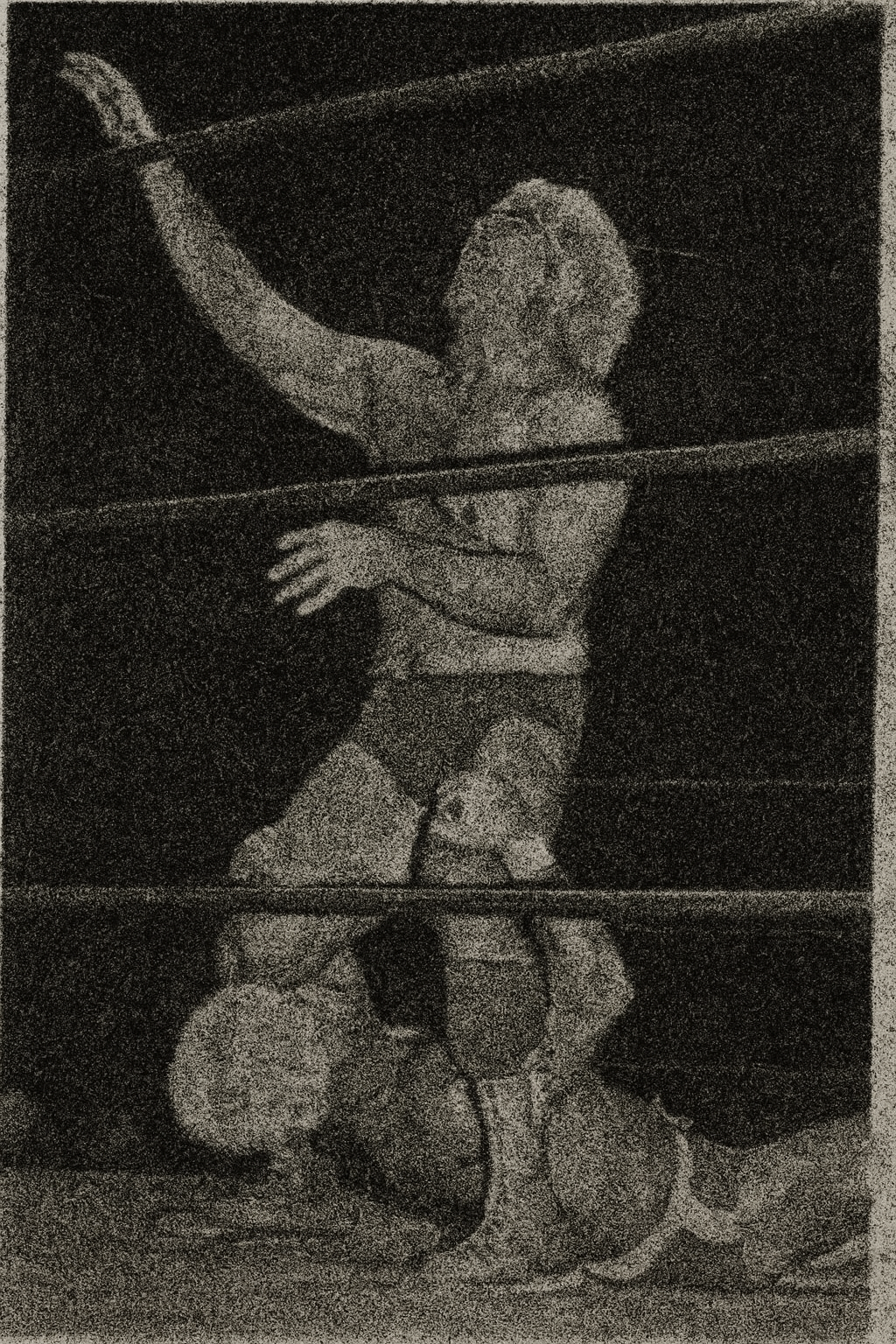
One image shows Garvin forcing Flair into the turnbuckle, all brute force against champagne arrogance. Another captures Flair resisting a sunset flip, desperation etched into every muscle. The most symbolic: a referee prying Garvin off a leg hold, the rules themselves bending under the weight of their hatred.
This wasn't WWE Magazine's glossy promotional spin. Inside Wrestling gave fans the illusion of seeing backstage, of witnessing the raw struggle beneath the spotlight. The writing matched the brutality: Flair in "absolute rage," Garvin "merciless" and satisfied by humiliation. The magazine understood that wrestling wasn't about winning—it was about survival.
Six Months of Escalation
The feud stretched from summer through winter, unusually long for the territory era when champions moved between cities every few weeks. Inside Wrestling tracked every beat: Flair's shock at losing, Garvin's refusal to grant a rematch, the Horsemen's attempts to intervene, and the pressure building toward Starrcade '87—the NWA's annual supercard, the only stage worthy of ending their war.
The magazine positioned Starrcade not as a wrestling event but as a reckoning. Two men. One belt. No excuses. The coverage didn't spoil the outcome—it didn't need to. The tension was the product.
The Magazine as Time Capsule
In 1988, this was how stories lived between television broadcasts. Fans didn't stream matches on demand or follow wrestlers on social media. They bought Inside Wrestling, studied every photograph, debated every editorial with friends, and felt like insiders to a world that existed half in reality, half in performance.
The magazine's survival matters because wrestling history is fragile. Territories folded. Tape libraries were erased. Wrestlers died young. But these magazines—printed on cheap paper, sold in grocery stores, dismissed as trash culture—endured. They captured not just the facts of feuds but the emotions, the rhythms, the way stories were told when wrestling was still territorial mythology.
Flipping through the January 1988 issue today is not nostalgia. It's archaeology. Every caption, every photo angle, every hyperbolic headline reveals how wrestling storytelling worked before McMahon consolidated the industry. It's a record of regional identity, kayfabe preservation, and the magazine industry that sustained wrestling's cultural presence outside the arena.
Why This Issue Matters to Collectors
Historical Inflection Point
Documents the rare moment when Flair was the hunter, not the champion. Most of his career is defined by defending the throne. This issue captures him as the desperate pretender, making it essential for understanding his complete narrative arc.
Cultural Artifact
The Flair-Garvin feud remains a touchstone for 1980s NWA storytelling—a rare instance when a non-Horsemen challenger held the belt and Flair's invincibility cracked. The magazine's coverage shapes how the feud is remembered.
Visual Archive
Wrestling television from this era is fragmented, taped over, or lost. These black-and-white photographs preserve moments that may not exist anywhere else: specific ring sequences, crowd reactions, referee interventions.
Starrcade Documentation
Issues tied to major events carry premium value. This magazine doesn't just promote Starrcade '87—it contextualizes the stakes, making it essential reading for anyone studying the show's legacy.
Preservation as Legacy
The January 1988 Inside Wrestling stands as more than memorabilia. It's a primary source for understanding how the NWA World Heavyweight Championship was presented to fans at its commercial peak, how Ric Flair's mythology was constructed and challenged, and how wrestling journalism shaped audience perception before the "smart fan" era.
For collectors, historians, and anyone who understands that wrestling's power comes from storytelling as much as athleticism, this issue isn't just a magazine. It's evidence that the war between Flair and Garvin mattered—not because of who won at Starrcade, but because for six months, it consumed wrestling's universe completely.
Explore the Archive
Browse decades of wrestling history preserved in original Inside Wrestling magazines—from Flair's rivalries to the feuds that defined the territorial era.
Browse Inside Wrestling Magazine CollectionWhether you're completing a collection, researching the territory era, or preserving wrestling's paper trail, these magazines represent the last generation of wrestling media that treated feuds as epic literature.