
The Photograph That Changed Everything
When Cassius Clay and Malcolm X Stood Side by Side
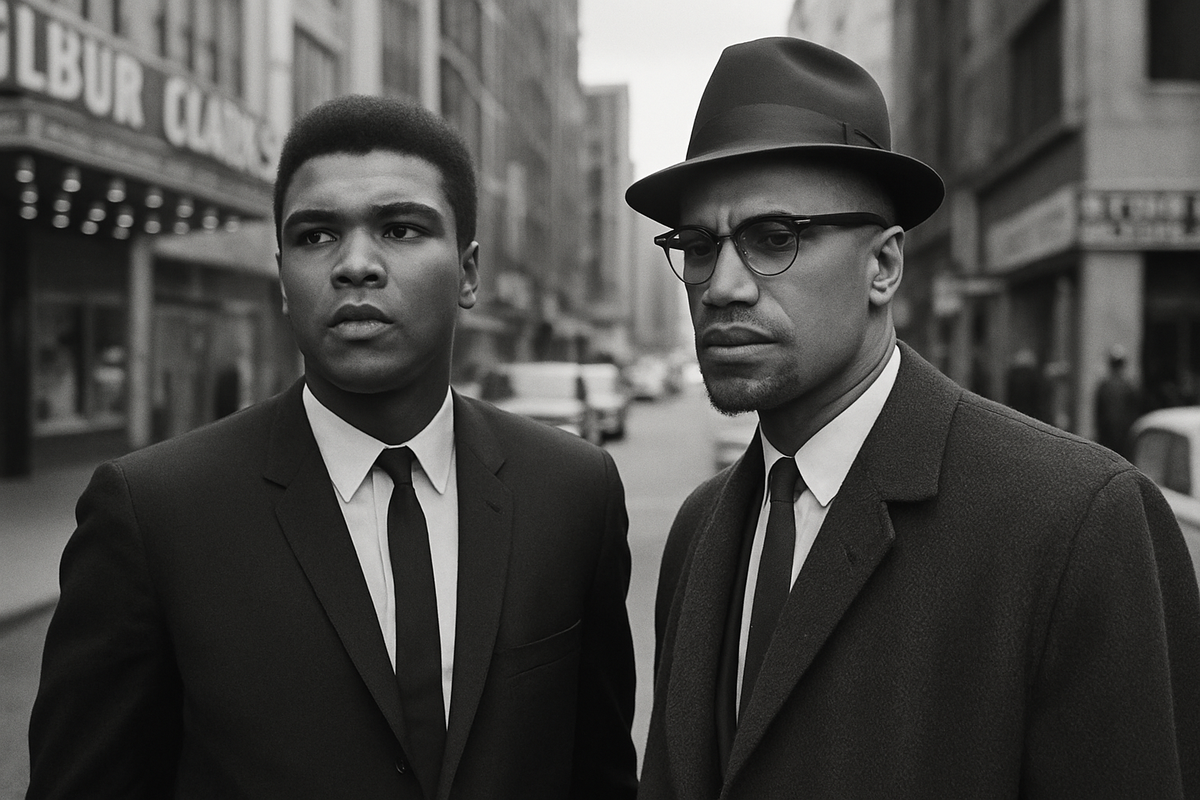
March 26, 1964. African Americans across the country opened their mailboxes to find a magazine cover that would become one of the most incendiary images in sports history. There, in stark black and white with bold red Jet branding, stood two men whose alliance would last mere weeks but whose impact would reverberate for generations: Cassius Clay, the new heavyweight champion of the world, and Malcolm X, the Nation of Islam's most electrifying voice.
The question blazed across the cover: "Will link with Malcolm X hurt Cassius Clay's boxing career?"
It was the wrong question. What Jet readers understood—and what mainstream white newspapers missed entirely—was that Clay wasn't calculating his career. He was staking his soul.
Archive Details
Historical Figure: Cassius Clay (Muhammad Ali) & Malcolm X
Issue Date: March 26, 1964
Archive Source: Jet Magazine
Historical Context: Weeks after Clay's upset victory over Sonny Liston, during his public alignment with the Nation of Islam
A Nation at the Breaking Point
February 1964 had delivered the upset of the century. Cassius Clay, a 22-year-old Louisville native with a mouth as fast as his fists, had demolished Sonny Liston, the most feared heavyweight since Joe Louis. Boxing experts had predicted Clay's destruction. Instead, Liston—exhausted, battered, and bewildered—refused to answer the bell for the seventh round.
But Clay's knockout came after the final bell. Days later, he confirmed what rumors had been whispering: he was a member of the Nation of Islam. He would soon shed his "slave name" for Muhammad Ali. And he was willing to sacrifice every dollar of his future earnings to stay true to his faith.
The year 1964 was fracturing America along every fault line. Freedom Summer organizers were preparing to flood Mississippi. The Civil Rights Act was weeks from passage. Martin Luther King Jr. preached nonviolent resistance while the Nation of Islam offered something sharper: Black pride, economic independence, and refusal to beg white America for dignity.
Clay—brash, beautiful, and utterly uncompromising—had chosen his side.
What White Newspapers Wouldn't Print
Mainstream sports pages treated Clay's conversion as a scandal or a publicity stunt. They mocked his confidence. They questioned his intelligence. They portrayed Malcolm X as a sinister puppet master manipulating a naive athlete.
Jet Magazine told a different story.
Founded in 1951 by John H. Johnson, Jet had become the heartbeat of Black America. Its pocket-sized format fit in a purse or back pocket, traveling from barbershops to church pews to kitchen tables. Where white newspapers buried or distorted Black achievement, Jet put it on the cover. Where others saw scandal, Jet saw history being written.
The March 26, 1964 issue didn't flinch from controversy—it leaned into it. The magazine let Clay speak in his own voice, unfiltered and unapologetic. It documented his $20,000 public challenge: anyone who could disprove Elijah Muhammad's teachings could claim the cash. It quoted him declaring he was "more preacher than boxer," willing to abandon $15 million in future purses if staying meant compromising his beliefs.
"I'm happy that money is not my God," Clay told Jet.
This wasn't an athlete hedging his bets. This was a man drawing a line.
The Cover That Captured a Disappearing Moment
The photograph itself was prophetic. Clay and Malcolm X, photographed together just weeks before their friendship would shatter, represented a convergence that couldn't last. Malcolm was already drifting from the Nation of Islam, having grown disillusioned with Elijah Muhammad's leadership. His formal break came in March 1964—the same month this issue hit newsstands. Less than a year later, he would be assassinated.
The image captures them frozen at the crossroads: Malcolm, the seasoned revolutionary, and Clay, the young champion stepping into his destiny. It's a document of possibility, alliance, and impending fracture.
Jet's format amplified the power of such moments. Bold covers demanded attention at newsstands. Inside, the magazine combined sharp reporting, striking photography, and cultural commentary that refused to sanitize Black life for white comfort. Clay wasn't reduced to his arrogance or antics. He emerged as a young man wrestling with faith, loyalty, and identity—the same crucible confronting millions of African Americans in 1964.
What the Issue Revealed
Beyond the explosive cover, Jet documented details that painted a fuller portrait:
Each detail reinforced what Jet understood: Clay wasn't performing. He was leading.
The Legacy of Witness
Jet never claimed to be neutral. It claimed to be honest. Just as earlier issues had shown Martin Luther King Jr. in a Birmingham jail cell and covered Medgar Evers's assassination, this issue showed a young athlete becoming something larger than sports could contain.
Clay's refusal to conform made him a hero to some, a threat to others. But Jet preserved the moment without distortion, giving Black readers an authentic record of their own history while white newspapers trafficked in caricature.
Flipping through those pages today feels like touching a live wire from 1964. The urgency hasn't faded. The questions Clay faced—about identity, sacrifice, and the cost of principle—still burn.
Why This Issue Matters to Collectors
Historical Timing
Published during the narrow window when Clay and Malcolm's alliance was public knowledge but not yet shattered. Within months, Malcolm would be dead. Within years, Muhammad Ali would be stripped of his title for refusing induction into the Vietnam War.
Cultural Significance
The cover featuring Clay and Malcolm X side by side captures a fleeting moment before their friendship fractured. Such images became instantly rare and poignant after Malcolm's assassination in February 1965.
Civil Rights Context
Documents the intersection of sports, religion, and the Black freedom struggle at its most volatile moment. This issue captured the spark before the explosion.
Collector Demand
Issues featuring Ali's early Nation of Islam years are among the most sought-after in the entire Jet archive. This one—with Malcolm X prominently featured—is rarer still.
Add This Historic Issue to Your Collection
The March 26, 1964 Jet Magazine represents a convergence that will never occur again: Muhammad Ali at the beginning of his journey, Malcolm X at the end of his, and the Black freedom struggle at its most explosive moment.
Browse Jet Magazine CollectionThe Artifact That Won't Fade
The March 26, 1964 issue of Jet Magazine isn't memorabilia. It's testimony.
It documents the courage to believe, speak, and risk everything for dignity—not as mythology, but as it unfolded in real time. For readers in 1964, this was a lesson in defiance. For us today, it's proof that some moments are too important to let slip into memory alone.
Owning this issue means holding a piece of Ali's transformation from brash boxer to global icon, preserved by the only publication bold enough to tell the story as it truly happened.
Thanks to Jet, that journey remains alive—and urgent—for every generation that follows.