
The Architect of Armageddon
Inside Time's Gripping Portrait of McNamara at the Nuclear Brink
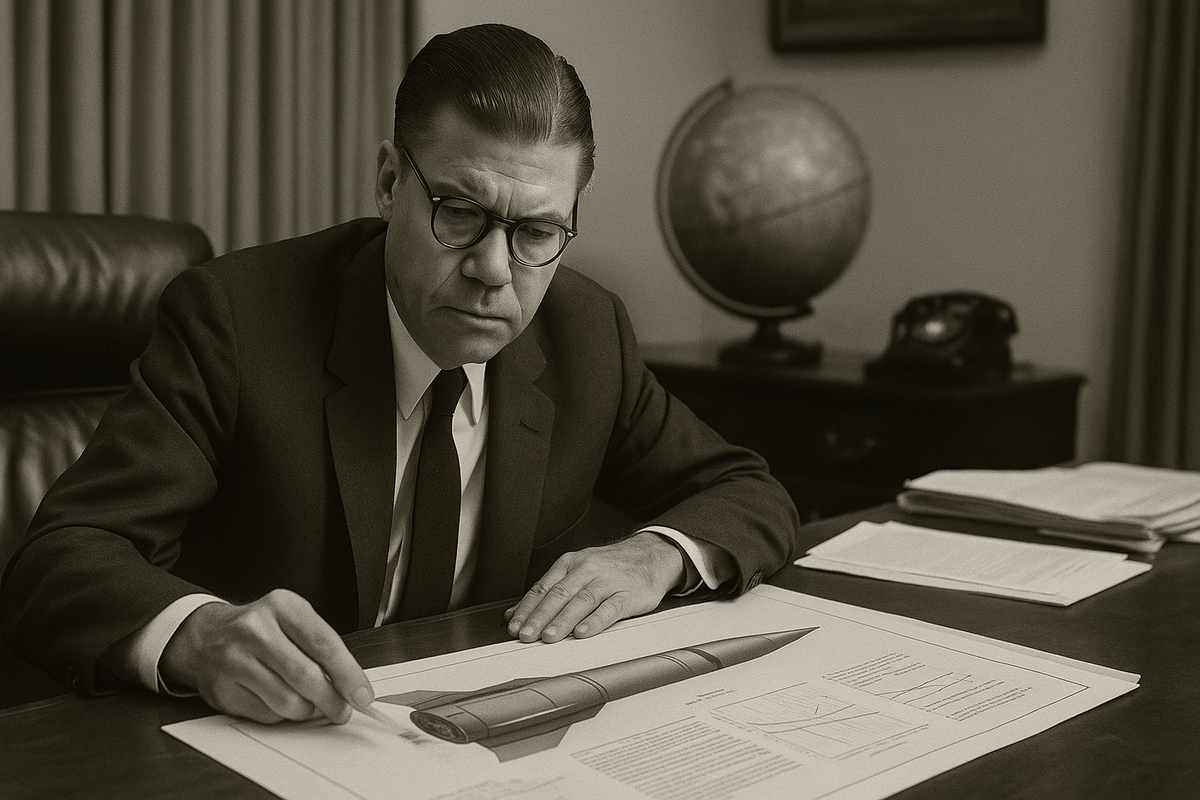
Robert McNamara sat at his Pentagon desk in February 1963, surrounded by missile trajectory charts and reconnaissance photographs of Soviet installations in Cuba. Four months earlier, the world had nearly incinerated itself. Now Americans wanted answers: How close had we actually come? Who was steering us through the atomic fog? And could cold mathematics really prevent hot war?
Time Magazine's answer arrived on newsstands February 15, 1963, with McNamara's severe, calculating face staring from the cover. The feature inside—"Defense: The Dilemma & the Design"—was not routine Cold War reporting. It was an autopsy of the Cuban Missile Crisis and a blueprint for survival, delivered while the nuclear shadow still stretched across American lawns.
For millions of readers that winter morning, this issue translated the most terrifying abstraction of the age into something concrete: the defense secretary as chess master, America's nuclear arsenal as his pieces, and the Soviet Union as an opponent who had just been forced into retreat. The stakes could not have been clearer. One miscalculation, one failure of nerve or reason, and cities would vanish.
Archive Details
Historical Figure: Robert McNamara, U.S. Secretary of Defense
Issue Date: February 15, 1963
Feature Title: "Defense: The Dilemma & the Design"
Historical Context: Published four months after the Cuban Missile Crisis
Archive Source: Time Magazine Original Issue
The Aftermath That Wouldn't End
October 1962 had rewritten the rules. Kennedy's showdown with Khrushchev over Soviet missiles in Cuba ended with Moscow backing down, but the crisis revealed how rapidly diplomacy could collapse into annihilation. By February, the immediate danger had passed—yet Soviet troops remained in Cuba, their installations hardened, their intentions opaque. Pentagon briefings and reconnaissance flights kept the White House grimly informed.
The deeper question haunted Washington: Was "massive retaliation"—the doctrine promising total nuclear response to any Soviet aggression—still credible? Or was it a suicide pact masquerading as strategy? McNamara had staked his reputation on an answer: flexible response. Graduated options. Controlled escalation. The application of military force as a scalpel, not a sledgehammer.
Time's coverage captured this intellectual revolution in American defense thinking. The magazine explained how McNamara was dismantling the old orthodoxy, replacing reflexive annihilation with calibrated deterrence. It was Cold War poker played with hydrogen bombs, and readers could see the chips stacking up: Polaris submarines prowling beneath the Atlantic, Minuteman missiles buried in Midwestern silos, Strategic Air Command bombers circling the Arctic around the clock.
When a Newsweekly Became a War Room Briefing
Time Magazine in 1963 commanded unmatched cultural authority. Its circulation exceeded millions, its photography was arresting, and its editorial voice shaped how Americans understood their world. The February 15 issue deployed every tool in that arsenal.
The layout itself told a story. McNamara studying diagrams. Missiles erupting from underground silos. Polaris submarines breaching the surface. Troops training for jungle warfare (a detail that would prove grimly prophetic). These weren't decorative images—they were visual evidence that Cold War strategy had moved beyond theory into operational reality.
The writing matched the urgency. Time's reporters dissected the nuclear triad, explained throw-weight and megaton yields, and made NATO anxieties legible to readers in Iowa and Oregon. They showed how Charles de Gaulle's France, skeptical of American nuclear guarantees, was building its own force de frappe. They revealed tensions between overwhelming deterrence and limited war, between allied solidarity and national sovereignty.
Most crucially, they profiled McNamara not as a warrior but as an engineer of survival—a man who brought Ford Motor Company efficiency metrics to the calculus of mutual assured destruction. Logic. Data. Mathematical models. These were his weapons against chaos.
The Cover That Defined an Era
Time's cover was surgical in its symbolism. McNamara's face, unsmiling and analytical, suggested neither warmth nor ideology—only calculated reason applied to apocalyptic risk. The editorial choice was deliberate: this was not a politician selling hope or fear. This was a technocrat managing the unmanageable.
Inside, the visual narrative reinforced that message. Charts illustrated force levels and missile ranges. Photographs documented hardware—the instruments of planetary death rendered in crisp black and white. The aesthetic was neither triumphalist nor pacifist. It was explanatory, almost clinical, as if readers were being walked through a classified briefing on their kitchen tables.
That tone mattered. Americans in 1963 lived with nuclear anxiety as ambient dread. Fallout shelters in backyards. Duck-and-cover drills in schools. Civil defense pamphlets explaining what to do when (not if) the sirens wailed. Time offered something between reassurance and realism: Yes, the danger is real. Yes, the arsenals are vast. But look—we have a plan, and we have this man running it.
What the Issue Actually Revealed
Time delivered granular detail that still startles:
The Cuban Residue
Soviet military personnel and installations remained entrenched months after the crisis, requiring constant U.S. surveillance and contingency planning.
McNamara's Doctrinal Revolution
The shift from automatic nuclear retaliation to flexible response meant Pentagon planners now gamed out conventional warfare, limited nuclear strikes, and graduated escalation scenarios.
European Fractures
NATO's unity was cosmetic. France insisted on independence from American nuclear decision-making. West Germany worried about being the battlefield.
The Hardware Catalog
Polaris submarines carrying 16 missiles each. Minuteman ICBMs with one-megaton warheads. B-52 bombers on airborne alert, crews trained to fly toward Soviet targets until recalled.
Perhaps most revealing was the portrait of McNamara himself—a man who quantified everything. Cost-benefit analyses applied to human survival. A defense secretary who calculated probable casualties from nuclear exchange the way he once calculated automotive production efficiency. Cold? Perhaps. Necessary? Time seemed to think so.
Where Journalism Meets Artifact
The best vintage magazines transcend their moment without losing their moorings in it. They speak both to their own era and to ours, revealing continuities and ruptures in how we think about power, danger, and survival.
Time's McNamara issue does exactly that. It shows us Cold War logic at its apex—rational, calibrated, terrifyingly fragile. It documents the moment America shifted from threatening everything to threatening precisely what was necessary. Whether that shift made the world safer or simply made annihilation more thinkable remains debated.
What's undeniable is the historical record these pages preserve. McNamara's technocratic confidence. Kennedy administration doctrine taking shape. Public anxiety seeking expert reassurance. The nuclear age trying to understand itself before the next crisis arrived.
Why Collectors Prize This Issue
Impeccable Timing
Published in the immediate wake of humanity's closest brush with nuclear war, it documented how American leadership processed near-catastrophe.
McNamara's Centrality
His role in both the Kennedy administration's nuclear strategy and the subsequent Vietnam disaster makes any primary source about him historically valuable.
Visual Documentation
The photographs, layouts, and editorial choices preserve how Cold War reality was packaged for mass consumption.
Primary Research Material
For historians researching 1960s defense policy, this is essential source material that captures thought in formation, not hindsight.
Access the Archive
Our collection spans original Time magazines from the 1920s through the late 20th century—decades of politics, war, culture, and transformation preserved as they were first reported.
Browse Time Magazine CollectionThe Document That Still Speaks
The February 15, 1963 Time Magazine remains essential Cold War reading. Its portrait of McNamara and his nuclear dilemma offered Americans both comfort and confrontation—the reassurance of rational planning, the sobering reality of how thin the margin for error had become.
Six decades later, that tension persists. How do we manage catastrophic risk? When does rationality become its own kind of madness? Can spreadsheets and missile counts really prevent civilizational collapse?
Time's 1963 answer was embodied in one man at one desk, making calculations that entire populations would live or die by. The magazine captured him at that pinnacle—before Vietnam, before disillusionment, before history rendered its verdict. What remains is the snapshot: February 1963, the world still intact, the architect of deterrence at work, and America trying to believe that logic could save us from ourselves.