
When Teen Idols Built Orphanages: The Untold Story of 1950s Fan Club Activism
How American teenagers turned celebrity worship into charitable warfare—and why the March 1959 issue of Teen Magazine proves fandom was always political
Open the March 1959 issue of Teen Magazine and you won't find what you expect.
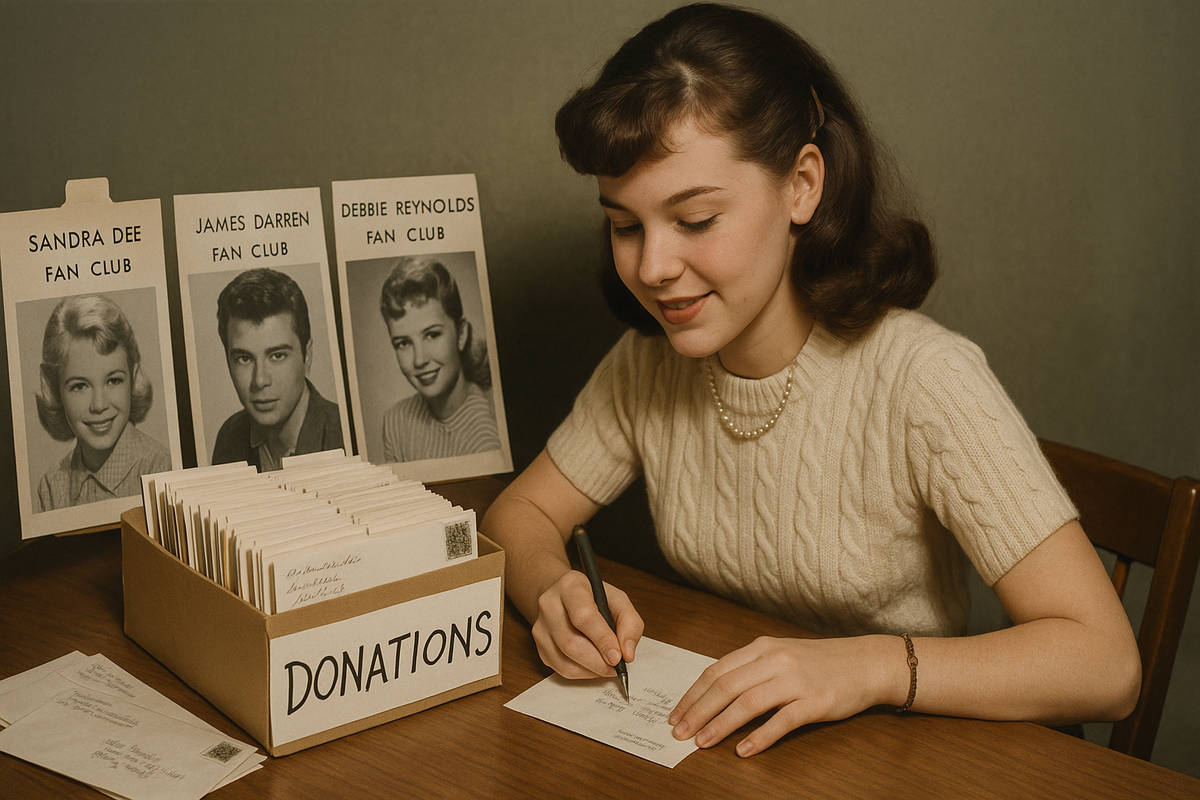
Yes, there are the requisite glossy spreads of Sandra Dee and James Darren in Gidget, the film that would make surfboards a suburban obsession. Yes, there's fashion advice and celebrity gossip. But tucked inside is something far more radical: evidence that American teenagers—dismissed then as now as vapid consumers—were running sophisticated charitable operations through their fan clubs.
Eddie Colbert's feature "FANtabulous" reads like a dispatch from an alternate timeline. The Jerry Lewis Club wasn't just collecting autographs; they were funding Muscular Dystrophy research through coordinated drives and dances. The Debby Murray Club organized Christmas food baskets for struggling families. The Rebel Jason Club collected toys for poor children. And most remarkably, Roxanne Adams's World Adoption Club pooled allowance money to support children abroad, fund a rest home, and bankroll a hospital—earning endorsements from stars like Jane Russell and Hugh O'Brian.
This wasn't charity as performance. It was fandom weaponized for good.
Archive Context
Publication: Teen Magazine
Issue Date: March 1959
Featured Article: "FANtabulous" by Eddie Colbert
Cover Stars: Sandra Dee, James Darren, Debbie Reynolds
Historical Significance: Documents organized youth activism and the charitable infrastructure of 1950s fan culture
The Economic Power of the Teenage Dollar
The 1950s invented the teenager as we know it. For the first time in American history, young people commanded serious purchasing power—and marketers knew it. Publications like Teen didn't just report on youth culture; they constructed it, selling readers an identity built on Hollywood glamour, fashion codes, and carefully curated aspiration.
But the decade's sunny reputation obscures a more complex truth. These were Cold War children, raised on civil defense drills and the ever-present threat of nuclear annihilation. Organizations like the March of Dimes and CARE didn't just ask for donations—they framed citizenship itself as active participation in alleviating suffering. Teen culture absorbed this message, and fan clubs became the delivery mechanism.
The Jerry Lewis Club's Muscular Dystrophy campaigns and the coordinated CARE package drives (members each donated $10—real money in 1959) weren't peripheral activities. They were central to how these organizations defined themselves. Fandom became a vehicle for what we'd now call social responsibility, decades before corporate PR departments colonized the term.
The Architecture of Influence
Teen Magazine understood something crucial: celebrity could be leveraged. The March 1959 issue demonstrates this with surgical precision.
Sandra Dee and James Darren's Gidget photo spread arrives alongside Debbie Reynolds in The Mating Game—not as distant icons, but as accessible role models. The magazine's genius was creating a feedback loop: stars inspired fan clubs, fan clubs did charitable work, and Teen documented it all, giving readers a blueprint for mattering.
Roxanne Adams's World Adoption Club represents the apex of this model. By securing Jane Russell and Hugh O'Brian's endorsements, Adams created something hybrid—part grassroots organization, part celebrity-backed NGO. It was proto-influencer activism, built on mimeographed newsletters and stamp money instead of Instagram stories and Patreon.
The magazine's interactive elements—puzzles like "LOOKEE! LOOKEE! LOOKEE!" and fan newsletters such as "Al's Album"—reinforced the message: you're not just reading this, you're part of it. Consumption was participation, and participation meant responsibility.
The Magazine as Time Capsule
What makes the March 1959 issue collectible isn't just its contents—though Sandra Dee's star power and the Gidget tie-in certainly help. It's what the issue documents: the moment when organized fandom emerged as a cultural and civic force.
The subscription inserts, the charity drive announcements, the fan club addresses—this is ephemera in the truest sense. It captures infrastructure that was never meant to last, making each surviving complete issue a primary source for understanding how youth culture organized itself before the internet made everything simultaneous and permanent.
Collectors and historians prize this issue because it challenges received narratives. The 1950s teenager, so often reduced to poodle skirts and sock hops, appears here as something more complicated: earnest, organized, and convinced that screaming for James Darren and funding polio research weren't contradictory impulses.
Why This Magazine Matters Now
We live in the age of stan culture, where fandoms move markets and topple executives. We understand, intuitively, that devotion can be marshaled toward social ends—whether that's funding billboards for a K-pop group or organizing voter registration drives for a celebrity's political cause.
The March 1959 Teen proves this isn't new. It's ancestral.
These newsletters and charity drives were analog precursors to GoFundMe campaigns and Twitter activism. The World Adoption Club's pooled resources prefigure Kickstarter. The Jerry Lewis Club's coordinated fundraising looks like a beta test for modern nonprofit strategy.
What we've lost, perhaps, is the synthesis. Today's fandom activism often feels reactive, crisis-driven, a pressure valve for parasocial intensity. The 1950s model was structural—fan clubs built charity into their identity from inception. It was assumed that if you loved a star, you'd work to improve the world in their name.
Collector Significance
Documents the formalization of fan culture at a pivotal moment, before Beatlemania rewrote the rules entirely
Sandra Dee, James Darren, and Debbie Reynolds were at their commercial peak. Gidget alone makes this issue significant to surf culture historians
"FANtabulous" is a rare primary source on how youth organizations blended entertainment and activism, a narrative largely absent from scholarship on the period
Complete issues with intact puzzles, inserts, and fan club addresses are increasingly scarce. These weren't meant to be archived; they were meant to be consumed, cut up, passed around
Proof that generosity and social consciousness were baked into teen identity long before Woodstock or Earth Day made youth activism a media spectacle
Explore the Full Archive
From the charity-driven fan clubs of the 1950s to MTV coverage of the 1980s, Teen Magazine didn't just reflect youth culture—it helped create it. Each issue is an artifact of fashion, music, movies, and the values that shaped American teenagers for three decades.
Browse Teen Magazine Collection