
When Fashion Stopped Apologizing: Inside Vogue's Blueprint for the 1970s
How the February 15, 1970 issue codified a decade of change—and became one of the most collectible fashion documents in history
The woman who opened Vogue on February 15, 1970 wasn't just browsing spring collections. She was holding a manifesto.
Fifty-five years later, this single issue remains one of the most significant fashion documents of the twentieth century—not because it predicted trends, but because it codified them. Navy-and-white knit ensembles shot in high-contrast black and white. DuPont Dacron polyester advertised as the fabric of liberation. Jane Fonda's "shaggy and terrific" haircut presented as the new standard of beauty. Liza Minnelli positioned as the face of bold, unapologetic femininity.
This wasn't aspiration. This was instruction.
For collectors and cultural historians, the February 15, 1970 issue stands as a hinge point—the moment American fashion journalism pivoted from the chaos of the 1960s toward something leaner, sharper, and more confident. What makes it collectible isn't nostalgia. It's precision.
Issue Details
Publication: Vogue Magazine
Issue Date: February 15, 1970
Cultural Context: Early 1970s—Women's Liberation Movement, Fabric Innovation Era
Featured Icons: Jane Fonda, Liza Minnelli
Archive Significance: Primary source documentation of fashion's transition from 1960s counterculture to 1970s modernism
The Cultural Coordinates: 1970 as Inflection Point
By February 1970, the convulsions of the previous decade—civil rights upheaval, antiwar fury, countercultural revolt—had burned themselves into exhaustion. What remained was a society searching for consolidation.
Women's liberation wasn't theoretical anymore. It was organizational. The National Organization for Women had filed sex discrimination lawsuits. Title IX was two years away. More women were entering law schools, boardrooms, and newsrooms than ever before. Fashion responded accordingly: streamlined silhouettes, professional polish, clothes built for movement rather than display.
Simultaneously, the textile industry was undergoing a technological revolution. DuPont's synthetic fabrics promised wrinkle-resistance and durability—a democratization of elegance. For the first time, a working woman could own a $100 knit dress-and-coat ensemble that functioned like couture but washed like cotton.
Celebrity culture was shifting too. Jane Fonda—antiwar activist, fitness icon, actress—embodied a new archetype: beauty as agency rather than passivity. Liza Minnelli's theatrical boldness signaled that glamour could be eccentric, personal, confrontational. Vogue didn't just photograph these women. It positioned them as avatars of a cultural realignment.
Even the beauty pages reflected globalization. Japanese loofahs. European skincare techniques. American fashion was shedding its insularity, absorbing influences that would define the next two decades.
The February 15 issue landed at precisely this intersection. It wasn't commentary about change. It was the change, documented in real time.
Vogue as Institution: Why This Magazine Mattered
By 1970, Vogue wasn't merely a fashion magazine. It was the arbiter. Under the editorial vision of Diana Vreeland and her successors, the publication had transformed itself into something closer to a lifestyle manifesto—fashion as philosophy, clothing as cultural argument.
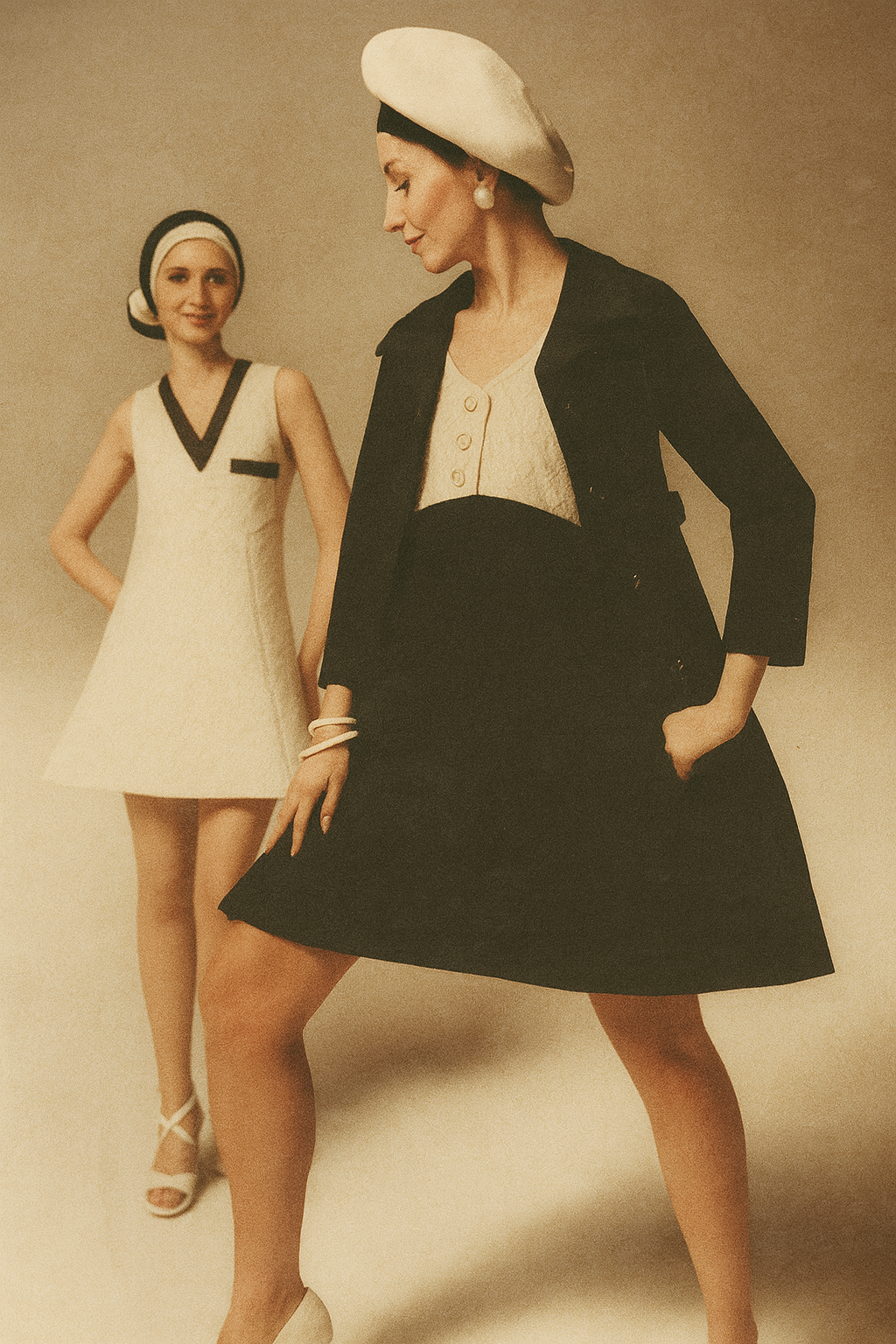
The February 15 issue demonstrated this mastery across every page. The navy-and-white knitwear spreads weren't styled as seasonal suggestions. They were presented as axioms: clean lines, sharp contrasts, minimal ornament. The photography was sculptural, almost architectural. These weren't clothes to be worn—they were positions to be inhabited.
The DuPont advertisement exemplified Vogue's genius for blending aspiration with pragmatism. The sleeveless dress-and-coat ensemble, priced at $100, wasn't positioned as luxury—it was positioned as modern. The implicit promise: technology could deliver elegance to the middle class. For readers in 1970, this wasn't marketing. It was permission.
Adjacent to these high-fashion spreads, the "Beauty Checkout" and "Every Beauty Thing" sections offered granular practicality: wig maintenance, skincare routines, product recommendations. The juxtaposition was deliberate. Vogue understood that authority required both aspiration and utility. Readers didn't just want to see Jane Fonda's haircut—they wanted instructions for replicating it.
This editorial formula—couture meets how-to, glamour meets accessibility—made Vogue indispensable. For millions of American women, these pages represented the closest proximity they'd ever have to Seventh Avenue or the Rue de Rivoli. Vogue didn't just reflect fashion. It was fashion.
The Visual Grammar: Design as Cultural Statement
The cover of the February 15 issue embodied the clarity emerging in 1970: bold photography, high contrast, zero distraction. This was realism as editorial weapon—no illustration, no abstraction, just direct confrontation with style.
Inside, the layouts functioned as visual arguments. Navy-and-white ensembles occupied full two-page spreads, photographed with the compositional rigor of fine art. The message was unmistakable: simplicity wasn't renunciation—it was sophistication.
The beauty pages operated differently. Where fashion spreads projected aspiration, beauty sections delivered intimacy. Readers encountered Jane Fonda not as icon but as peer—her haircut described in accessible language, her look presented as achievable rather than distant. Liza Minnelli's theatrical makeup wasn't framed as costume but as courage: beauty as self-definition.
This tension—between the aspirational and the attainable—defined Vogue's genius. The magazine never condescended, but it never excluded. It showed readers what excellence looked like, then handed them the tools to approach it.
The Archive Speaks: Seven Elements That Define the Issue
Navy-and-White as Doctrine
Not a trend. A palette. Presented as timeless, universally flattering, and immune to the chaos of pattern or ornament.
The DuPont Dacron Intervention
Synthetic fabrics marketed not as substitutes but as innovations. Wrinkle-resistant elegance at $100—a price point that positioned modernity as accessible luxury.
Fashion Economics Made Visible
The $100 ensemble. The $42 V-neck knit. Rare glimpses into what style actually cost in 1970, offering collectors concrete data points for understanding fashion's democratization.
Jane Fonda's "Shaggy and Terrific" Moment
A haircut as cultural signal. Casual, individual, unpolished by earlier standards—yet presented by Vogue as the new ideal. Authority endorsing rebellion.
Liza Minnelli's Arrival
Not yet the icon of Cabaret, but already positioned by Vogue as the face of bold, personality-driven beauty. A preview of the theatrical glamour that would dominate the mid-1970s.
Global Beauty Rituals
Japanese loofahs. European skincare. The beauty pages documented American fashion's internationalization—a shift from provincial to cosmopolitan.
Photography as Thesis
High-contrast black-and-white images that elevated fashion spreads into art objects. The layouts weren't documenting clothes—they were making aesthetic arguments about modernism, simplicity, and visual restraint.
These elements combine to form something rarer than a magazine: a document of cultural transition, preserved in its original form.
The Permanence Problem: Why Physical Archives Matter
Vintage magazines endure because they exist outside the logic of digital media. They can't be edited retroactively, algorithmically suppressed, or deleted by platform collapse. They are fixed witnesses.
In 1970, readers absorbed Vogue slowly—on coffee tables, in beauty salons, saved in personal libraries. The magazine's permanence was its power. It couldn't be scrolled past or swiped away. It demanded attention.
That same permanence now makes these issues invaluable to historians. Digital archives can preserve images, but they can't replicate the material experience: the weight of the paper, the smell of aging ink, the tactile reality of turning pages. Physical magazines carry information that scans cannot capture.
This is why collectors pursue originals rather than reproductions. The artifact is the archive.
Why Collectors Pursue This Issue
Historical Positioning
Early 1970s issues capture the moment women's liberation moved from protest to institution. Fashion history and social history converge.
Celebrity Intersection
Jane Fonda and Liza Minnelli weren't just featured—they were positioned as harbingers. Collectors value issues that document stars at inflection points in their cultural influence.
Design and Typography
The visual language of this issue represents Vogue at peak editorial sophistication. Layouts from this era are studied in design schools as examples of visual storytelling.
Material Innovation Documentation
The DuPont advertisements capture technological optimism before polyester became synonymous with cheap fashion. These ads document a moment when synthetic fabrics promised revolution.
Scarcity and Condition
Well-preserved 1970 issues grow rarer each year. Magazine paper from this era degrades easily. Clean copies with intact pages and minimal yellowing command premium prices.
Material Culture
Owning this issue means holding physical evidence of how a society saw itself at a turning point. It's not memorabilia. It's material culture.
Conclusion: The Issue That Codified a Decade
The February 15, 1970 issue of Vogue remains essential not because it was visionary, but because it was definitive. Its navy-and-white minimalism. Its embrace of synthetic innovation. Its positioning of Jane Fonda and Liza Minnelli as beauty's new vanguard.
This wasn't prediction. This was declaration.
More than fifty years later, the issue stands as proof that fashion journalism at its finest doesn't just document culture—it shapes it. Vogue in 1970 didn't reflect the mood of a changing decade. It set the mood.
For anyone serious about understanding how American style modernized, this issue isn't optional reading. It's the foundation text.
And unlike digital ephemera, it still exists exactly as it was—waiting to be held, studied, and preserved.
Access the Archive
Our collection houses thousands of original Vogue magazines spanning the 1930s through the 1990s. Each issue offers direct access to fashion, beauty, and cultural history exactly as it was first published—no digitization, no mediation, no loss of fidelity.
For collectors, design historians, and cultural researchers, these magazines provide something increasingly rare: primary sources in their original material form.
Browse Vogue Magazine Collection