
Fashion on a Budget, Confidence for a Career
When American women opened the February 1950 issue of Ladies' Home Journal, they found something radical disguised as practicality: a complete professional wardrobe for $91.80. Not a suggestion. Not a fantasy. A line-itemed blueprint for independence.
Cynthia McAdoo's feature, "American Beauty's $91.80 Career Wardrobe," arrived at a cultural inflection point. Millions of women had tasted economic autonomy during the war years, and many refused to surrender it. Yet postwar America expected them to look polished, feminine, and appropriately modest—all while living on secretarial wages. This wasn't merely a fashion spread. It was a manual for navigating conflicting expectations, a coded message that professional ambition and financial prudence could coexist with style.
The article offered proof: you could walk into an office, a classroom, or a church social looking modern and self-assured without draining your household budget. For readers seated at kitchen tables across America, this was permission and possibility bound in glossy pages.
Historical Archive Details
Publication: Ladies' Home Journal
Issue Date: February 1950
Feature Article: "American Beauty's $91.80 Career Wardrobe" by Cynthia McAdoo
Featured Subject: Helen Ryan, research worker and student's wife
Archive Significance: Documents postwar women's fashion, economics, and workplace identity
The Postwar Bargain: Style as Strategy
The year 1950 stood at the threshold of profound social change. World War II had drawn millions of women into factories, offices, and service industries. Many returned to domestic life after 1945, but a significant population remained in the workforce or quietly reentered it. Consumer culture surged, wages climbed, and ready-to-wear fashion made style increasingly democratic.
Yet professional women operated under scrutiny. They were expected to project competence without threatening traditional gender roles, to embrace modernity while honoring convention. The $91.80 wardrobe answered this tension directly: a woman could present herself as capable and contemporary without appearing extravagant or frivolous.
This was a full decade before the feminist movements that would reshape American society, but Ladies' Home Journal was already documenting the lived realities of working women—not fashion as escapism, but clothing as infrastructure for social mobility and self-determination.
A Magazine That Spoke to Millions
Unlike haute couture publications that showcased unattainable luxury, Ladies' Home Journal addressed the concerns of middle-class American households. Its editorial mix of fashion, fiction, homemaking advice, and social commentary made it one of the nation's most influential periodicals.
McAdoo's wardrobe feature operated as instruction, not inspiration. Each garment carried a specific price. The models were identified as real women—Helen Ryan, a research worker and student's wife, among them—representing the emerging demographic of educated working women. The clothing balanced pragmatism (gray tweed suits, washable blouses) with restrained elegance (jersey dresses, cashmere collars).
Readers could trace the arithmetic themselves: sketch out their own versions, calculate what adjustments their budgets allowed, envision their own transformation. The article assumed competence and agency, treating its audience as strategists rather than dreamers.
The Visual Grammar of Aspiration
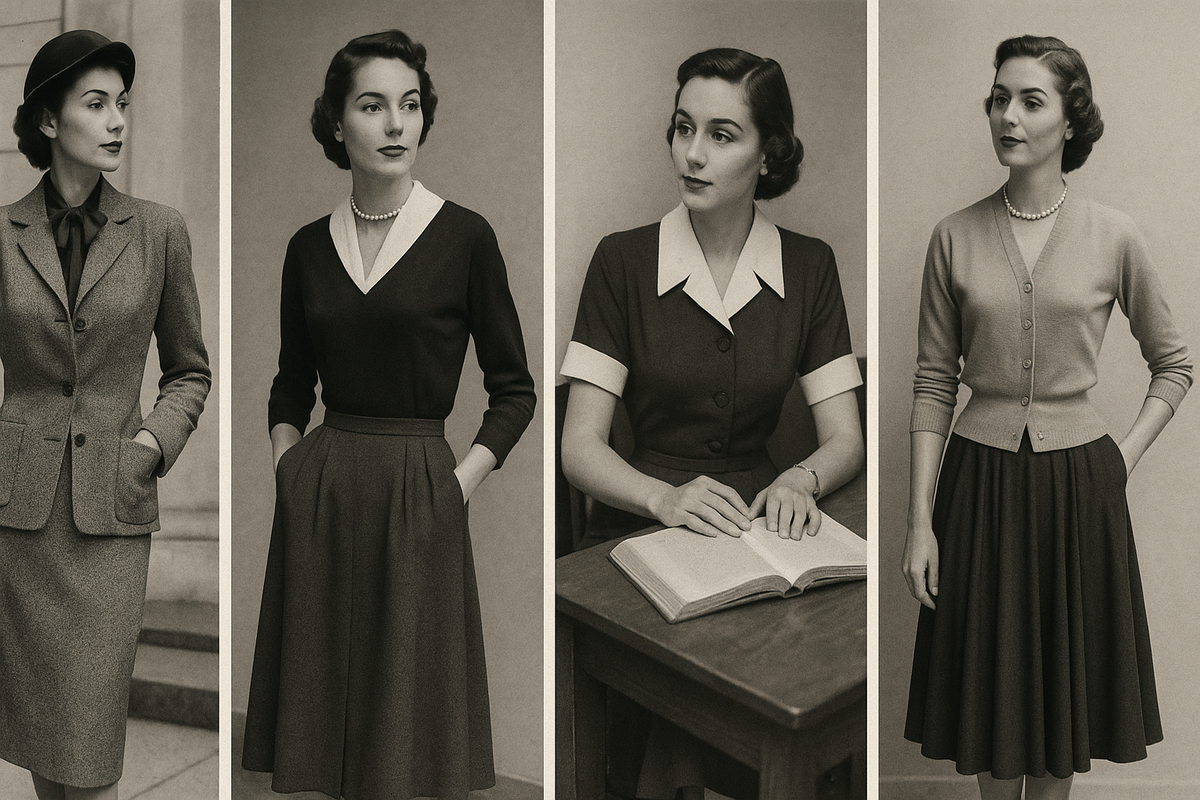
The feature's black-and-white photographs conveyed both style and utility. A gray tweed suit at $23 appeared with multiple blouses and accessories, demonstrating versatility across settings. A linen-collared jersey blouse priced at $9 suggested understated professionalism. A navy rayon crepe dress at $14.95, styled with crisp white collars and cuffs, transitioned from office to evening with minimal adjustment.
Accessories extended the wardrobe's reach—cardigans, pearls, and simple jewelry multiplied outfit combinations without expanding costs. The visual logic was deliberate: women didn't need abundance; they needed intelligence. Fashion became problem-solving, each photograph a proof of concept.
The models stood naturally, confidently, stripped of the theatrical glamour common to fashion photography. This visual realism closed the psychological distance between page and reader. These could be neighbors, colleagues, sisters.
The Architecture of the $91.80 Wardrobe
The complete wardrobe cost $91.80, placing professional style within reach of the average working woman's budget.
Skirts, blouses, and suits were selected for compatibility, multiplying outfit possibilities through deliberate coordination rather than volume.
Tweeds, rayon crepe, and washable jerseys acknowledged the realities of women managing both professional and domestic responsibilities.
Individual pieces adapted across contexts—a single dress could shift from daytime propriety to evening sophistication with the addition of pearls or a cardigan.
By highlighting women like Helen Ryan, the article addressed the growing population of college-educated women entering professional fields.
The feature emphasized domestic practicality over European couture, aligning with postwar nationalist sentiment and industrial confidence.
Images prioritized natural presentation over idealized fantasy, strengthening identification between reader and subject.
The wardrobe captured the negotiation between femininity and professionalism that defined women's lives at mid-century.
Beyond Ephemera: Why These Magazines Endure
Unlike catalogs or advertisements designed for immediate obsolescence, Ladies' Home Journal created lasting cultural records. Each issue functioned as both mirror and instruction manual, reflecting contemporary life while shaping reader expectations and possibilities.
The $91.80 wardrobe resonates across decades because it addresses permanent questions: How do we construct identity through appearance? How do we balance aspiration with constraint? How do we signal competence while navigating social expectations?
Just as vintage Life magazines serve as visual chronicles of global events, Ladies' Home Journal preserved the intimate architecture of American domestic and professional life—the small strategies and daily calculations that defined women's experiences.
Why Collectors Prize This Issue
Published at the decade's opening, it crystallizes the fashion sensibilities and social anxieties of postwar America.
The itemized prices and detailed photographs provide irreplaceable data for historians, costume designers, and researchers studying mid-century consumer culture.
The article captures early tensions around women's roles that would erupt into national conversation within fifteen years.
Issues featuring comprehensive wardrobe guides with complete price breakdowns are particularly sought after by collectors.
Holding this issue means possessing an artifact of American womanhood at a pivotal moment—when clothing represented not just appearance but aspiration, autonomy, and the discipline of making limited resources yield maximum effect.
Explore the Archive
The February 1950 issue of Ladies' Home Journal offers far more than fashion history. It documents the cultural landscape of American women at mid-century, capturing the intersection of economics, gender, and self-presentation.
Browse Ladies' Home Journal Magazine CollectionFrom the 1900s through the 1970s, these issues preserve decades of women's lives, fashion evolution, literary culture, and social transformation.
A Blueprint That Still Speaks
Cynthia McAdoo's "American Beauty's $91.80 Career Wardrobe" remains a landmark in American fashion journalism. It told women they could project professionalism, style, and confidence without financial recklessness—a message that transcends its era.
To hold this issue is to hold more than vintage paper. It is to hold evidence of how women built identities, negotiated expectations, and claimed space in a transforming nation. The $91.80 wardrobe was never just about clothes. It was about the mathematics of dignity, the architecture of self-presentation, and the quiet revolution of women who dressed for the futures they intended to claim.