
When America Needed Reassurance, The Saturday Evening Post Delivered Conrad Richter
How a March 1940 story about cattle ranchers became a cultural lifeline on the eve of World War II
March 2, 1940. Europe was burning. America was holding its breath. And millions of families opened their mailboxes to find a story about cattle ranchers.
It wasn't escapism. It was a lifeline.
That week's issue of The Saturday Evening Post carried Conrad Richter's "Life Was Simple Then"—a short story that would become a defining artifact of American cultural memory on the eve of World War II. While headlines screamed about Hitler's advancing armies and the collapse of European democracies, Richter offered something more subversive than distraction: a mirror held up to the American character itself.
For readers in 1940, this wasn't nostalgia. It was survival instruction disguised as fiction.
Archive Details
Featured Author: Conrad Richter (Pulitzer Prize 1951, National Book Award 1961)
Issue Date: March 2, 1940
Illustrator: Harold Von Schmidt
Archive Source: The Saturday Evening Post
Historical Context: Published five months after the Nazi invasion of Poland, eight months before the Battle of Britain
The Weight of March 1940
The context matters brutally here. The Great Depression had carved a decade of scars into American life. Recovery was fragile, uncertain. Poland had fallen five months earlier. Britain and France were fighting for their existence. Every American household understood the question wasn't if war would reach them, but when.
Against this backdrop, Richter's story did something remarkable: it reached back to the cattle ranges of the American West and reminded readers what endurance actually looked like. Not the sunny mythology of cowboys and campfire songs, but the grinding reality of families who survived drought, economic collapse, and frontier isolation through sheer moral fiber.
The Saturday Evening Post understood what its audience needed. Not propaganda. Not cheerleading. But a reminder that the values that built America—the actual work of building it, mile by painful mile—were still accessible. Still true. Still worth defending.
The Post as National Stage
By 1940, The Saturday Evening Post had transcended magazine status to become American cultural infrastructure. With circulation in the millions, it reached bank presidents and dairy farmers, urban intellectuals and rural schoolteachers. It was the rare publication that could speak to the entire country at once—not by dumbing down, but by elevating.
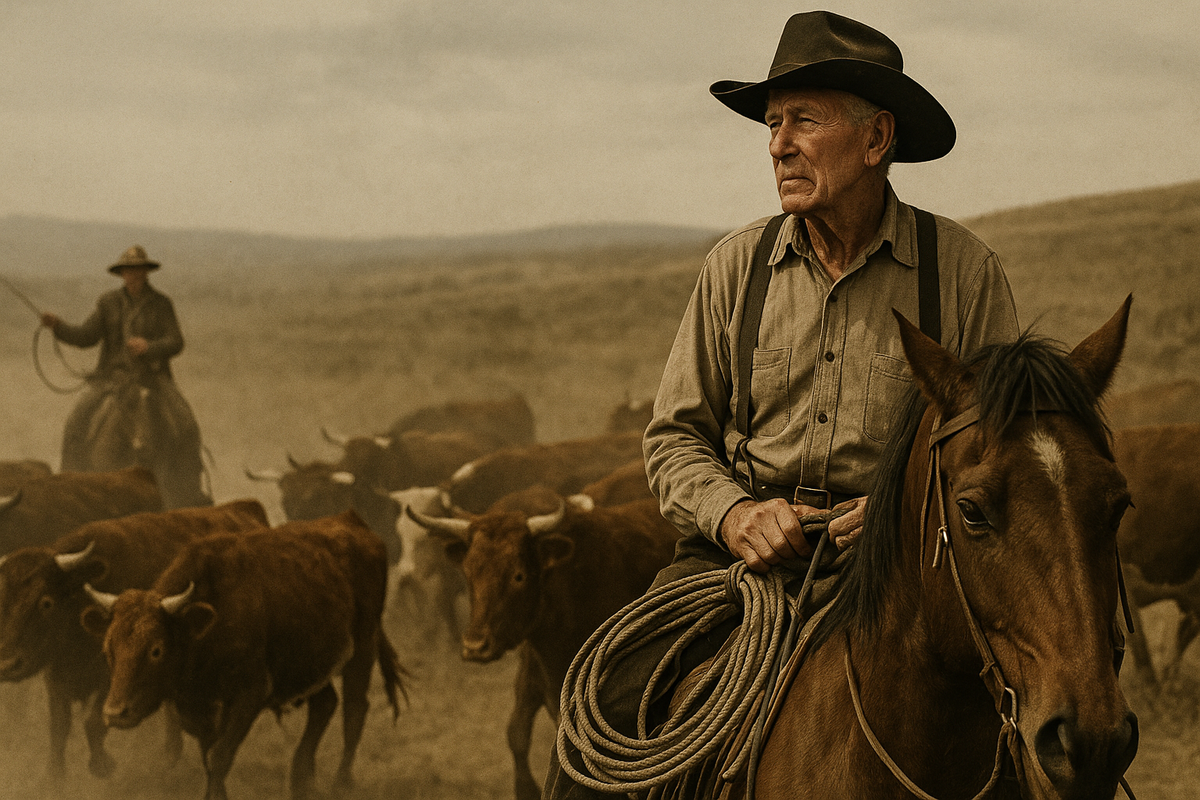
"Life Was Simple Then" arrived illustrated by Harold Von Schmidt, whose dramatic renderings of cattle stampedes and ranch life had already made him one of America's most celebrated illustrators. His images didn't merely accompany Richter's prose—they amplified it. Families gathered around these pages the way later generations would gather around television screens, with Von Schmidt's dust-choked roundup scenes and weathered rancher portraits making fiction feel like documentary evidence.
This was the Post's genius: text and image fused into cultural statement. While newspapers delivered the crisis, the Post delivered the context—the deeper story of who Americans believed themselves to be when tested.
Inside the Fiction That Mattered
Richter centered his story on Doane Williams and his family, tracking the rhythms of ranch life through roundups, weddings, and community gatherings. But the "simple" in his title carried a devastating complexity. Life wasn't easy on those ranges. It was brutal, precarious, often deadly.
What was simple was the moral clarity. Earlier generations lived with a directness of purpose that 1940 readers could only envy. When a storm threatened the herd, you rode into it. When family needed you, you appeared. When hardship arrived—and it always arrived—you endured.
Von Schmidt's illustrations drove this home with cinematic force. His riders strain against chaos, cattle kick up blinding dust, men shout orders that the wind devours. These weren't romantic paintings. They were studies in determination against impossible odds.
For readers watching Europe collapse under mechanized warfare, the parallel was inescapable. The roundup scene—with its depiction of order maintained against natural fury through collective will—became metaphor without preaching. Richter and Von Schmidt showed what American resilience looked like in its raw, unpolished form.
The story's generational wisdom cut deepest. Characters passed down lessons about sacrifice, honesty, endurance—the very transmission of values that 1940 America desperately needed to believe still functioned. In kitchens and churches and town halls across the country, families were having the same conversations: what do we preserve, what do we protect, what do we pass forward when everything seems uncertain?
Richter's title answered with precision. "Life Was Simple Then" didn't mean easy. It meant clear. It meant that hardship could forge character in ways comfort never would.
The Story's Enduring Themes
The Ranching World
Richter depicted the cattle ranges not as romantic fantasy but as a world of hard labor, danger, and dignity. His ranchers endured storms, hunger, and uncertainty, yet their lives carried meaning rooted in family and land.
The Roundup Scene
One of the most vivid sequences captured the dusty chaos of a cattle roundup, with riders straining to keep order while storms and darkness threatened. It symbolized both the unpredictability of nature and the determination of human effort.
Generational Wisdom
Characters echoed the lessons of elders, teaching the younger generation about sacrifice, resilience, and honesty. In 1940, with war on the horizon, this message of passing values from one generation to the next carried profound weight.
The Title's Lesson
"Life Was Simple Then" didn't mean life was easy. It meant that earlier generations lived with a clarity of purpose, unclouded by modern distractions. It was a bittersweet reminder that hardship could shape character in ways comfort never could.
Why This Issue Commands Collector Attention
Literary Archaeology
Conrad Richter would claim both the Pulitzer Prize (The Town, 1951) and the National Book Award (The Waters of Kronos, 1961). This Post story captures him mid-trajectory, already masterful but not yet laureled—the equivalent of owning early Dylan or pre-fame Hemingway. Collectors prize these moments when great artists were working in popular forums before critical canonization.
Illustrative Importance
Harold Von Schmidt's work here represents American illustration at its technical and emotional peak. His depictions of Western action and human drama under pressure have only appreciated in value as the tradition of magazine illustration has vanished. These pages document a lost art form.
Cultural Timestamp
Every element of this issue—the advertisements for cigarettes and household goods, the editorial commentary, the other stories and features—creates a three-dimensional portrait of American life on March 2, 1940. It's not just Richter's story that matters. It's the context surrounding it.
The Inflection Point
Issues from late 1939 through 1941 carry special weight because they capture America's last moments of peacetime consciousness. After Pearl Harbor, everything changed. This issue exists in that liminal space—aware of the storm, not yet inside it.
What Preservation Actually Preserves
Vintage issues of The Saturday Evening Post endure because they were never disposable. Families saved them. Built collections. Passed them down as evidence of what mattered. Today, they function as primary source documents for understanding how America narrated itself to itself during its most defining century.
In an age when content evaporates within hours, these physical artifacts carry weight precisely because they were designed for permanence. The Post wasn't just reporting the moment—it was creating the record for whoever came after.
Access the Archive
Our collection includes thousands of original Saturday Evening Post magazines spanning from the early 20th century through the postwar decades. Each issue documents American culture, politics, literature, and visual art as it unfolded—not through retrospective analysis, but through contemporary witness.
Browse Saturday Evening Post Magazine CollectionThe Story That Keeps Speaking
The March 2, 1940 issue—with Conrad Richter's "Life Was Simple Then" and Harold Von Schmidt's illustrations—stands as more than historical curiosity. It represents American storytelling serving its highest function: not escape from reality, but preparation for it.
Richter's ranchers enduring storms. Von Schmidt's riders maintaining order against chaos. The Post's faith that serious literature and art could reach mass audiences without condescension.
These weren't just entertainment choices. They were cultural decisions about what Americans needed to remember about themselves before everything changed.
The issue survives today as both artifact and argument—evidence that when the world felt most unstable, America turned to stories about endurance, looked to its past for instruction, and found in fiction the truths that history couldn't yet name.
That's not nostalgia. That's cultural memory doing the work it was designed for.