
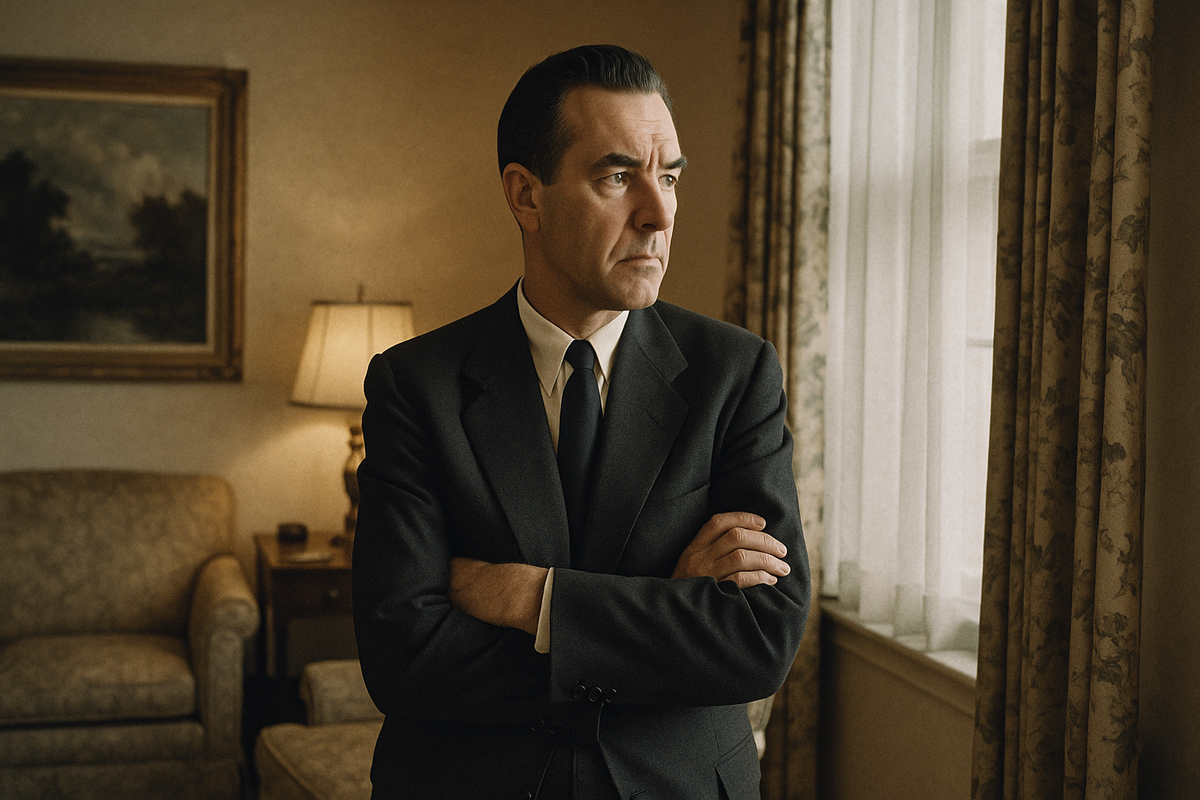
The Election That Predicted America
Inside Time's 1954 Portrait of New Jersey's Political Crossroads
On October 18, 1954, Time Magazine made an unusual editorial decision: it devoted its national spotlight not to Washington or Moscow, but to New Jersey. The cover story, "A Political Microcosm," declared that this industrial state—crowded with union halls and sprouting suburbs, machine bosses and reform candidates—held the key to understanding America's political future.
Time's editors weren't exaggerating. New Jersey's 1954 Senate race crystallized every fault line fracturing Cold War America: Eisenhower moderates versus McCarthy extremists, reformed Democrats versus corrupt Republicans, suburban independents versus urban machines. Two men stood at the center of this storm—Clifford Case, the 6'2" Republican reformer who voted with labor unions, and Robert Meyner, the Democratic governor rebuilding his party from the ashes of scandal. Their contest would answer a question that haunted the entire nation: Could American democracy survive its own contradictions?
Archive Intelligence
Publication: Time Magazine
Issue Date: October 18, 1954
Cover Story: "A Political Microcosm"
Historical Figures: Clifford Case (Republican Senate Candidate), Robert B. Meyner (New Jersey Governor)
Political Context: 1954 Midterm Elections, McCarthy Era, Eisenhower's "Middle Way" Republicanism
Eisenhower's Fragile Coalition
By 1954, Dwight Eisenhower's presidency faced its first real test. His promise of "middle way" governance—fiscally conservative, socially moderate—had carried Republicans to victory in 1952. But two years into his term, the coalition was splintering. Senator Joseph McCarthy's anti-Communist witch hunts divided the GOP between pragmatists and zealots. Democrats, meanwhile, were learning to fight again after twenty years of Roosevelt-Truman dominance had made them complacent.
New Jersey became the laboratory. Heavy industry met white-collar commuters. Democratic machines that had ruled cities for decades confronted a new breed of reformist politicians. The state's voters—skeptical, sophisticated, unaligned—would decide whether America wanted competence or ideology, reform or revenge.
Case: The Republican Who Wouldn't Behave
Clifford Case was an anomaly. Descended from six generations of New Jersey Dutch Reformed stock, the Rahway congressman carried himself with a scholar's gravity and a lawyer's precision. Time painted him as a man whose integrity made enemies on both sides: he supported housing programs and Social Security expansions that enraged Republican conservatives, yet refused to bow to Democratic machines.
His independence made him dangerous. A faction of right-wing Republicans launched a smear campaign, mocking Case and his Democratic opponent Charles Howell with crude jingles. They called him a closet liberal. They questioned his loyalty to the party. Case's response was silence—he simply campaigned harder among the suburban moderates who valued competence over conformity.
What Time understood, and what made Case's candidacy historically significant, was that he represented Eisenhower's gamble: Could Republicans win without red-baiting? Could they govern without choosing between Wall Street reactionaries and Main Street populists? New Jersey's Senate seat would deliver the verdict.
Meyner: The Democrat Who Broke the Machine
Robert B. Meyner was everything the old Democratic bosses weren't. No backroom deals. No tolerance for graft. After winning the governorship in 1953—breaking years of Republican control—he systematically dismantled the corrupt apparatus that had embarrassed his party.
Frank Hague, the legendary Jersey City boss who once controlled New Jersey politics like a personal fiefdom, was gone. Meyner represented something new: a Democrat who could win without owing favors, who built coalitions across counties rather than extracting tribute from them. Time recognized his national potential immediately. Here was a governor who looked presidential—disciplined, articulate, untainted.
His 1954 campaign demonstrated the Democratic Party's resilience. Out of power in Washington, humiliated by Eisenhower's 1952 landslide, Democrats were rebuilding at the state level. Meyner proved they could do it without resurrecting the corrupt machines that had alienated voters in the first place.
The Ghost of Harold Hoffman
No Republican in New Jersey could escape Harold G. Hoffman's shadow. The former governor had embezzled nearly $300,000 from state agencies. He'd maintained ties to protection rackets and organized crime. His legacy hung over Case like a curse—not because Case resembled Hoffman, but because New Jersey voters had learned to distrust Republican promises of clean government.
Democrats hammered the Hoffman scandals relentlessly. Federal investigations into the Federal Housing Administration and other agencies kept corruption in the headlines throughout 1954. Case, the reformer, found himself defending a party whose recent past contradicted everything he stood for.
This tension—between what Case represented and what Republicans had done—captured the central drama of Eisenhower's GOP. Could the party of Lincoln reinvent itself, or would it remain captive to the bosses and fixers who'd dominated its state organizations?
Time's Portrait: Politics as Drama
The October 18, 1954 issue showcased Time's singular editorial voice. Photographs captured Case at home with his family, projecting modest domesticity. Meyner appeared in thoughtful poses, the careful statesman. The typography was bold, the analysis sharper than wire.
Time didn't merely report platforms—it constructed narratives. Case became the earnest crusader battling extremists. Meyner transformed into the pragmatic rebuilder salvaging his party's soul. The magazine understood that readers wanted heroes and villains, turning points and consequences.
This approach made Time essential reading for Americans trying to decode their own political moment. The magazine didn't just tell them what happened in New Jersey; it explained why they should care about a state election half a continent away.
The Enduring Significance
The October 18, 1954 issue of Time Magazine captured a principle that shapes American politics still: local elections predict national futures. New Jersey's contest between Case and Meyner wasn't just about a Senate seat or a governor's mansion. It was about whether moderation could survive extremism, whether reform could overcome corruption, whether American voters would choose competence or ideology.
Time's decision to call New Jersey a "political microcosm" proved prophetic. The battles fought there—between party establishments and independent candidates, between machine politics and grassroots movements—would define American democracy for decades.
For collectors, this issue offers more than historical insight. It provides a tangible connection to the moment when America's postwar consensus began to fracture, when the political coalitions of the Roosevelt era started to dissolve, when the choices voters made in places like New Jersey shaped the nation's trajectory.
Why Collectors Covet This Issue
Historical Pivot Point
Documents the moment when Eisenhower Republicanism confronted its internal contradictions, and when Democrats began their climb back to relevance.
Rising Political Stars
Both Case and Meyner would shape mid-century American politics. Their early portrayals here capture them before national fame—raw, ambitious, unfinished.
McCarthy-Era Context
Preserves the ideological warfare within the Republican Party at the height of McCarthyism, showing how moderates fought to reclaim their party from demagogues.
Authentic Period Artifact
From the advertising to the editorial voice, this issue breathes 1950s America—its anxieties about Communism, its faith in reform, its hunger for competent leadership.
Experience Political History Firsthand
This issue represents one entry in Time Magazine's unparalleled chronicle of 20th-century America. From the 1920s forward, Time documented every presidential election, every political upheaval, every cultural transformation—not as history, but as news.
Explore thousands of original Time magazines, each one a window into how Americans experienced their era in real time.
Browse Time Magazine Collection