
The Magazine That Brought Nine Presidents to Your Christmas Table
Inside the December 25, 1948 Saturday Evening Post—where Ira R. T. Smith's fifty years at the White House met Norman Rockwell's postwar America
On Christmas morning 1948, while Harry Truman was still savoring the greatest upset in American political history, millions of families unwrapped something unexpected alongside their presents: half a century of presidential secrets, delivered by the one man who had seen it all.
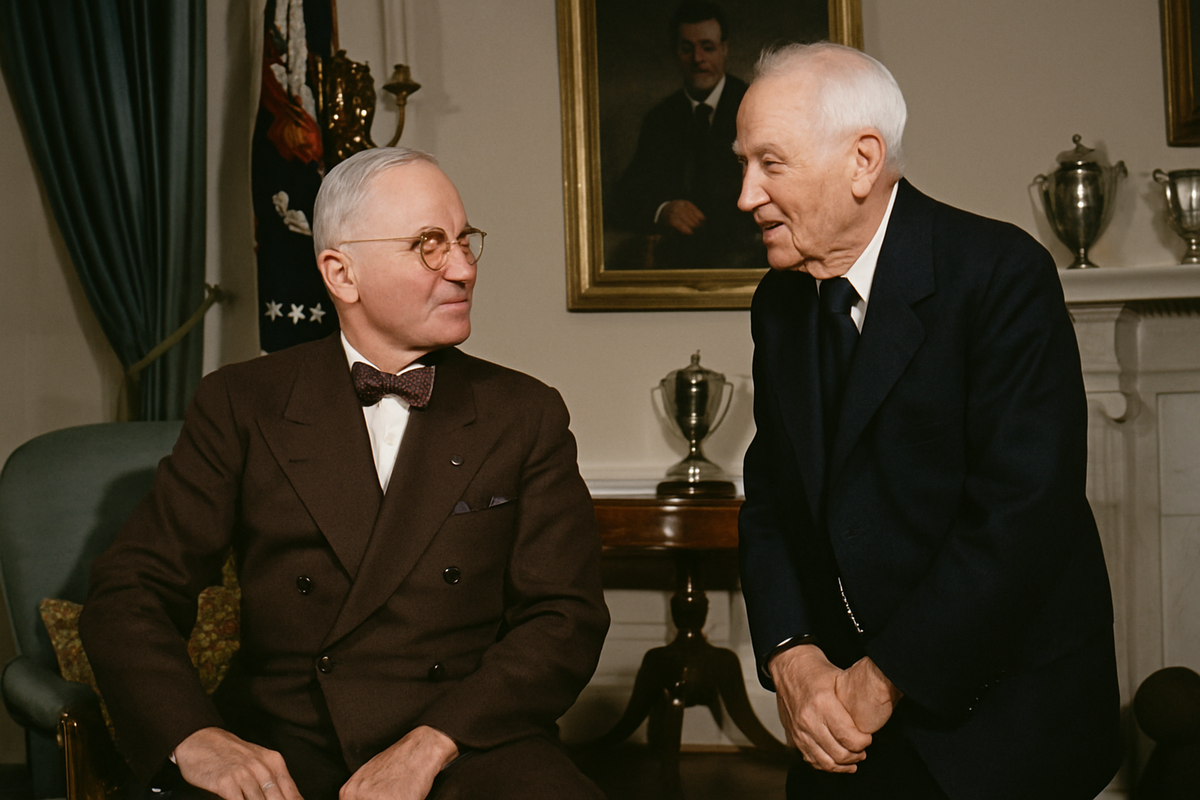
The Saturday Evening Post that week didn't just feature another holiday cover. It was a summons backward through time, guided by Ira R. T. Smith—the White House Chief of Mails who had served nine presidents, from William McKinley's frock coats to Truman's plain-spoken defiance. His memoir, "My Fifty Years in the White House," co-written with Joe Alex Morris, wasn't gossip. It was institutional memory made flesh, published at the precise moment America needed reminding that presidents pass, but the presidency endures.
Archive Details
Historical Figure: Ira R. T. Smith, White House Chief of Mails (1897-1948)
Issue Date: December 25, 1948
Cover Artist: Norman Rockwell ("Home for Christmas")
Archive Source: The Saturday Evening Post
Presidents Chronicled: McKinley, T. Roosevelt, Taft, Wilson, Harding, Coolidge, Hoover, F. Roosevelt, Truman
When Presidential Memory Became a Christmas Gift
The timing was no accident. Truman had just obliterated Thomas Dewey's expected coronation, holding aloft that infamous Chicago Tribune headline—"DEWEY DEFEATS TRUMAN"—like a trophy. The Berlin Blockade had Europe holding its breath. The Cold War was hardening from metaphor into concrete bunkers and barbed wire. Americans, barely three years removed from V-J Day, were caught between exhaustion and anxiety, prosperity and paranoia.
Into this moment, The Saturday Evening Post—then among the most influential magazines in American life—offered something radical: perspective. Smith's recollections weren't mere anecdotes. They were proof that the Republic had survived worse. McKinley's assassination. Wilson's stroke. The Great Depression. A world war. And through it all, the mail kept arriving at 1600 Pennsylvania Avenue, sorted by the same steady hands.
The Man Who Knew Where the Bodies Were Filed
Smith occupied a peculiar position in American power: invisible yet indispensable. As Chief of Mails, he wasn't shaping policy or whispering in presidential ears. He was managing the deluge—tens of thousands of letters monthly, from marriage proposals to death threats, from school children to foreign dignitaries. He knew which correspondence landed on the presidential desk, which got routed to departments, and which got filed away as evidence of America's magnificent, occasionally unhinged, civic energy.
But proximity breeds observation. Over five decades, Smith watched Theodore Roosevelt box in the White House gymnasium until a sparring partner's punch cost him the vision in one eye—a detail Roosevelt kept hidden from the public for years. He witnessed Franklin Roosevelt's theatrical genius, noting how FDR was always performing, even in supposedly private moments, forever conscious of his audience. He remembered William McKinley as "the last of the old frock-coat presidents," a 19th-century formality marooned in the modern age.
These weren't state secrets. They were better: the human details that historians miss and journalists rarely glimpse. When Rough Riders from San Juan Hill showed up unannounced at the White House, Roosevelt didn't turn them away—he reveled in their presence, as if still charging up that Cuban hillside. When William Howard Taft's good humor couldn't quite mask his struggles with weight and political pressure, Smith noticed. When Woodrow Wilson's legalistic precision began alienating his own staff, Smith watched the consequences unfold in real time.
The memoir's most enduring contribution may be its documentation of Theodore Roosevelt's Mississippi hunting trip—the moment he refused to shoot a captured bear cub, a decision immortalized in Clifford Berryman's political cartoon and subsequently transformed into the Teddy Bear. The Post reprinted Berryman's illustration alongside Smith's account, connecting presidential character to American childhood in a single image.
Rockwell's War Comes Home
Norman Rockwell's cover that week—"Home for Christmas"—wasn't merely decorative. It was a mirror held up to a nation still processing reunion and loss. The painting depicted a soldier's homecoming, surrounded by family, neighbors, and children in a scene of jubilant chaos. Rockwell populated the canvas with his own: wife Mary, sons Jerry, Tommy, and Peter. Even Grandma Moses, the folk artist, posed as the grandmother, her presence linking high art to vernacular tradition.
Three years after V-J Day, every American household understood this scene viscerally. The soldiers were home, but the war's shadow hadn't lifted. Families had been shattered and reassembled. The dead weren't coming back, but the living were trying to rebuild something recognizable. Rockwell's cover said: This is what we fought for. This is what endures.
Inside, Smith's presidential memories reinforced the same message. Leaders had changed. Crises had mounted. But the institution held. The mail got sorted. Democracy lurched forward.
Presidential Portraits Across Half a Century
Theodore Roosevelt's Intensity
Boxing matches in the White House gymnasium that cost him vision in one eye. Rough Riders appearing unannounced. The bear cub incident that birthed the Teddy Bear legend.
Franklin Roosevelt's Theater
Smith observed FDR as perpetual performer, theatrical in private and public alike, forever conscious of his audience and presentation.
William McKinley's Formality
Remembered by Smith as "the last of the old frock-coat presidents"—a 19th-century figure navigating the modern presidency.
Woodrow Wilson's Logic
The precise academic whose legalistic mind shaped policy but created tensions with staff who couldn't match his exacting standards.
William Howard Taft's Humor
Good-natured personality attempting to mask struggles with weight, health, and the crushing pressures of the office.
Institutional Continuity
The unbroken thread across nine administrations—from McKinley's Victorian presidency to Truman's atomic age decisiveness.
The Post as Permanent Record
The Saturday Evening Post understood something that modern digital media has forgotten: permanence matters. These weren't disposable updates or vanishing stories. They were printed on substantial stock, illustrated by serious artists, edited with care, and designed to sit on coffee tables for weeks—sometimes years. Families passed them down. Libraries archived them. Collectors preserved them.
Smith's memoir, in particular, benefited from this permanence. Had it appeared in a newspaper, it would have lined birdcages within days. Published in The Post, it became reference material, a primary source for presidential historians, a glimpse into an era when institutional knowledge still resided in individual minds rather than digital databases.
The magazine's editorial strategy was sophisticated: combine serious reporting with popular appeal, literary fiction with visual art, political analysis with human interest. It worked because readers trusted The Post to curate American culture, to decide what mattered and what would last.
Why This Issue Commands Collector Obsession
Historic Timing
Published immediately after Truman's legendary upset over Dewey, capturing America at a political and cultural crossroads between wartime sacrifice and Cold War anxiety.
The Rockwell Factor
Norman Rockwell's Christmas covers rank among the most sought-after illustrations in 20th-century American art. "Home for Christmas" distills postwar reunion into a single unforgettable image.
Presidential Proximity
Smith's first-hand observations of nine presidents across fifty years offer something no official biography can match—the texture of institutional memory and human detail.
Cultural Density
Between Rockwell's cover, Smith's memoir, Berryman's Roosevelt cartoon, and Grandma Moses's cameo, this issue concentrates an unusual amount of American cultural production in a single artifact.
Christmas Collectibility
Holiday issues carry special nostalgic weight for collectors. This particular Christmas merged family reunion imagery with presidential history at a pivotal national moment.
Physical Permanence
Original copies represent the actual paper stock that shaped mid-century American consciousness—evidence in material form of what Americans believed and valued.
Explore the Archive
For those who pursue original copies of The Saturday Evening Post spanning decades of American history, literature, art, and commentary, these magazines represent more than nostalgia. They are evidence. They are arguments in material form about what America was, and what it believed itself to be.
Browse The Saturday Evening Post Magazine CollectionThe Endurance Test
Seventy-seven years later, the December 25, 1948 Saturday Evening Post passes the only test that matters for historical artifacts: it still speaks. Smith's presidential observations remain sharp. Rockwell's cover still evokes the particular ache of homecoming. The issue's central insight—that democratic institutions outlast the men who temporarily command them—feels less like reassurance than necessity.
Presidents continue to arrive and depart. Crises mount and recede. The mail still gets sorted, though now by different hands using different technologies. What Smith understood, and what The Post communicated so effectively, was that this continuity isn't automatic. It requires attention, maintenance, and memory.
This magazine is memory made tangible. Not the sanitized memory of official histories, but the granular, textured, occasionally contradictory memory of someone who was actually there, watching presidents be human, watching democracy function despite itself. That's worth preserving. That's worth holding in your hands.