
The Magazine That Refused to Look Away
Jet's Front-Line Chronicle of Watts, 1965
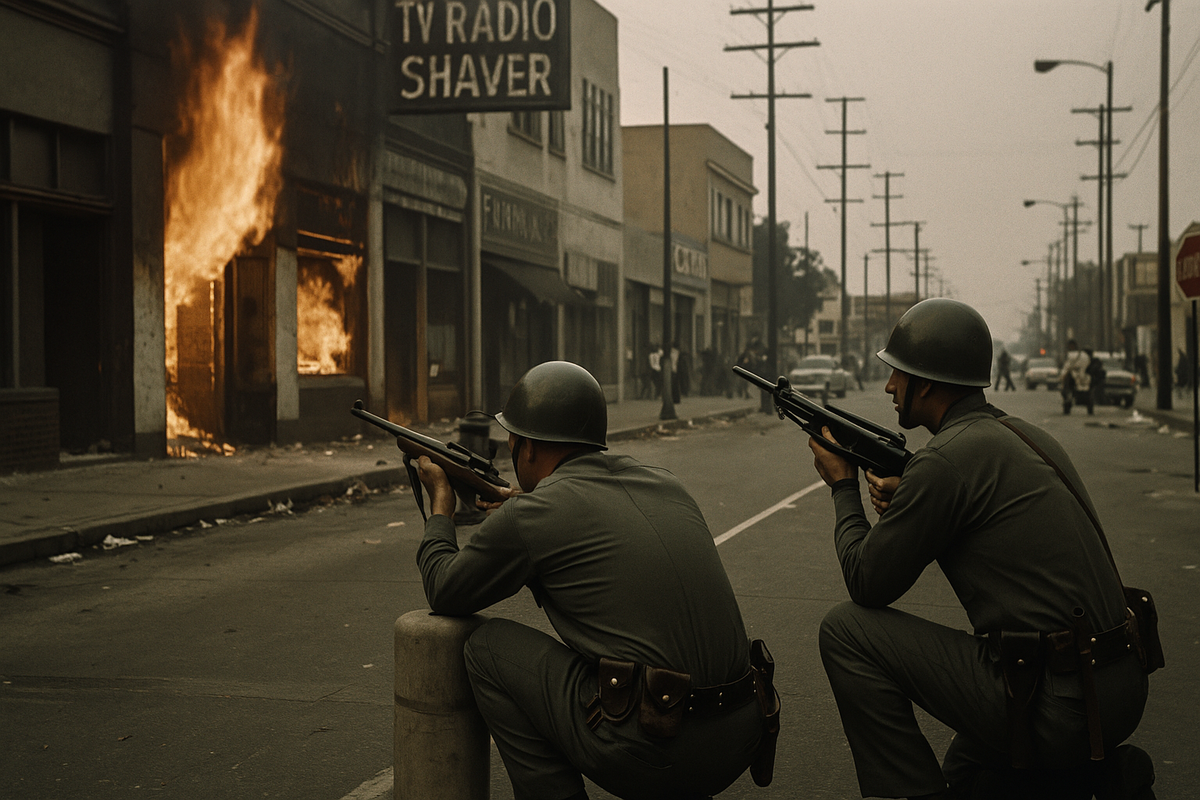
On newsstands across Black America in early September 1965, a pocket-sized magazine appeared with the visual grammar of war correspondence. Helmeted police crouched behind cover, rifles trained on an American street. The banner read "Special Report: Life Inside a Riot Zone." Six words down the right margin—Frustrations. Fears. Feuds. Fires. Fights. Funerals—told the story in staccato.
This was the September 2, 1965 issue of Jet Magazine, and it arrived at a moment when the nation's understanding of racial progress had just shattered against the pavement of South Los Angeles.
Archive Details
Publication: Jet Magazine
Issue Date: September 2, 1965
Historical Event: Watts Rebellion (August 11-17, 1965)
Cover Story: "Special Report: Life Inside a Riot Zone"
Archive Significance: Primary source documentation of urban uprising
When Victory Tasted Like Smoke
The calendar told one story. August 6, 1965: President Lyndon Johnson signed the Voting Rights Act, dismantling Jim Crow's electoral machinery. Civil rights leaders spoke of triumph. The evening news broadcast footage of celebration.
Watts told another story entirely.
Five days later, on August 11, a traffic stop spiraled into six days of what Jet would document as urban warfare. By the time the fires died, 34 people were dead, over 1,000 injured, and $40 million in property reduced to ash. The rebellion—Jet never called it a riot—forced a reckoning: legal victories in the South had done nothing for the tens of thousands trapped in California's ghettos, where unemployment, police brutality, and housing discrimination created a different kind of Jim Crow.
Mainstream outlets covered Watts as pathology. Jet covered it as politics.
What Jet Saw That Others Missed
By 1965, Jet had become the circulatory system of Black America—passed hand-to-hand in barbershops, read in church basements, carried in purses and back pockets. Its pocket format was strategic: information designed for mobility, for communities that couldn't wait for monthly magazines or rely on newspapers that buried their stories on back pages.
The September 2 issue deployed that mobility for frontline journalism. Where other publications counted property damage, Jet reported the mechanics of rebellion:
This wasn't sociology. This was war correspondence from inside the perimeter.
The Journalism of Proximity
Jet's coverage succeeded because it abandoned the false neutrality that mainstream journalism mistook for professionalism. The magazine's reporters understood what their readers knew instinctively: Watts wasn't an outbreak of madness. It was the logical endpoint of systemic neglect.
The reporting combined visual evidence with cultural translation. Photographs showed helmeted troops, gutted storefronts, and weeping residents. But the text explained why—connecting the immediate explosion to decades of economic abandonment, discriminatory housing, and police violence. Articles like "Shouts of 'We'll Kill Whites'" and "Burn to 'This is War' Heard" didn't sanitize the rage. They contextualized it.
For Jet's readers—many of whom lived in similar conditions in Chicago, Detroit, Newark, Philadelphia—this wasn't distant tragedy. It was recognition. The magazine served as both witness and warning: what happened in Watts could happen anywhere the same pressures built.
The Cover as Historical Document
The September 2, 1965 cover remains one of Jet's most iconic images precisely because it refused aesthetic distance. The composition—police in combat stance, weapons ready, on an American street—visually argued that urban Black neighborhoods had become occupied territory.
This was intentional editorializing through photography. Jet didn't explain that America was treating its citizens like enemy combatants. It showed it.
The six-word cascade—Frustrations. Fears. Feuds. Fires. Fights. Funerals—worked as both table of contents and thesis statement. Each word represented a section of the coverage, but together they formed a narrative arc: from underlying conditions to violent expression to human cost.
The Unfinished Story
What makes this issue uncomfortable—and therefore valuable—is its refusal of resolution. Jet didn't offer reassurance that Watts represented growing pains on the path to equality. It presented the rebellion as evidence that America's racial crisis ran deeper than laws could reach.
The questions the magazine raised in 1965 remain urgent: What happens when legal victories don't translate to material change? When communities exhaust peaceful options? When the gap between promise and reality becomes unbearable?
Jet documented these questions in real time, creating a record that matters more now than it did then—because we're still asking them.
Why This Issue Endures
Sixty years later, the September 2, 1965 Jet stands as essential source material for understanding American racial politics. Its significance compounds across multiple registers:
Captures the Watts Rebellion from the perspective of the community experiencing it, not the authorities suppressing it—a viewpoint largely absent from mainstream archives.
Published between the Voting Rights Act and the escalation of urban rebellions that would define the late 1960s, marking the moment when civil rights focus shifted from legal segregation to economic inequality.
Documents not just events but language, symbols, and strategies of resistance that mainstream sources either ignored or misunderstood.
Photography provides evidence that contradicts official narratives—showing not chaos but community response to state violence.
For Collectors and Historians
Acquiring the September 2, 1965 Jet Magazine means possessing a fragment of unfiltered history. This is journalism produced under pressure, for an audience that needed truth more than comfort. It captures:
- The moment urban America exploded into the national consciousness
- The voices and images systematically excluded from mainstream narratives
- The expansion of civil rights struggle from Southern legal battles to Northern economic warfare
The issue is increasingly rare in collectible condition. Paper degrades, pocket-sized magazines were read until they fell apart, and many copies were simply discarded after the news cycle moved on. What survives represents both historical accident and deliberate preservation—copies saved because someone understood they were witnessing history.
Explore the Archive
Browse the complete collection of original Jet magazines and access decades of African American life documented with urgency, specificity, and cultural authority that no other publication matched.
Browse Jet Magazine CollectionThe September 2, 1965 issue of Jet Magazine is more than vintage ephemera. It's a primary source on a turning point in American history—the week the civil rights movement's narrative of progress collided with the reality of urban despair. For anyone serious about understanding the 1960s, racial politics, or the power of the Black press, this issue isn't optional. It's foundational.