
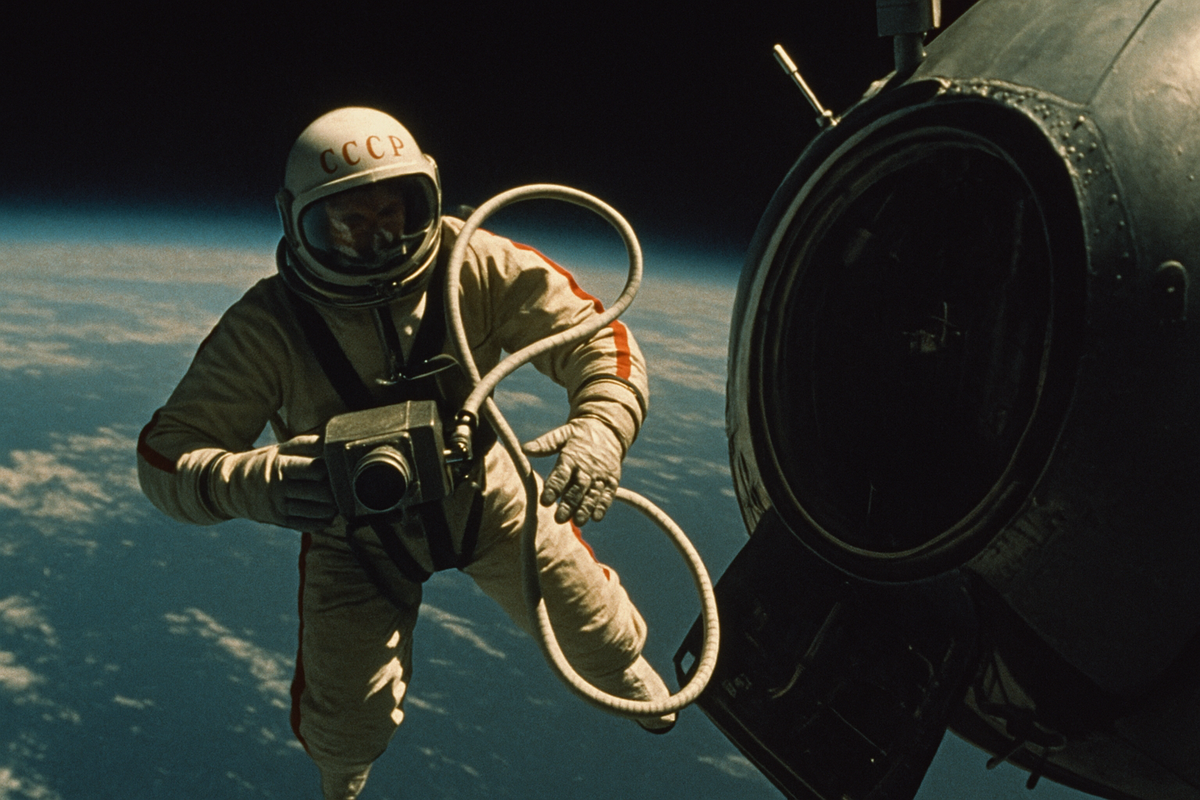
Into the Void: The March 26, 1965 Time Magazine That Brought the Spacewalk to America's Breakfast Table
Alexei Leonov had twelve minutes to prove that humans could survive outside a spacecraft—or die trying.
On March 18, 1965, the Soviet cosmonaut opened the hatch of Voskhod II and pushed himself into the vacuum of space, tethered by a 16-foot cord that was all that stood between him and eternity. His pressure suit immediately began to balloon in the absence of atmospheric pressure. His hands slipped inside his gloves. His feet lifted away from his boots. When the time came to reenter the airlock, he couldn't fit. He was forced to bleed oxygen from his suit—a gamble that could have left him unconscious—just to squeeze back inside.
Eight days later, Americans opened the March 26, 1965 issue of Time Magazine and learned what had happened. For the first time, mainstream journalism brought the reality of extravehicular activity into sharp focus: not as science fiction, not as propaganda, but as a documented feat that redrew the boundaries of human capability. The Soviets had done it first. Again.
Archive Details
Historical Figure: Alexei Leonov, Soviet Cosmonaut
Issue Date: March 26, 1965
Archive Source: Time Magazine
Mission: Voskhod II Extravehicular Activity
Duration of Spacewalk: 12 minutes
When Magazines Were the Front Line of the Cold War
By March 1965, the space race had become the most visible theater of Cold War competition. The Soviet Union had already claimed Sputnik (1957) and Yuri Gagarin's orbital flight (1961). The United States had answered with John Glenn (1962) and President Kennedy's audacious 1961 promise to land a man on the Moon before decade's end. But Leonov's spacewalk represented something more unnerving than rocket launches or orbital trajectories—it was proof that humans could operate in the void itself.
Time Magazine understood the stakes. This wasn't simply a story about space travel. It was a story about technological supremacy, national prestige, and the terrifying question of whether America was falling behind.
The magazine's coverage made the spacewalk both intimate and geopolitical. Photographs captured Leonov emerging from Voskhod II in grainy black-and-white, Muscovites cheering in Red Square, and NASA engineers at Cape Kennedy preparing Apollo hardware for America's response. Time's writers dissected the mechanics of Leonov's suit, the risks he faced, and the strategic implications of Soviet success. They used phrases like "adventure into emptiness" and "a glimpse of fantasy made real"—language that conveyed wonder without surrendering to romanticism.
For readers in 1965, this was the first detailed explanation of what it actually meant to float outside a spaceship. How the body reacted. What could go wrong. How close triumph was to catastrophe.
Time's Editorial Authority in the Age of Uncertainty
The cover of the March 26, 1965 issue reflected Time's commitment to journalistic realism. No illustrations. No abstractions. Real photography from the mission, delivered directly to kitchen tables across America. Inside, the editorial approach blended technical precision with political analysis—explaining oxygen systems and umbilical lines while situating Leonov's feat within the broader struggle for global dominance.
What distinguished Time from other popular magazines was its refusal to choose between education and drama. The writers contextualized the science without drowning readers in jargon. They acknowledged Soviet achievement without conceding American defeat. And they framed the spacewalk as both a turning point and a call to action.
The key moments Time chronicled remain striking:
The Walk Itself
Leonov floated for 12 minutes, the first human to confront space without the shell of a spacecraft between him and infinity.
The Near-Disaster
His suit expanded so dangerously that he nearly couldn't reenter. The decision to bleed air was improvised, unrehearsed, and potentially fatal.
Soviet Propaganda
The USSR broadcast images of Leonov to the world as proof of technological superiority, forcing NASA to accelerate its own EVA program.
American Resolve
Time balanced admiration with determination, noting that Apollo hardware was already under construction and that the U.S. was preparing its own historic steps.
Each moment underscored the central tension of the era: awe at what humans could achieve, fear of what rivals had already accomplished, and the stubborn belief that America would catch up.
Why This Issue Endures as a Collector's Artifact
For collectors of Cold War ephemera, the March 26, 1965 Time Magazine is more than a back issue—it's a primary source document from the moment when the space race became personal.
Space race issues like this retain their power because they preserve uncertainty. In 1965, no one knew if the United States would catch the Soviets. No one knew if the Moon landing was even possible. The ambition, the danger, and the doubt are all embedded in these pages.
Unlike digital archives, a physical 1960s Time magazine is permanent. It carries not just facts, but the weight of the moment—the emotions and anxieties of readers who didn't yet know how the story would end.
Collector Significance
Historical Timing
Published just days after Leonov's walk, this was the first mainstream American coverage of humanity's leap into the void. Readers weren't looking back at history; they were experiencing it as breaking news.
Cultural Significance
The issue captures the peak of Cold War anxiety, when every Soviet achievement triggered American urgency and self-examination.
Geopolitical Depth
This magazine is as much about superpower competition as it is about space exploration, making it essential reading for anyone studying mid-century international relations.
Visual Impact
The photographs of Leonov, Soviet celebrations, and NASA preparations make this one of the most visually arresting Time issues of the 1960s.
A Magazine That Holds a Moment
The March 26, 1965 issue of Time Magazine remains one of the defining publications of its decade. By chronicling Alexei Leonov's spacewalk, it captured not just an achievement, but the drama of Cold War competition, the limits of human endurance, and the imagination of millions who wondered what came next.
Holding this magazine is like holding the moment when the future felt both terrifying and wide open—when survival and disaster were separated by a thin tether and a few cubic feet of oxygen, and when magazines were the lens through which the world came into focus.
For anyone who values history, vintage Time magazines aren't simply collectibles. They're living artifacts of humanity's first steps into the stars.
For Collectors and Historians
If you study the Cold War, the space race, or the evolution of American journalism, this issue belongs in your collection.
Browse Time Magazine CollectionFrom the 1930s through the 1970s, these magazines chart the rise of modern America—World War II, Vietnam, civil rights, the Moon landing, and the moments in between.