
The Sanctuary: Inside Yves Saint Laurent's Paris Duplex
How Vogue's November 1971 "Oasis in Paris" revealed the private world of fashion's greatest philosopher
On November 1, 1971, Vogue did something radical. It stopped selling fashion and started revealing a mind.
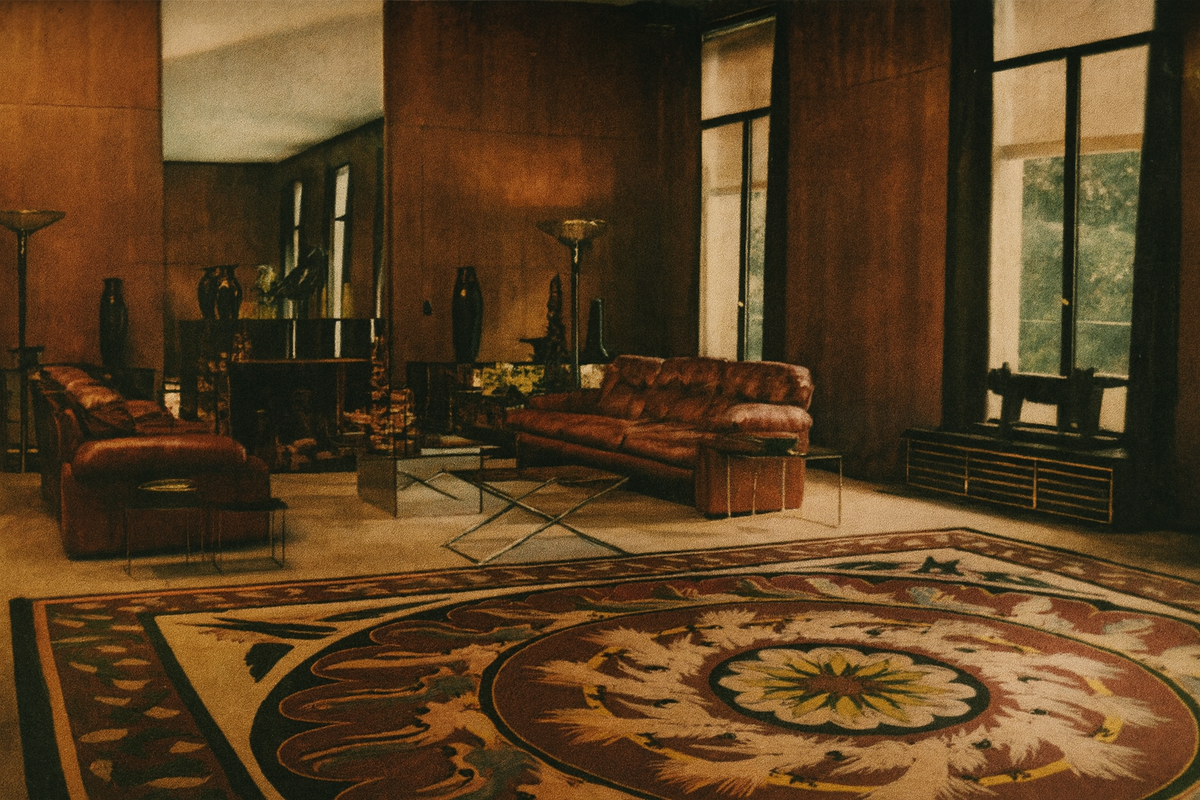
The issue's feature, "Oasis in Paris," opened the doors to Yves Saint Laurent's private duplex—not as spectacle, but as confession. Here was the designer who had liberated women from rigid couture, who had sent tuxedos and peasant blouses down the same runways, now surrounded by seventeenth-century Chinese sculptures, African masks, Art Deco lacquerwork, and humble white slipcovers. The photographs were quiet, almost ascetic. No flamboyance. No performance. Just a man at home with his books, his art, and the objects that fed his genius.
For anyone who believed fashion began and ended at the hemline, this was proof otherwise.
Paris, 1971: The Year Sophistication Got Complicated
By November 1971, the revolutionary fervor of the sixties had curdled into something harder to name. The Vietnam War dragged on. Women's liberation was dismantling workplace hierarchies and social scripts. The youthquake—that explosion of miniskirts and mod rebellion—had matured into a hunger for refinement, but one still laced with defiance.
Paris remained fashion's throne, but the rules had shifted. Yves Saint Laurent was rewriting them. His Rive Gauche line had already democratized high design, making artistry accessible without sacrificing its soul. He understood that modern women needed more than garments—they needed armor, identity, freedom. His work bridged haute couture and ready-to-wear, collapsing the false divide between art and commerce.
Against this backdrop, Vogue's decision to profile his home was more than editorial choice—it was cultural strategy. Fashion, the magazine insisted, was inseparable from how one lived, thought, and surrounded oneself with beauty. Saint Laurent was not just a couturier. He was a philosopher of style, and his duplex was the text.
Archive Details
Historical Figure: Yves Saint Laurent
Issue Date: November 1, 1971
Archive Source: Vogue Magazine
Feature Title: "Oasis in Paris"
Editor-in-Chief: Grace Mirabella
Cover Photographer: Irving Penn
The Architecture of Intimacy
The "Oasis in Paris" spread unfolded like a visual essay, each photograph composed with the precision of a runway collection. Readers saw light pooling on polished Art Deco metalwork, the grain of ancient Chinese wood, the contrast between modernist severity and centuries-old craftsmanship. This was not decoration. This was curation as autobiography.
Vogue captured Saint Laurent's spaces the way great war photographers captured battlefields—not with sensationalism, but with devastating clarity. The magazine showed that personal style was total, extending from the cut of a jacket to the placement of a book, from the drape of slipcovers to the spirituality of African sculpture.
For readers accustomed to fashion as surface, this was revelation. Style was atmosphere. It was thought made visible.
The Cover and the Contradiction
Irving Penn's cover photograph set the terms: a model in eveningwear and Tiffany jewels, shot with monastic restraint. No excess. No distraction. Pure line. This was Grace Mirabella's Vogue—the magazine had recently transitioned from Diana Vreeland's maximalism to something cooler, more architectural.
Inside, "Oasis in Paris" delivered the same discipline. No gilt, no grandeur. Instead: books stacked like companions, souvenirs chosen for memory rather than display, white slipcovers that could be washed. The contrast was deliberate. High fashion on the cover, human scale inside. Glamour and humility in conversation.
This was Vogue at its most sophisticated—capable of holding contradictions without collapsing them.
Ten Objects, One Philosophy
The photographs and captions from the spread reveal Saint Laurent's design philosophy through what he chose to live with:
His shelves held literature, philosophy, art history. The duplex functioned as library and salon, a space where ideas lived alongside objects.
Seventeenth-century sculptures and ceramics anchored his rooms in deep cultural time, grounding modernist impulses in centuries of craft tradition.
Vogue noted his preference for washable white slipcovers—an almost monastic touch that refused ostentation even as he collected museumworthy art.
He surrounded himself with souvenirs, photographs, modest mementos. Emotional value outweighed decorative impact.
His dining room featured a round table, chosen so every guest could see one another. Equality and intimacy encoded in furniture.
One room honored 1930s modernism: lacquered walls, polished leathers, works by Jean Dunand. Saint Laurent saw Art Deco as fashion's mirror—clean lines concealing intense craft.
Large sculptures and masks brought non-Western spirituality into European interiors, challenging the conventions of Parisian taste.
A Paul Colin portrait and related objects celebrated the icon who had electrified Paris since the 1920s, linking Saint Laurent to an earlier generation of boundary-breakers.
Chinese ceramics beside African sculpture beside European Art Deco. His home staged a dialogue between continents, a refusal of cultural hierarchy.
The final photograph showed the couturier at ease in his living room, proof that this was not a set piece but a lived reality. Creativity and rest occupying the same frame.
Why Collectors Covet This Issue
Cultural Authority
Any issue offering intimate access to Yves Saint Laurent's world becomes instant historical record. His influence on twentieth-century fashion is absolute; documentation of his private life is rare.
Lifestyle as Evidence
Unlike pure fashion editorials, this feature captured interiors, art, design philosophy—making it essential for scholars of both fashion history and decorative arts.
Editorial Transition
Published months after Diana Vreeland's departure and Grace Mirabella's ascension, this issue marks a pivot point in Vogue's editorial identity, from theatrical to architectural.
Photographic Archive
The images of Saint Laurent's duplex function as primary source material, visual evidence of how one of fashion's greatest minds constructed his private world.
Original copies of Vogue November 1971 trade as cultural artifacts, not simply fashion references. They document a moment when the magazine functioned as anthropology.
Why It Endures
Early 1970s Vogue remains essential because it refused to separate style from substance. Each issue tracked shifting gender dynamics, cultural collisions, the expansion of fashion into a complete philosophy of living.
"Oasis in Paris" stands out even within this archive. It captured Saint Laurent not in performance—not at the atelier, not on the runway—but in stillness. Surrounded by books, art, and the quietude that fueled his vision.
Today, when fashion is consumed instantly and discarded just as fast, holding an original copy of Vogue November 1971 restores weight to the medium. Magazines were once treasured objects, studied slowly, kept as reference libraries. This issue proves why.
The Lasting Image
More than fifty years later, the November 1, 1971 issue of Vogue remains one of the most penetrating portraits of Yves Saint Laurent ever published. "Oasis in Paris" showed the sanctuary of a man who reshaped how women dressed for the modern world—and in doing so, revealed that his aesthetic was never just about clothes. It was about balancing Art Deco elegance with African sculpture's spiritual force, Chinese antiquity's wisdom with the simplicity of washable slipcovers.
To hold this issue today is to enter his salon, to see how beauty becomes philosophy when arranged with intention.
This is not just fashion history. This is evidence of how we learned to live deliberately.
For anyone who values the material record of twentieth-century culture, vintage Vogue magazines are not reading material. They are primary sources. They are proof.
For Collectors and Scholars
Our collection of original Vogue magazines spans the 1930s through the 1980s, tracing not just fashion history but the evolution of cultural self-consciousness. Each issue is a time capsule, a primary document, a window into how people understood themselves through style.
Browse Vogue Magazine Collection