
Ford, the Wagner Act, and the Fight for America's Workers
When the Supreme Court upheld labor's right to organize, Henry Ford declared war. Life Magazine captured the collision.
On April 26, 1937, Americans who opened their copies of Life Magazine witnessed more than industrial reportage. They held in their hands a chronicle of rupture—the moment when the Supreme Court handed organized labor its first unambiguous legal victory, and Henry Ford declared he would fight that victory to the end.
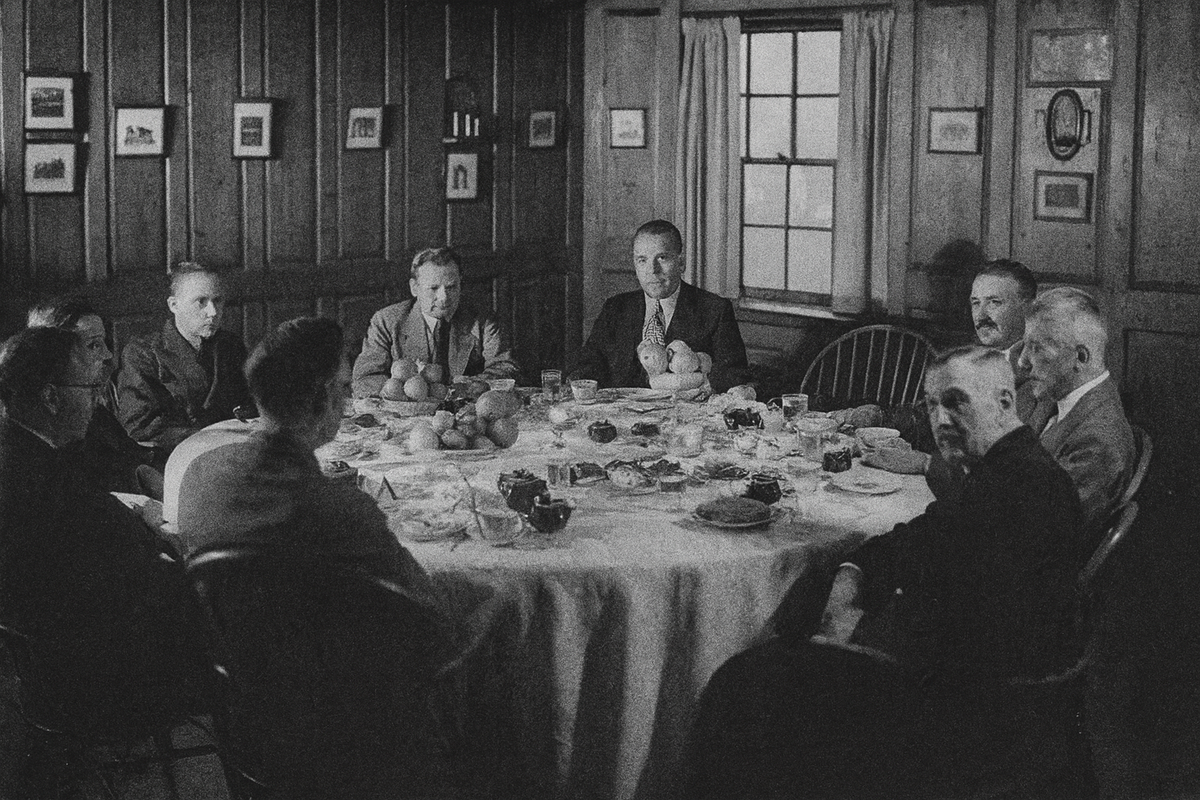
This wasn't policy analysis. It was theater: Justice Owen J. Roberts in his robes, Ford's nine executives around a Dearborn luncheon table, Harry Bennett's bloodied face after the 1932 Rouge massacre, and—most chilling—a steel guard tower at an Alabama textile mill, mounted with machine guns to repel union organizers.
Life understood what newspapers could not: that history is made visible through faces, through architecture, through blood. The Wagner Act was law. But Ford's empire was defiance made steel.
Archive Details
Issue Date: April 26, 1937
Historical Figures: Justice Owen J. Roberts, Henry Ford, Harry Bennett, Senator Robert Wagner
Archive Source: Life Magazine Collection
Historical Context: Supreme Court upholds the Wagner Act (National Labor Relations Act) in 5-4 decision
The Court That Changed Everything
The Great Depression had not merely displaced workers—it had shattered the illusion that capital and labor shared common ground. By 1935, Congress passed the Wagner Act, granting workers the right to organize and creating the National Labor Relations Board to enforce it. Employers immediately challenged the law's constitutionality.
Most observers expected the Supreme Court to strike it down. The Court had already dismantled key New Deal programs. But in April 1937, Justice Owen J. Roberts broke ranks. His swing vote in a 5–4 decision upheld the Wagner Act, and with it, transformed American labor law overnight.
For the first time, unions had federal protection. For the first time, employers could not simply fire organizers and call in private police. The CIO, emboldened, prepared to unionize every major industry in the country.
Henry Ford prepared for war.
Life's Lens: Power Made Visible
Life Magazine had already established itself as the nation's defining visual journal. Where newspapers offered columns of type, Life offered witness. Its April 26, 1937 coverage of the Wagner Act decision deployed photography not as illustration but as argument.
The magazine presented Justice Roberts in formal solemnity—the man whose vote rewrote the compact between worker and boss. Then it took readers inside Ford's Dearborn compound, where nine executives sat for a luncheon portrait. Each man was identified by name and title. The message was unmistakable: this is how power organizes itself. This is the hierarchy that will resist.
Other photographs carried more menace. Harry Bennett, Ford's notorious head of security, appeared in two images—one showing him bleeding after the 1932 "Hunger March" clash that left four Communist demonstrators dead at the Rouge gates, another depicting him at ease in his office, prepared to repel the next wave of agitation.
Then there was the guard tower: a steel structure at a Talladega, Alabama textile mill, positioned to house machine guns should union drives turn violent. The photograph required no caption to convey its meaning. This was the South's answer to federal law.
Life excelled at making abstract power concrete. Readers didn't just learn about labor conflict—they saw its machinery.
Ford's Defiance: "We'll Never Recognize Any Union"
While General Motors negotiated with the United Auto Workers and Chrysler wavered, Henry Ford stood alone. His position was unambiguous: "We'll never recognize any union."
Ford framed his resistance not as opposition to workers but as defense against outside manipulation. He believed unions were instruments of financiers and radicals determined to destroy his company. To Ford, the Rouge complex—the most integrated industrial facility on Earth—proved that enlightened management made unions unnecessary. He paid higher wages than his competitors. He hired workers others wouldn't. Why would they need protection from him?
But Ford's paternalism had limits, and those limits were enforced by Harry Bennett. Bennett ran Ford's Service Department, a private security force that functioned as corporate militia. Workers knew that organizing meant confronting Bennett's men. The 1932 massacre was not an aberration—it was a demonstration.
Even after the Supreme Court ruling, Ford saw no reason to capitulate. The law might have changed. His factory had not.
The CIO's Southern Campaign and the Machinery of Fear
The Wagner Act's impact extended far beyond Detroit. Life documented the CIO's push into Southern textile mills, where conditions rivaled the worst of industrial exploitation and resistance took forms unthinkable in Northern cities.
The Talladega guard tower was not hypothetical deterrence. It represented a calculated message: we will kill before we negotiate. Southern mill owners, watching Northern factories fall to union drives, prepared for siege. The tower, mounted and ready, symbolized how far capital would go to preserve the old order.
For readers accustomed to thinking of labor conflict as a Northern, urban phenomenon, these images forced recognition. The struggle was national. The stakes were existential.
Key Themes in Life's Coverage
The Supreme Court Decision
Justice Roberts' swing vote upholding the Wagner Act gave unprecedented power to unions and Congress, fundamentally altering the balance between labor and capital.
Ford's Industrial Empire
The River Rouge complex represented the most remarkable example of large-scale industrial integration in the world—and Ford's determination to control it absolutely.
Harry Bennett's Violence
Photographs of Bennett bleeding after the 1932 clash reminded readers that labor struggles at the Rouge were matters of physical confrontation and bloodshed.
Southern Textile Struggles
The CIO's campaign extended beyond Detroit, highlighting mill workers' hardships and the extreme anti-union defenses erected throughout the South.
Corporate Leadership
The luncheon photograph of Ford's top executives humanized the men, but the caption made clear: Ford remained the "boss."
A National Turning Point
The words and images together captured America at a crossroads—the moment when federal law met industrial resistance.
Why This Issue Endures
Collectors prize the April 26, 1937 issue of Life Magazine not merely for its age but for its precision. It captures the precise moment when American labor law pivoted, and it does so through irreplaceable visual documentation.
The issue contains the faces of history's architects: Justice Roberts, whose vote altered the balance; Senator Wagner, whose law bore his name; Henry Ford, whose resistance defined an era; and Harry Bennett, whose violence enforced it. The photographs—Ford's executives at lunch, Bennett's bloodied aftermath, the Alabama guard tower—remain among the most potent labor images of the decade.
For descendants of factory workers, this magazine offers tangible connection to ancestral struggle. For students of American power, it provides primary evidence of how elites responded to legal constraint. For collectors of vintage Life, it represents one of the publication's most significant domestic stories—a document not just of what happened, but of how Americans first saw it happen.
The Permanence of Photojournalism
What makes vintage Life indispensable is its transformation of policy into presence. Court rulings are abstractions until you see the justices who rendered them. Corporate power is theory until you see nine men around a table, one man conspicuously absent because he is the boss.
This is why original issues matter. Digital archives preserve content, but they cannot replicate the material experience of holding April 26, 1937 in your hands—of turning pages that were turned in Dearborn factories and Manhattan offices and Alabama mill towns, by people who understood they were living through transformation.
These magazines are not nostalgia. They are testimony.
Collector Significance
The April 26, 1937 issue of Life Magazine represents one of the most important labor-related publications of the 1930s. Its combination of historic timing, visual power, and cultural resonance makes it essential for serious collectors.
Historic Timing
Published days after the Supreme Court's landmark decision, this issue captures the moment when American labor law fundamentally changed.
Visual Documentation
Contains irreplaceable photographs of Justice Roberts, Ford's executives, Harry Bennett's confrontations, and the Alabama guard tower.
Cultural Resonance
Labor rights remain contested today. This magazine captures their moment of legal emergence with unmatched visual power.
Personal Connection
For families whose ancestors worked in Depression-era factories, this provides tangible connection to their history and struggles.
Explore the Archive
Thousands of original Life Magazines spanning the 1930s through the 1970s are available in our collection. Each issue preserves culture, politics, conflict, and art as they unfolded—captured by photographers and writers who witnessed history before it was history.
Browse Life Magazine CollectionWhether you collect labor history, study American photojournalism, or honor family members who worked in Depression-era factories, these magazines offer rare access to history as it was first reported—unfiltered, urgent, and irreplaceable.
Conclusion: The Issue That Captured a Crossroads
The April 26, 1937 issue of Life Magazine remains essential reading for anyone studying American labor, industrial power, or the New Deal's contested legacy. It documents both the Supreme Court's historic endorsement of the Wagner Act and Henry Ford's fierce refusal to comply—a collision between law and will that would define the next decade of American work.
Life's photographs did what prose alone could not: they showed readers the justices in Washington who upheld federal power, and Ford in Dearborn who defied it. They revealed the boardrooms, the bloodshed, the factory gates, and the guard towers.
For collectors and historians today, this issue is not artifact—it is evidence. Evidence of the moment when American workers gained legal standing, and American capital prepared to resist with every resource at its command.