
From Battlefield to Barnyard: The First Civilian Jeeps
How Life Magazine Documented America's Wartime Transition in a Single January Issue
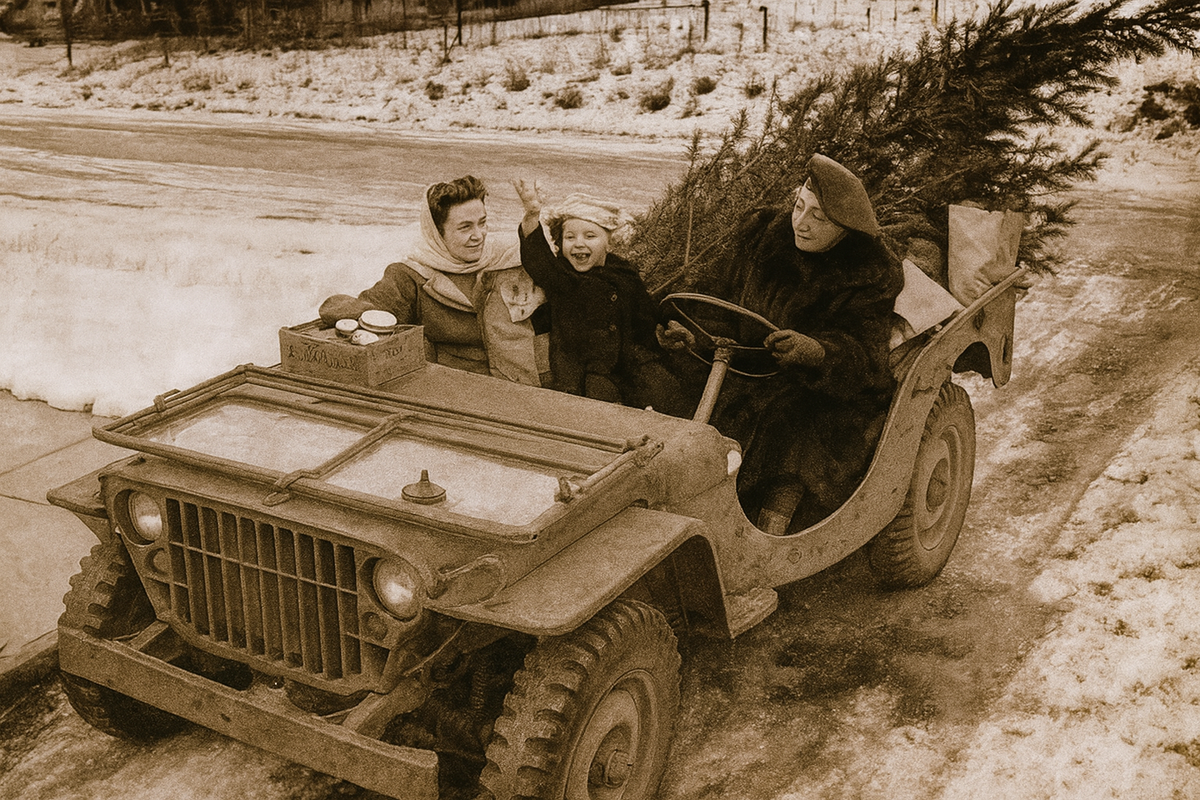
Mrs. Heine of Lucas, Kansas steered her newly purchased Jeep through January snow, a Christmas tree jutting from the back seat, groceries wedged beside bundled neighbors. The photograph that captured this moment—published in the January 3, 1944 issue of Life Magazine—marked a turning point most readers wouldn't fully grasp for years. The vehicle carrying hay and holiday supplies across the Kansas prairie had, just months earlier, carried ammunition and soldiers across European battlefields.
This was the first documented sale of Army surplus jeeps to American civilians.
The article, titled "U.S. Civilians Buy Their First Jeeps," did more than chronicle an unusual transaction. It captured the precise moment when wartime technology crossed into peacetime hands, when the machinery of global conflict began its transformation into the tools of domestic prosperity. For a nation still rationing butter and gasoline, still counting casualties in the Pacific, the Jeep's arrival on American farms represented something radical: proof that the war would end, and proof that when it did, the country would emerge fundamentally changed.
Archive Details
Historical Subjects: The Heine Family, Lucas, Kansas
Issue Date: January 3, 1944
Archive Source: Life Magazine
Article Title: "U.S. Civilians Buy Their First Jeeps"
January 3, 1944: A Date at the Crossroads
America had been at war for just over two years. The Jeep—officially designated the Willys MB and Ford GPW—had already earned its reputation as the most versatile vehicle the military had ever deployed. Engineered in a frantic 49-day development cycle before Pearl Harbor, it had proven itself in North African deserts, Italian mountains, and Pacific jungles. Soldiers called it "the vehicle that won the war," and they weren't entirely exaggerating.
By late 1943, production had reached such volume that the Army began releasing small batches of reconditioned vehicles through authorized dealers. The timing was deliberate. Military planners understood that surplus equipment would flood the market after victory, and controlled civilian releases served as both economic test and public relations gesture.
Life's coverage arrived at the perfect cultural moment. Readers were exhausted by rationing, weary from labor shortages, and desperate for any signal that normal life would return. The Jeep article provided that signal in the most tangible form imaginable: photographs of an ordinary Kansas family using a military vehicle to feed cattle, haul hay, and run Christmas errands.
Three developments converged in this single issue:
Life's Photographic Power
By 1944, Life Magazine had established itself as the defining photojournalism platform in America. While newspapers printed wire service photographs and competitors like The Saturday Evening Post favored illustrated covers, Life built entire narratives from images. Readers didn't just learn about events—they witnessed them.
The Jeep story exemplified this approach.
Across multiple pages, Life documented the Heine family's first weeks with their Army surplus vehicle:
- Mrs. Heine navigating snowy roads, her Jeep loaded with neighbors, groceries, and a conspicuous Christmas tree—a deliberate visual connection between military utility and domestic comfort.
- Mr. Heine feeding cattle on open range, the Jeep climbing hills and fording streams that would have stopped conventional farm trucks.
- The Jeep hitched to a hay trailer, which Heine praised as "the best truck hitch ever"—a farmer's endorsement that carried more weight than any manufacturer's claim.
- Town mechanics crowding around the vehicle, examining its four-wheel drive system and spartan dashboard with the fascination mechanics reserve for genuinely novel engineering.
- Rows of battered Army jeeps in a Chicago reconditioning facility, showing the hard service these vehicles had endured before reaching civilian buyers.
The photographs worked because they balanced technical documentation with human narrative. Life didn't just show machinery—it showed Mrs. Heine behind the wheel, Mr. Heine hauling fence posts, neighbors studying the engine. The Jeep wasn't presented as hardware. It was presented as a character in the story of American adaptability.
The text complemented rather than competed with the images. Readers learned that reconditioned jeeps sold for $750, delivered 17 miles per gallon, and came through Chicago auto dealers. But the real information lived in the photographs: a mother could drive one, a farmer could trust one, a community could gather around one.
The Cultural Architecture of the Issue
The January 3, 1944 cover featured actress Barbara Bel Geddes, signaling Life's editorial balance between wartime gravity and cultural coverage. But once readers moved past that cover, the Jeep photo essay dominated.
Life's approach differed fundamentally from its competitors. Where newspapers provided facts and The Saturday Evening Post offered commentary, Life created presence. The cattle circling Heine's Jeep, the mechanics bent over the engine, Mrs. Heine gripping the steering wheel through January cold—these images transported readers to Lucas, Kansas without requiring a single word of description.
This was photojournalism as immersion. Life didn't report on the Jeep's civilian debut. It placed readers in the passenger seat.
The magazine understood something profound about wartime psychology: Americans needed to see the future, not just read about it. Editorial descriptions of postwar prosperity felt abstract. But a photograph of a Kansas mother driving a military vehicle to buy groceries? That was concrete. That was imaginable. That was real.
The Specifications That Mattered
The article's power resided in its specific details, the granular facts that transformed reporting into documentation:
- The Heine Family of Lucas, Kansas—among the first U.S. civilians to purchase a surplus Jeep, they used it for farm work, family transportation, and community service.
- Price: $750—roughly equivalent to six months of a factory worker's salary, but still within reach for an established farming family.
- Fuel Economy: 17 miles per gallon—remarkable efficiency for a vehicle designed to prioritize capability over economy.
- Christmas Errands—Mrs. Heine's grocery run with the conspicuous tree symbolized the Jeep's transformation from instrument of war to tool of everyday life.
- Farm Applications—feeding cattle across rough terrain, hauling hay trailers, repairing fences in remote pastures, even hunting wolves that threatened livestock.
- Community Response—local mechanics and neighbors gathered to study the vehicle's mechanical innovations, particularly its four-wheel drive system.
- Chicago Reconditioning Source—Army surplus vehicles were refurbished and sold through authorized auto dealers, creating a controlled release of military equipment into civilian markets.
- Postwar Symbolism—the Jeep represented consumer freedom after years of rationing, manufacturing restrictions, and material sacrifice.
- Technology Transfer—a clear example of wartime innovation finding peacetime application, previewing the broader economic transition that would define the late 1940s.
- Cultural Resonance—beyond its practical utility, the Jeep functioned as a metaphor for American ingenuity, resilience, and the capacity to transform destruction into creation.
These weren't random facts. They were the building blocks of a narrative about national transformation.
The Collector's Perspective
For vintage magazine collectors, the January 3, 1944 issue occupies a unique position. It documents a specific inflection point—the moment when civilian Americans first gained access to the machinery that would reshape postwar transportation and recreation.
Serious Jeep historians, WWII collectors, and scholars of American material culture prize this issue because it documents not just a vehicle sale, but a cultural shift. The Heine family's purchase represented the beginning of a long transformation: military Jeeps into CJ models, CJ models into recreational vehicles, recreational vehicles into the foundation of the modern SUV category.
The issue matters because it captured the beginning, not the conclusion.
Why These Issues Endure
Life Magazine's wartime issues persist in cultural memory because they offered more than news reporting—they provided visual permanence to transient moments.
In 1944, Americans couldn't record their own experiences the way later generations would. They relied on professional photojournalists to document the era. Life performed this service with exceptional skill, creating a visual archive that families would save, share, and pass down through generations.
For Jeep enthusiasts specifically, this issue represents the origin story of civilian Jeep culture. Before the CJ-2A, before the Wagoneer, before the Wrangler, there was a Kansas farmer feeding cattle from an Army surplus vehicle. That photograph established a lineage that runs unbroken to the present.
For collectors more broadly, the issue demonstrates photojournalism's unique capacity to shape public imagination. The Jeep wasn't just reported—it was framed, contextualized, and elevated into a symbol of American adaptability. Life didn't simply document the transition from war to peace; it helped construct the narrative Americans would use to understand that transition.
Where to Find These Historical Artifacts
Thousands of original Life magazines remain available to collectors today. From the 1930s through the 1970s, Life documented the rise of consumer culture, global conflicts, civil rights movements, and cultural revolutions. Each issue functions as a time capsule, preserving not just information but the physical experience of encountering that information in its original form.
Browse Life Magazine CollectionWhether you're researching Jeep history, studying World War II home front culture, or simply connecting with mid-century American experience, these magazines offer something digital archives cannot: the weight, texture, and smell of history itself.
Conclusion: The Beginning of a Legend
The January 3, 1944 issue of Life Magazine and its article "U.S. Civilians Buy Their First Jeeps" stands as one of the most significant documents in automotive and cultural history.
It showed a Kansas family converting military hardware into farm equipment. It demonstrated how wartime innovation could serve peacetime needs. And it offered Americans their first glimpse of a postwar world built not only on sacrifice but on resilience, practicality, and the imaginative repurposing of what war had created.
For anyone who values historical documentation, this issue is essential. For those who understand the Jeep's cultural significance, it is nothing less than the founding text—the moment when a military vehicle became an American icon.