
From "Hopeless Fatty" to Model: Inside the Brutal Beauty Machine of 1950s America
How Ladies' Home Journal weaponized shame, sold transformation, and scripted a generation of women's self-worth
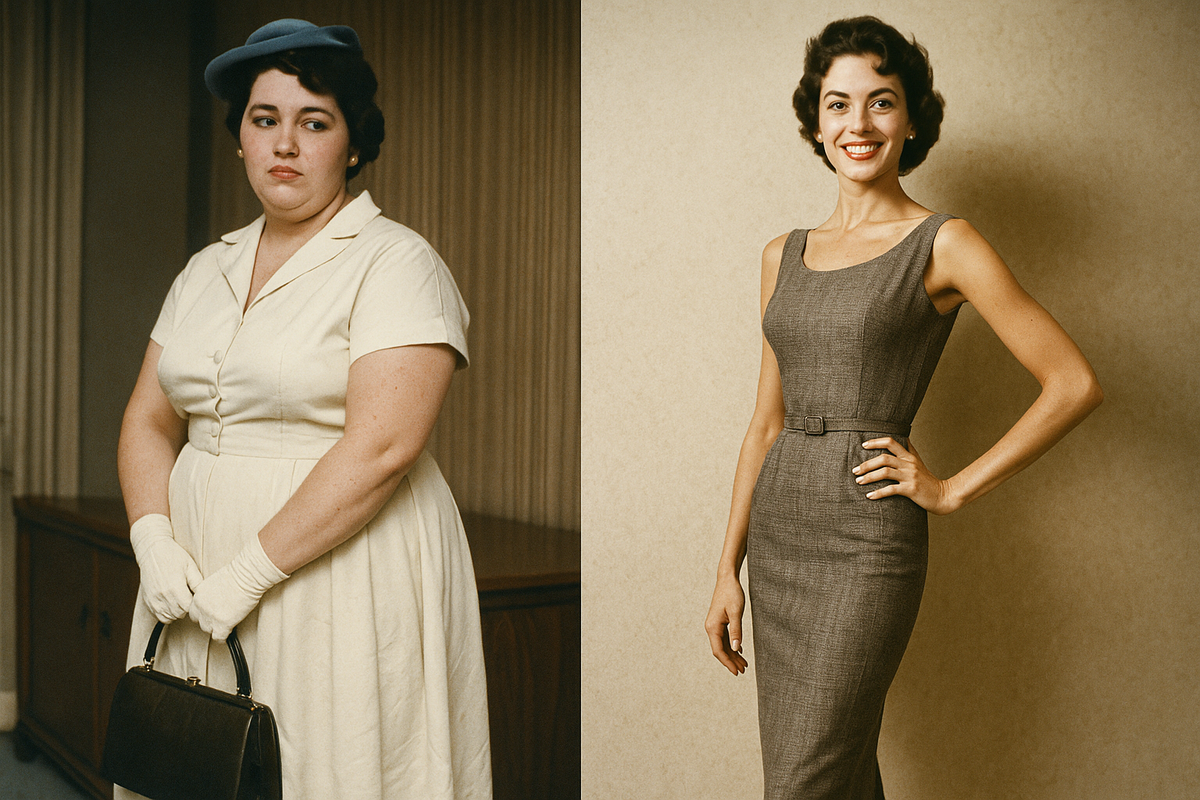
In January 1955, millions of American women opened their copies of Ladies' Home Journal and found a girl staring back at them—twice. On one page, Diane Macom stood rigid in a white dress, gloves, and hat, her figure thick, her posture defeated. The caption was merciless: "dowdy dumpy look." Turn the page, and there she was again: transformed, slim, smiling. Bust 34. Waist 22. Hips 34. Weight 110 pounds. The measurements were printed like a report card. The message was clear: this could be you, if you have the discipline.
The article, "I Was a Hopeless Fatty… Now I'm a Model," wasn't selling hope. It was selling shame—and then redemption. Written by Dawn Crowell Norman, the Journal's beauty editor, it documented how a young woman from New Brunswick, New Jersey shed fifty pounds and, in doing so, shed her "inferiority complex." But this wasn't just one girl's triumph over extra helpings at dinner. It was a blueprint for how postwar America taught women that their value was measured in inches, that beauty was a moral imperative, and that magazines like the Journal held the keys to social survival.
Today, that issue sits in archives and collectors' shelves as something more than nostalgia. It's evidence.
Archive Details
Subject: Diane Macom, New Brunswick, New Jersey
Publication: Ladies' Home Journal, January 1955
Author: Dawn Crowell Norman, Beauty Editor
Feature Title: "I Was a Hopeless Fatty… Now I'm a Model"
Circulation: Over 6 million readers
Historical Context: Postwar America, peak of suburban domesticity and beauty culture
The Postwar Pressure Cooker
By 1955, America had metabolized the war. Suburbs sprawled. Television sets glowed in living rooms. The nuclear family—father at work, mother at home—became the default setting for respectability. But for women, the postwar "return to normal" came with a tightening noose of expectations. Be thin. Be polished. Be grateful. Be invisible except when decorative.
Diane Macom's story wasn't an outlier. It was a mirror held up to an entire generation of young women navigating high school dances, dating hierarchies, and the cold algebra of peer judgment. To be overweight in the 1950s wasn't just uncomfortable—it was social exile. And Ladies' Home Journal, with its circulation surpassing 6 million, wasn't documenting this anxiety. It was manufacturing it.
The magazine understood its assignment. Postwar teenage culture was booming—the word "teenager" itself was still new—and the Journal positioned itself as the authority on how girls should transform into women. Slimness wasn't presented as one choice among many. It was the prerequisite for everything else: popularity, romance, marriage, motherhood. The unspoken contract was simple: control your body, control your future.
The Architecture of Transformation
What made Diane's story so effective wasn't subtlety. It was structure.
The photographs did the heavy lifting. The "before" image was staged to maximize unflattering angles—stiff posture, unfashionable clothes, a body presented as a problem to be solved. The "after" shot delivered the fantasy: graceful, fitted, smiling. These weren't candid snapshots. They were propaganda.
Then came the interview, written in a disarming Q&A format that mimicked intimacy:
"What thrills you most about losing 50 pounds?"
"Did you cut out all sweets?"
"Did you exercise during your diet?"
Diane's answers were a mix of practicality and vulnerability. She described a punishing regimen—fruit for breakfast, small portions, no seconds, no sweets, forty-five minutes of walking daily—but framed it as liberation. The weight loss didn't just change her body. It "erased" her inferiority complex. It made boys notice her. It let her dance without shame.
The magazine added a sidebar: "Diane's Tips to Teenagers." Here, the transformation extended beyond the scale. Fold your lingerie carefully. Apply powder and lipstick correctly. Stand with grace. Wear conservative shoes and coats. Beauty, the Journal insisted, wasn't just about losing weight. It was about total self-management—a performance of femininity that required constant rehearsal.
The Journal as Cultural Authority
Ladies' Home Journal wasn't just selling magazines. It was selling a worldview.
By the mid-1950s, it was one of the most powerful voices in American women's lives, blending fiction, photography, recipes, decorating advice, and features like Diane's into a seamless narrative of what womanhood should look like. Other publications might have treated dieting as a medical issue. The Journal made it moral. Slimness became synonymous with self-control, and self-control became synonymous with worthiness.
What distinguished the Journal from its competitors was its emotional register. It didn't lecture. It seduced. Every article—whether about dieting, decorating, or child-rearing—reinforced the same lesson: the ideal woman was disciplined, attractive, devoted to improvement, and quietly ambitious within narrow confines. Diane's story worked because it offered both aspiration and instruction. You, too, could transform. You, too, could earn your place.
What the Story Really Taught
Strip away the makeup tips and the measurements, and the article's core lessons are stark:
Diane's transformation wasn't private. It was documented, measured, and held up for scrutiny. Her bust, waist, and hips were printed for millions to judge.
The ability to refuse sweets and walk for forty-five minutes daily wasn't just about health. It was proof of moral fiber.
The ideal wasn't abstract. It was Bust 34, Waist 22, Hips 34. Precision mattered. Approximation was failure.
Diane didn't gain confidence through self-acceptance. She gained it through conformity. Only when her body matched the standard did she feel worthy.
The language—"hopeless fatty," "dowdy dumpy"—wasn't accidental. It was designed to sting, to create a problem desperate for the Journal's solution.
The Magazine as Mirror and Weapon
Ladies' Home Journal endures for the same reason LIFE does: it wasn't just reporting on women's lives. It was scripting them. Each recipe, each fashion spread, each beauty feature was a directive. This is how you should look. This is what you should want. This is who you should be.
For modern readers, these magazines provoke a double response. Fascination at the craftsmanship—the photography, the prose, the sheer authority of the editorial voice. And horror at the pressure cooker they created, where a teenage girl's self-worth could hinge on whether she could shrink herself to twenty-two inches at the waist.
Diane Macom's story is both inspiring and chilling. She found confidence. But she found it by meeting a standard designed to keep most women in a state of perpetual inadequacy.
Why This Issue Endures
Historical Precision
The article captures the exact moment when postwar America's obsession with domesticity and appearance reached fever pitch. It's a snapshot of the beauty-industrial complex at full throttle.
Visual Evidence
Before-and-after transformations are collector gold because they crystallize ideology into image. These photos don't just show change—they mandate it.
Cultural Archaeology
For anyone studying body image, diet culture, or women's history, this issue is primary source material. It shows what was said, how it was said, and what was left unsaid.
Personal Resonance
Many collectors seek these issues because their mothers or grandmothers read them, lived by them, and internalized their lessons. Owning the magazine is owning a piece of family memory—and reckoning with it.
Market Demand
Issues featuring dramatic transformation stories, especially from the 1950s, remain highly sought after. They're not just collectibles. They're conversation starters.
Why This Issue Matters Now
The January 1955 Ladies' Home Journal featuring "I Was a Hopeless Fatty… Now I'm a Model" isn't a relic. It's a warning. The language has softened—we don't say "hopeless fatty" anymore—but the machinery is still running. The measurements have changed, but the message hasn't: your body is never quite right, and we're here to fix it.
Diane Macom lost fifty pounds and gained a modeling contract. But she also gained an inferiority complex that could only be erased through conformity. That's the bargain magazines like the Journal offered: transform yourself completely, and maybe—maybe—you'll be enough.
Holding this issue today means holding that bargain in your hands. It's a reminder that aspiration and oppression often wear the same smile.
Explore Women's History Through Original Magazines
If you want to understand how beauty culture shaped—and scarred—generations of American women, vintage magazines are the richest archive available. They don't just tell you what people thought. They show you what people internalized.
Browse Ladies' Home Journal Magazine CollectionEach issue is a living artifact—part instruction manual, part cultural diary, part time capsule of expectations.