
The Saturday Evening Post, August 19, 1950: When Lionel Barrymore Told All
Hollywood's greatest dynasty confesses, Norman Rockwell paints America, and a magazine captures the nation at its cultural peak
The traveling salesman slumps in his boarding house chair, necktie loosened, cards spread before him in a game of solitaire. Norman Rockwell painted him with characteristic tenderness—the ordinary American, caught between appointments, playing out his lonely evening ritual. But anyone who bought the August 19, 1950 issue of The Saturday Evening Post for that cover alone had no idea what waited inside.
Turn past Rockwell's weary salesman and you enter a different world entirely: Hollywood at its most candid, most glamorous, most ruthlessly honest. "We Barrymores!" screamed the headline, and beneath it, Lionel Barrymore—patriarch of America's theatrical dynasty—began dismantling the family myth in his own words.
This wasn't publicity. This was confession.
Archive Metadata
Historical Figure: Lionel Barrymore
Issue Date: August 19, 1950
Archive Source: The Saturday Evening Post
Cover Artist: Norman Rockwell
Featured Memoir: "We Barrymores!" (First Installment)
The Dynasty Speaks
By 1950, the Barrymore name had ruled American entertainment for two centuries. Louisa Lane Drew commanded 19th-century stages. Maurice Barrymore and Georgiana Drew raised three children who would define acting for generations: Ethel, the Broadway goddess; John, "The Great Profile," whose genius burned as bright as his self-destruction; and Lionel himself, who survived them all to tell the story.
The Post gave Lionel eight pages to do it. No studio handlers. No sanitized press releases. Just the man who'd watched his brother drink himself toward death, who'd seen his sister become American royalty, who'd traded the stage for Hollywood and lived to reckon with what that transformation meant.
The first installment traced the Barrymore-Drew theatrical lineage back to the 1700s, acknowledging the family rivalries and tragedies alongside the triumphs. Readers in 1950 knew the Barrymores as legends. Lionel showed them the human beings—flawed, brilliant, damaged, magnificent.
A Magazine at the Height of Its Powers
The Saturday Evening Post had been shaping American consciousness since 1821, but the postwar years marked its apex. Six million subscribers. Norman Rockwell covers that became cultural touchstones. A reputation for mixing high and low, serious and entertaining, foreign correspondence and Hollywood gossip without apology.
The August 19, 1950 issue demonstrated this range with surgical precision. Alongside Lionel's memoir sat Marguerite Higgins' "The Terrible Days in Korea"—frontline reporting from a woman who would win the Pulitzer Prize for her coverage. There was fiction ("Queen of the Ball"), political commentary, humor columns. The Post didn't segment its audience. It assumed Americans could handle complexity: war and celebrity, tragedy and comedy, Rockwell's everyman and Garbo's face in the same 100 pages.
This was the magazine at its cultural zenith, before television fractured mass media into niches, before specialization killed the general-interest format. The Post spoke to everyone because it refused to talk down to anyone.
The Photographs That Sold the Story
The Post paired Lionel's prose with images that transformed memoir into visual history:
Greta Garbo and John Barrymore
Locked in their Grand Hotel (1932) embrace—one of cinema's defining moments, when stage actors became movie stars and Hollywood conquered the world.
Ethel and Lionel's Birthday
A private moment made public, showing the aging legends as siblings first, icons second, celebrating Ethel's 70th birthday together.
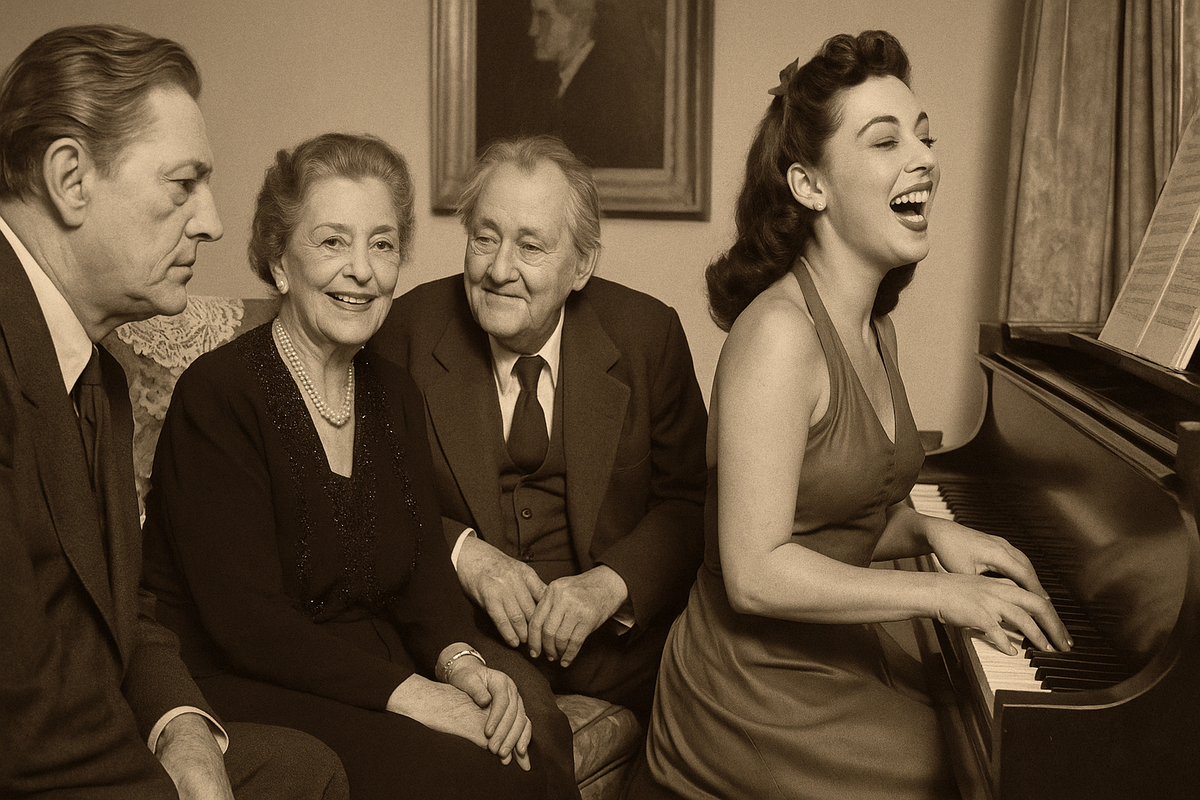
Ann Miller at the Piano
The next generation of Hollywood talent, singing for the old guard, the dynasty continuing through new voices.
John Blyth Barrymore
Proof that the theatrical bloodline ran deep, that this story wouldn't end with Lionel's generation.
These weren't publicity stills. They were artifacts, carefully chosen to anchor Lionel's narrative in visual proof. The Post understood that credibility required evidence, that readers in 1950 wanted intimacy backed by documentation.
The Post's Enduring Architecture
What made the Saturday Evening Post extraordinary wasn't its celebrity profiles or its Rockwell covers in isolation. It was the editorial faith that Americans wanted—deserved—the full spectrum of their culture delivered simultaneously, without hierarchy or condescension.
Korea and Hollywood. High art and popular entertainment. Norman Rockwell's lonely salesman and Lionel Barrymore's dysfunctional dynasty. The Post assumed its readers could hold multiple Americas in their heads at once, and for decades, they proved the magazine right.
These mid-century issues survive as something more than nostalgia. They're blueprints for a lost media ecosystem, proof that mass culture once meant "everything for everyone" rather than "something for someone."
Why August 19, 1950 Matters Now
The Rockwell Cover
His work defines mid-century American visual culture, and original issues command serious prices among collectors.
The Barrymore Memoir
A Hollywood legend's unfiltered first-person account, published while the Golden Age still glittered. Lionel died in 1954.
The Higgins Dispatch
Korea at the war's most desperate moment, reported by a journalist who broke every gender barrier in her profession.
The Cultural Moment
Postwar prosperity meeting Cold War anxiety, television rising, Hollywood's studio system beginning its slow collapse.
This wasn't just a magazine. It was a time capsule sealed at precisely the right moment, capturing the hinge point when one America was ending and another beginning.
Where History Lives
The August 19, 1950 Saturday Evening Post sits at the intersection of American art, celebrity, journalism, and self-mythology. Rockwell's salesman on the cover. Lionel Barrymore's confessions inside. Marguerite Higgins' war reporting alongside fiction and commentary. Six million readers encountering all of it simultaneously, understanding themselves as part of something larger than their individual lives.
For collectors, these magazines offer tangible connection to that moment—not digital scans or reprints, but original artifacts printed when the ink was still fresh, when these stories were breaking news rather than history.
Explore the Archive
Whether you're building a serious collection, researching Hollywood's Golden Age, or preserving family history, these issues provide something increasingly rare: primary sources in their original form, unmediated by algorithms or editorial revision.
Browse The Saturday Evening Post Magazine CollectionHold the August 19, 1950 issue and you're holding the moment when Lionel Barrymore decided the truth mattered more than the legend. You're holding Norman Rockwell's America and Greta Garbo's Hollywood, Marguerite Higgins' Korea and the Post's vision of national identity.
You're holding 1950 itself, preserved in paper and ink.