
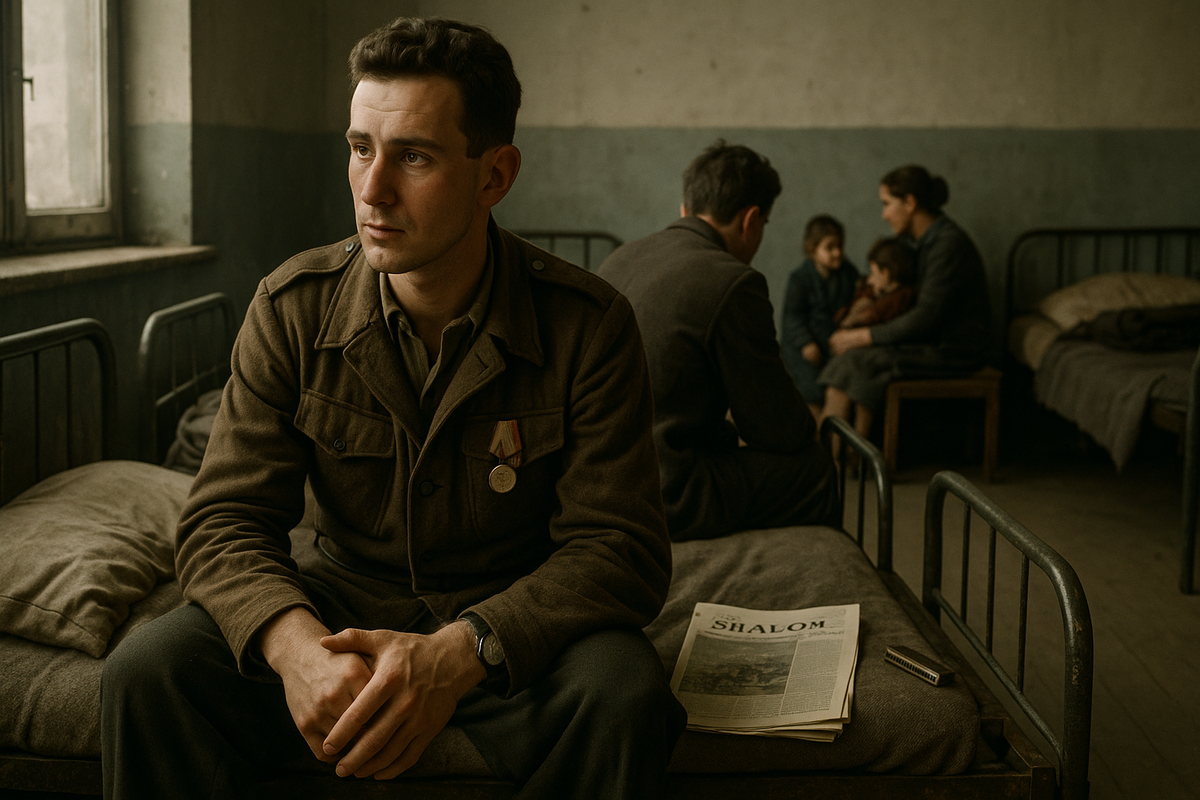
The Seventeen-Year-Old Guerrilla Fighter Who Became the Face of Israel's Birth
How The Saturday Evening Post captured a Polish resistance fighter on the eve of statehood—three weeks before history changed forever
Three weeks before the state of Israel declared its existence, American families sat down to breakfast with a magazine that would become a historical artifact. The April 10, 1948 issue of The Saturday Evening Post arrived in living rooms across the country with a cover depicting an Oregon lumberyard—stacked timber for the postwar housing boom, painted in John Atherton's signature realism. Readers flipped past it to find something far more urgent: the story of a teenage resistance fighter named Jerzy Fordonsky, waiting in a Milan refugee camp for his one-way ticket to war.
Ernest O. Hauser's "One-Way Ticket to Palestine" was not just journalism. It was a photograph of a world standing at a fulcrum point, published in the final days before the British Mandate collapsed and the Middle East was redrawn in blood and declaration. For subscribers in small-town America, it was a collision between two realities: their own prosperity and the still-burning wreckage of Europe.
Archive Details
Historical Figure: Jerzy (Jerry) Fordonsky, Polish-Jewish resistance fighter and displaced person
Issue Date: April 10, 1948
Publication: The Saturday Evening Post
Article: "One-Way Ticket to Palestine" by Ernest O. Hauser
Photography: Eugene Kammerman
Cover Artist: John Atherton
Historical Context: Published three weeks before Israel's declaration of independence (May 14, 1948)
The Boy From Lodz Who Refused to Stay Dead
Jerzy Fordonsky was seventeen when Hauser met him. He had already lived three lifetimes.
Born to a Jewish family in Lodz, Poland, his childhood ended the moment German tanks crossed the border in 1939. What followed was a brutal education: guerrilla warfare at an age when most boys were finishing school, constant flight from Nazi patrols, the methodical erasure of everyone he loved. He fought with resistance units. He wore the uniform of the Polish Army. He collected medals for courage that most men never display in a full military career.
By 1948, he was living in a displaced persons camp in Milan—one of millions of Jewish survivors classified, catalogued, and warehoused by Allied authorities who had won the war but couldn't figure out what to do with the people it had broken. Eugene Kammerman's photographs, which accompanied Hauser's article, show Jerzy in cramped quarters, his military decorations pinned to his chest. In one image, he plays harmonica for displaced children, coaxing music from an instrument as battered as the world around him. In another, he reads newspapers, devouring updates from Palestine with the intensity of a man studying a map to his future.
He had one goal: get to Palestine and keep fighting.
The Magazine That Held America's Contradictions in Balance
By 1948, The Saturday Evening Post had mastered a peculiar alchemy. It was simultaneously the most American of magazines and one of the most internationally engaged. Norman Rockwell painted its vision of national identity—soda fountains, small towns, Thanksgiving dinners. But turn the page, and you'd find dispatches from guerrilla wars, investigations into diplomatic failures, portraits of refugees who had lost everything.
The April 10, 1948 issue exemplified this duality. Between its covers:
Fiction: Jacland Marmur's "Daring Lady." Noel Langley's "Day of Vengeance." Richard Stern's novelette, "The Man Who Was Always Right."
Features: Jack Alexander profiling the creator of Dagwood and Blondie. Herbert Dalton examining diplomatic failures in "Diplomats with Handcuffs." And Hauser's "One-Way Ticket to Palestine."
Humor and cartoons: the levity that kept readers from drowning in the world's weight.
This wasn't just editorial strategy. It was cultural philosophy. The Post understood that Americans wanted entertainment and escape, but they also wanted to understand the world they now dominated. Three years after V-J Day, the United States was the globe's undisputed superpower, and its citizens needed to reckon with what that meant—including the fates of people like Jerzy Fordonsky, whose survival demanded more than sympathy.
Why This Issue Matters to Collectors
For those who hunt vintage magazines, the April 10, 1948 Saturday Evening Post occupies rare territory. It's not just collectible—it's a document of a world that existed for exactly three more weeks.
Irreplaceable Timing
Hauser's article went to press while the British were still (barely) in control of Palestine. On May 14, 1948, David Ben-Gurion declared Israel's independence. The world Jerzy was trying to reach became a nation at war within a month of publication.
Archival Photography
Kammerman's images of Jerzy are both art and evidence—the visual record of displacement that no amount of historical prose can fully capture. The boy with the harmonica. The decorated soldier in a refugee camp.
Cultural Contrast
Atherton's Oregon lumberyard on the cover—timber for building American suburbs—sits mere pages away from Hauser's report on Jewish DPs living in camps. Prosperity and devastation, bound in the same artifact.
Editorial Breadth
Mid-century American magazines held the entire spectrum of human experience: high literature and low humor, domestic concerns and foreign crises, art, journalism, entertainment, and moral reckoning.
The Collector's Lens: What You're Actually Holding
When you acquire an original copy of this issue, you're not buying nostalgia. You're acquiring a primary source.
This is what Americans read while history was still in motion. This is how they learned about the displaced persons camps, the fight for Palestine, the world that the war had shattered but not yet rebuilt. The advertisements alone—for cigarettes, cars, household products—tell a parallel story of what American capitalism looked like at its postwar zenith.
For institutions building collections on postwar Jewish history, the founding of Israel, American media, or mid-century journalism, this issue is essential. For private collectors interested in the Saturday Evening Post's cultural influence, it represents the magazine at peak relevance—still reaching millions, still shaping how Americans understood their world.
For those with family histories connected to these events—survivors of the camps, veterans of Israel's War of Independence, immigrants who made similar journeys—this magazine is more than paper. It's witness testimony printed in real time.
Collector Significance
Historical Rarity
Published three weeks before Israel's founding, this issue captures the precise moment between displacement and statehood—a window that closed forever on May 14, 1948.
Documentary Value
Eugene Kammerman's photographs provide irreplaceable visual documentation of DP camp life and the faces of those who would soon fight for Israel's survival.
Cultural Artifact
From John Atherton's cover to the advertisements inside, every page reflects the tensions between American prosperity and European devastation.
Browse the Archive
The full collection of original Saturday Evening Post magazines, including the April 10, 1948 issue, is available for collectors, historians, and institutions.
These are not reprints. They are the actual magazines that sat on coffee tables in 1948, that survived decades in attics and basements, that carry the texture and weight of their era.
Browse Saturday Evening Post Magazine CollectionWhat happened to Jerzy Fordonsky after Hauser's article was published, history does not record in the pages of the Post. But his story—and the millions like it—shaped the state that came into existence three weeks later. This magazine caught him in the space between worlds: no longer entirely a victim, not yet a citizen, but a young man with medals on his chest and a harmonica in his hands, reading newspapers and waiting for his war to begin again.
That moment, frozen in print, is what you hold when you hold this issue.