
The Press Conference That Broke the Silence
Bob Dylan, Rolling Stone, and the December 1967 Issue That Redefined Rock Journalism
For sixteen months, Bob Dylan had vanished.
No concerts. No interviews. No explanations. Just rumors spiraling through the counterculture like smoke—retirement, disillusionment, permanent retreat. The man who had soundtracked a generation's awakening had gone quiet at the exact moment America needed him most: 1967, the Summer of Love colliding with Vietnam, utopia and chaos sharing the same headlines.
Then, in December, he reappeared. Not with a new album or a grand statement, but with five concerts in the Bay Area and a single press conference. And one magazine—launched just a month earlier, still finding its voice—captured it all.
The December 14, 1967 issue of Rolling Stone didn't just document Dylan's return. It marked the moment when rock journalism became cultural history.
Archive Details
Historical Figure: Bob Dylan
Issue Date: December 14, 1967
Archive Source: Rolling Stone Magazine, Issue #2
Event: San Francisco Press Conference
The Silence That Shook a Generation
July 1966: Dylan crashes his motorcycle near Woodstock, New York. The details remain murky—severity of injuries, circumstances, aftermath—but the result is absolute. He withdraws. No public appearances. No statements. The voice of his generation goes silent.
This wasn't just any artist stepping back. Dylan had written the anthems that defined the early 1960s: "Blowin' in the Wind," "The Times They Are A-Changin'," "A Hard Rain's A-Gonna Fall." He'd been crowned—against his will—as spokesman for civil rights, for protest, for youth rebellion itself. His absence created a vacuum that no one else could fill.
By December 1967, the questions had multiplied: Had he abandoned protest music? Retreated from fame permanently? Lost faith in the movement that had claimed him as its prophet?
The San Francisco press conference would provide answers—though not the ones anyone expected.
Rolling Stone Makes Its Move
Rolling Stone launched in November 1967, a scrappy newcomer in a landscape of fan magazines and trade publications. But founders Jann Wenner and Ralph Gleason had a different vision: treat rock music with the intellectual seriousness it deserved. Not as teenage entertainment, but as the defining art form of a generation.
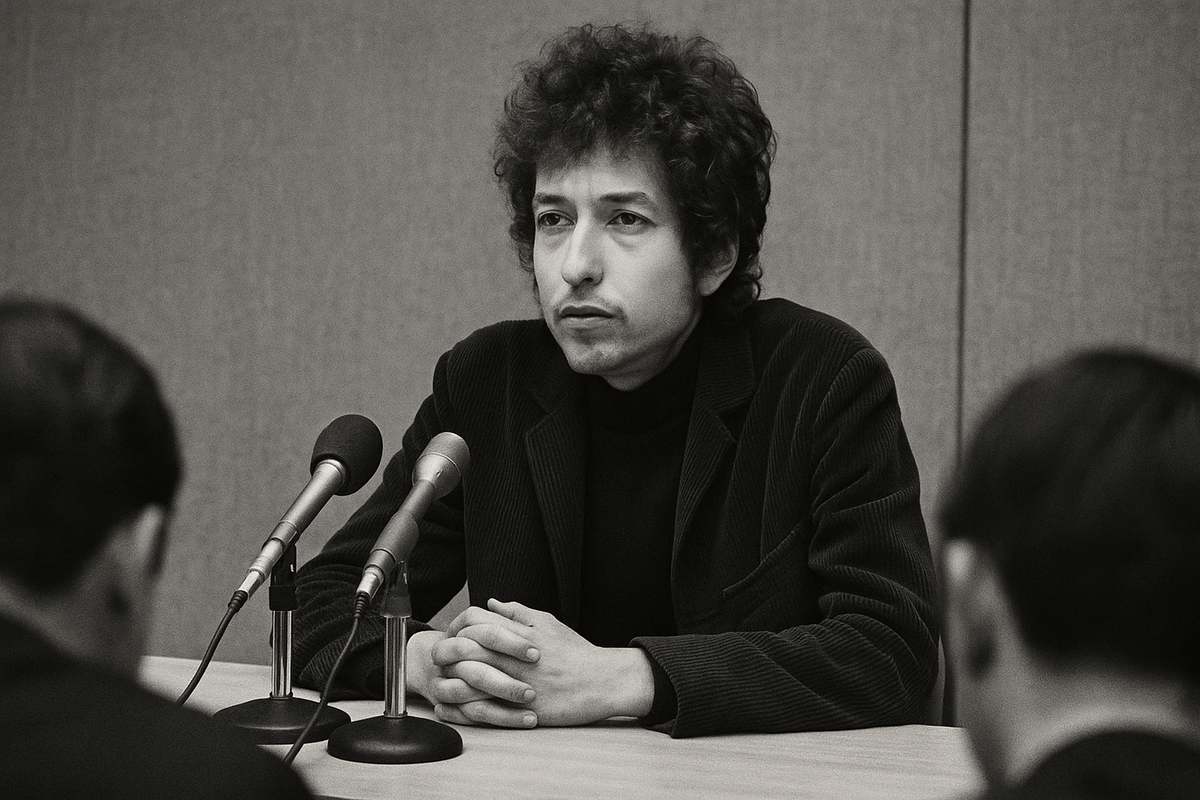
Getting Dylan for their second issue was a coup. More importantly, Rolling Stone understood what to do with him. Rather than filtering his words through a reporter's interpretation, they printed the press conference transcript in full, accompanied by stark, high-contrast photographs—Dylan at the piano, at the microphone, seated at the press table, his face shadowed and contemplative.
No psychedelic posters. No colorful collages. Just Dylan, unfiltered and unadorned. The message was clear: this was about substance, not spectacle. The design matched the seriousness of Dylan's own refusal to perform easy answers.
What Dylan Actually Said
The press conference revealed an artist in active rebellion—not against society, but against the role society had forced upon him. His responses, by turns evasive and brutally honest, sketched the outlines of a new Dylan:
"I don't really feel like singing protest songs now, because I wouldn't really feel like singing them." Not a rejection of his past work, but an assertion that authenticity mattered more than nostalgia.
Asked what product he'd endorse, Dylan deadpanned: "Ladies' garments." The absurdity was the point—he wasn't interested in playing the game.
"There's no presidents in this country, there's just a bunch of temporary employees." A sharp dismissal of the authority structures that wanted to claim him.
"The words are just as important as the music." A defense of lyrics as literature, a stance that would define his entire career.
On legacy, he refused to perform songs he no longer believed in, calling it dishonest to sing just to please audiences.
Each comment built toward a singular declaration: Dylan was not abandoning music, but he would no longer be the cultural spokesman the world demanded. He was reclaiming his right to evolve, to contradict himself, to be something other than a symbol.
The Lasting Echo
Rolling Stone proved something crucial with this issue: music journalism could be serious cultural reporting. Just as Life magazine had elevated photojournalism into historical documentation, Rolling Stone was transforming rock coverage into anthropology—capturing not just the music, but the ideas, conflicts, and transformations that music made visible.
Dylan's press conference reads differently now than it did in 1967. What seemed like evasion was actually clarity. He was rejecting a false choice: you could be an artist without being a spokesman, you could matter culturally without surrendering your autonomy, you could evolve without betraying your past.
That December issue documented the exact moment Dylan began redefining those terms for himself—and for everyone who came after.
Why This Issue Matters Now
Historical Timing
Dylan's first public appearance after the motorcycle crash, captured by a magazine still defining its identity. Both artist and publication were finding their voices simultaneously.
Documentary Value
This remains one of the only unfiltered records of Dylan's thinking during this transitional period. No mediation, no reinterpretation—just his words, preserved exactly as spoken.
Rarity
Early Rolling Stone issues (1967-1969) are scarce. The magazine hadn't yet become the institution it would be, and print runs were limited. Issues tied to pivotal cultural moments command serious attention from collectors.
Cultural Significance
The press conference captured a generation negotiating its own meaning. Dylan's refusal to be simplified mirrored the broader tensions of 1967—the conflict between idealism and reality, between individual artistry and collective movements.
Holding this issue today is holding evidence of a conversation that shaped modern music, journalism, and celebrity itself.
For Collectors and Historians
If you're searching for vintage Rolling Stone magazines, early Dylan artifacts, or cultural touchstones from the 1960s counterculture, the December 14, 1967 issue represents something irreplaceable: a primary source from a hinge moment in American culture.
This isn't just memorabilia. It's a historical document—the voice of an artist refusing to be consumed by his own myth, preserved by a magazine bold enough to let him speak for himself.
Browse Rolling Stone Magazine Collection