
When Baseball Met Blitzkrieg
The Life Magazine That Watched a Kingdom Fall in 48 Hours
Joe DiMaggio smiled from the cover. Inside, a nation vanished.
On May 1, 1939, Americans who bought Life Magazine for its glossy celebration of Opening Day found themselves holding something else entirely—a photographic autopsy of how modern warfare could erase a country before the weekend ended. Benito Mussolini had just conquered Albania in less time than it took to play a three-game series, and Life's cameras had captured every calculated step.
This wasn't breaking news by the time it reached newsstands. The invasion had concluded three weeks earlier. But what Life offered was something no newspaper could match: visual proof that the 1930s world order wasn't crumbling—it had already collapsed. The photographs didn't ask readers to imagine tanks rolling through Tirana. They showed the tanks. They showed Count Galeazzo Ciano stepping off a plane to install a puppet government. They showed King Zog's pet vulture—a bird symbolizing Albanian independence—gripped in the hands of an Italian soldier.
For collectors today, this issue represents more than historical documentation. It captures the last spring before the world understood what was coming.
The 48-Hour Kingdom
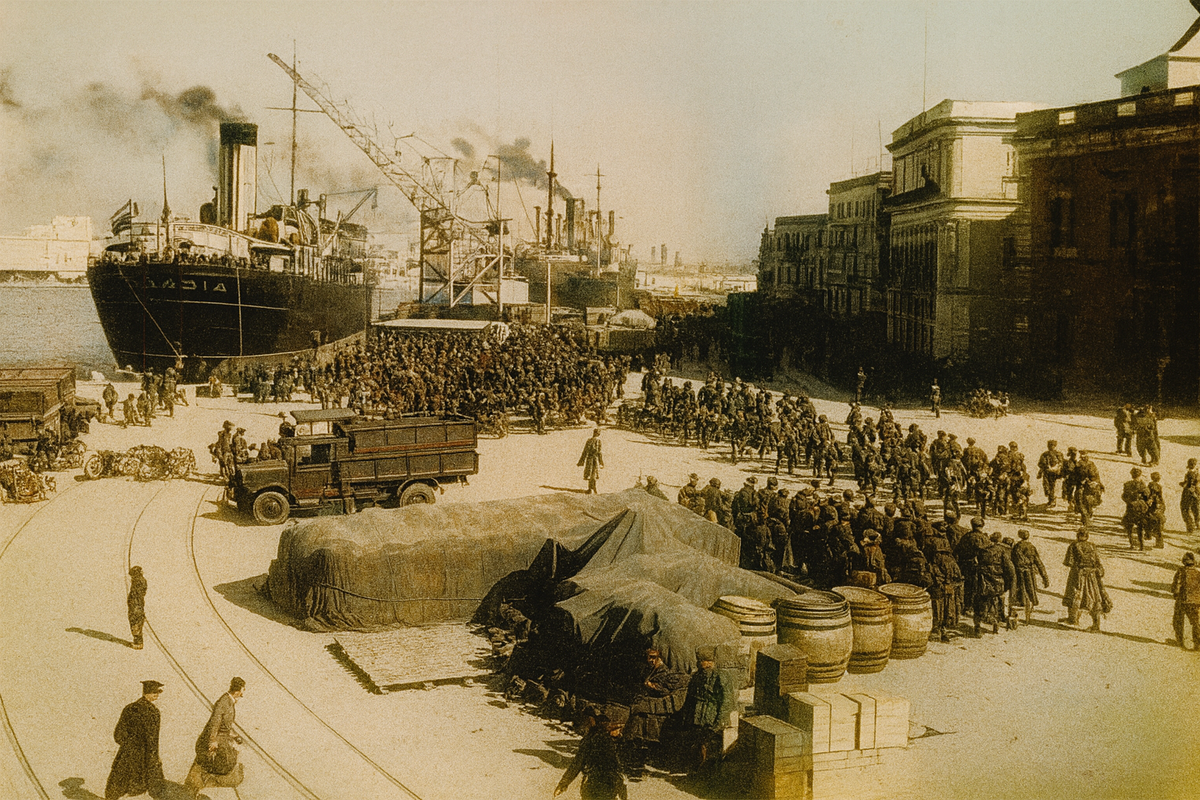
April 7, 1939. Italian warships, aircraft, and 70,000 troops surged across the Adriatic. By April 8, Tirana had fallen. By April 16, King Victor Emmanuel III of Italy wore Albania's crown.
Albania fielded 13,000 soldiers. They were overwhelmed not by superior numbers alone, but by the machinery of modern war—tankettes, coordinated air assaults launched from Taranto, artillery that turned port cities into submission before troops even landed. King Zog I fled into exile so quickly that Life's photographers documented the chaos he left behind: a looted royal palace, its paintings ripped from gilded frames, statues beheaded in the frenzy, state rooms ransacked by mobs Zog himself had unleashed by freeing prisoners in a desperate bid for resistance.
The resistance never materialized. What emerged instead was a prototype for the conquests to come—swift, mechanized, and brutally efficient.
Archive Details
Publication: Life Magazine
Issue Date: May 1, 1939
Cover Subject: Joe DiMaggio
Primary Story: "The Italo-Albanian War Takes Its Small Place in World History"
Historical Context: Published four months before Hitler's invasion of Poland and the start of World War II
Key Figures: Benito Mussolini, King Zog I, Count Galeazzo Ciano, King Victor Emmanuel III, Minister Khafer Ypi
Why Life Mattered: The Story Was the Photograph
Life Magazine had perfected a revolutionary editorial model by 1939: the photograph was the narrative. Text existed to contextualize what readers could already see.
The May 1, 1939 issue deployed this approach with surgical precision:
Italian soldiers disembarking at Durazzo (modern Durrës), vehicles streaming from transport ships, artillery positioned on captured docks—the choreography of invasion rendered in high-contrast black and white.
Count Ciano's theatrical arrival in Tirana, Mussolini's son-in-law flanked by officers, installing what Life dryly called "restored order." The photographs exposed the charade: this wasn't liberation. It was annexation dressed in diplomatic protocol.
Albanian Minister Khafer Ypi publicly thanking Italy for its "friendship" while Italian troops stood guard—a masterclass in how occupation becomes official policy through coerced ceremony.
The vulture. Perhaps no image crystallized the conquest more perfectly than the photograph of an Italian soldier holding King Zog's prized bird. Zog styled himself "King of the Sons of the Eagle." The symbolism required no caption.
Funeral corteges for Italian casualties—because even blitzkrieg has costs, and even those costs could be transformed into propaganda for noble sacrifice.
These weren't editorial illustrations. They were primary sources, evidence that Americans could study in their living rooms while Europe prepared for catastrophe.
The Contrast That Defined an Era
Joe DiMaggio's face on that cover wasn't editorial accident—it was Life's genius distilled. The magazine understood its audience: Americans who loved baseball, Hollywood, and the promise of a hopeful spring. But Life also understood its responsibility. It drew readers in with accessible Americana, then immersed them in the machinery of fascist expansion.
The juxtaposition was deliberate and devastating. While DiMaggio prepared for another season of greatness, Mussolini was rehearsing for world war. The visual language made this impossible to ignore: tanks on one page, ballplayers on another, both rendered with the same photographic clarity.
Unlike opinion journals that told readers what to think, Life showed them what was happening and trusted them to grasp the implications. The Albanian photo-essay didn't editorialize about appeasement or Axis ambitions. It didn't need to. The images—looted palaces, fleeing monarchs, mechanized columns—spoke a language that transcended political debate.
What the Photographs Revealed
Speed as Weapon
Albania fell faster than most military planners thought possible. The invasion demonstrated that modern mechanized forces could overwhelm unprepared states before international response could even be organized.
Propaganda as Statecraft
Every staged photograph of Italian "order" and Albanian "gratitude" revealed how conquest became legitimacy through controlled imagery. Mussolini understood that winning battles was only the beginning—controlling the narrative was victory itself.
The Vulnerability of Sovereignty
Albania wasn't invaded because it threatened Italy. It was invaded because it could be invaded, because its strategic ports offered Adriatic control, because small nations were now pieces on a chessboard where only great powers moved.
Rehearsal for Apocalypse
Published four months before Hitler invaded Poland, this issue documented what would become standard operating procedure—the blitzkrieg refined, the propaganda perfected, the international community paralyzed.
What Makes It Vital Now
The May 1, 1939 issue transcends nostalgia. It functions as a case study in how democracies process authoritarian aggression, how media shapes public understanding of distant crises, and how photojournalism can preserve what propaganda tries to erase.
Life's coverage didn't stop Mussolini. No magazine could. But it created an archive that outlasted fascism itself—proof that even "small wars" in forgotten countries signal larger catastrophes to come.
For historians studying the interwar period, this issue offers evidence of what Americans knew and when they knew it. For collectors, it represents peak photojournalism from an era when magazines were cultural institutions, not disposable content. For anyone seeking to understand how the world stumbled into global war, these pages offer answers that textbooks can't provide.
The photographs remain. The tankettes rolling into Durazzo. The looted palace. The vulture in enemy hands. The Albanian officials pledging loyalty under occupation. The funeral processions for Italian soldiers who died conquering a country that couldn't defend itself.
This is what spring 1939 looked like. This is what Americans saw while DiMaggio prepared for Opening Day. This is the magazine that documented a kingdom's fall and preserved it for generations who would need to remember why speed, machinery, and propaganda could never be underestimated again.
The Collector's Perspective: Why This Issue Endures
Temporal Precision
This issue sits at the exact hinge point—after Munich, after Czechoslovakia's dismemberment, before Poland. It captures the world's last months of pretending that fascist expansion could be contained through diplomacy.
Photographic Rarity
The Albanian campaign was brief, its victims had no voice in Western media, and its documentation was largely controlled by Italian propagandists. Life's independent photographic record remains one of the few contemporary Western visual archives.
The Baseball Cover
Collectors prize the DiMaggio cover not despite its disconnect from the Albanian content, but because of it. That contrast—American innocence, European violence—encapsulates spring 1939 more perfectly than any editorial could articulate.
Artifact Authenticity
Unlike digitized archives or reprints, original issues carry the physical presence of 1939—the paper stock, the printing quality, the advertisements for products that no longer exist. Holding this issue means holding what American readers held when they first learned that kingdoms could vanish in 48 hours.
Explore the Archive
The May 1, 1939 issue of Life Magazine is part of a larger collection spanning the 1930s through the 1970s—decades when Life documented every pivot point of the 20th century. From pre-war tensions to post-war reconstruction, from scientific breakthroughs to cultural revolutions, these magazines are not reading material. They are original artifacts.
Browse Life Magazine Collection