
Where the Russians Like Us, But—
The Saturday Evening Post Issue That Caught the Cold War Being Born
On December 21, 1946, two versions of America stared at each other from opposite ends of the same magazine.
On the cover: Falls City, Nebraska in full Christmas frenzy. John Falter—hometown boy made good—had painted the rush of last-minute shoppers crowding the sidewalks, their arms full of packages, their faces flushed with holiday urgency. It was pure Americana: prosperous, familiar, safe.
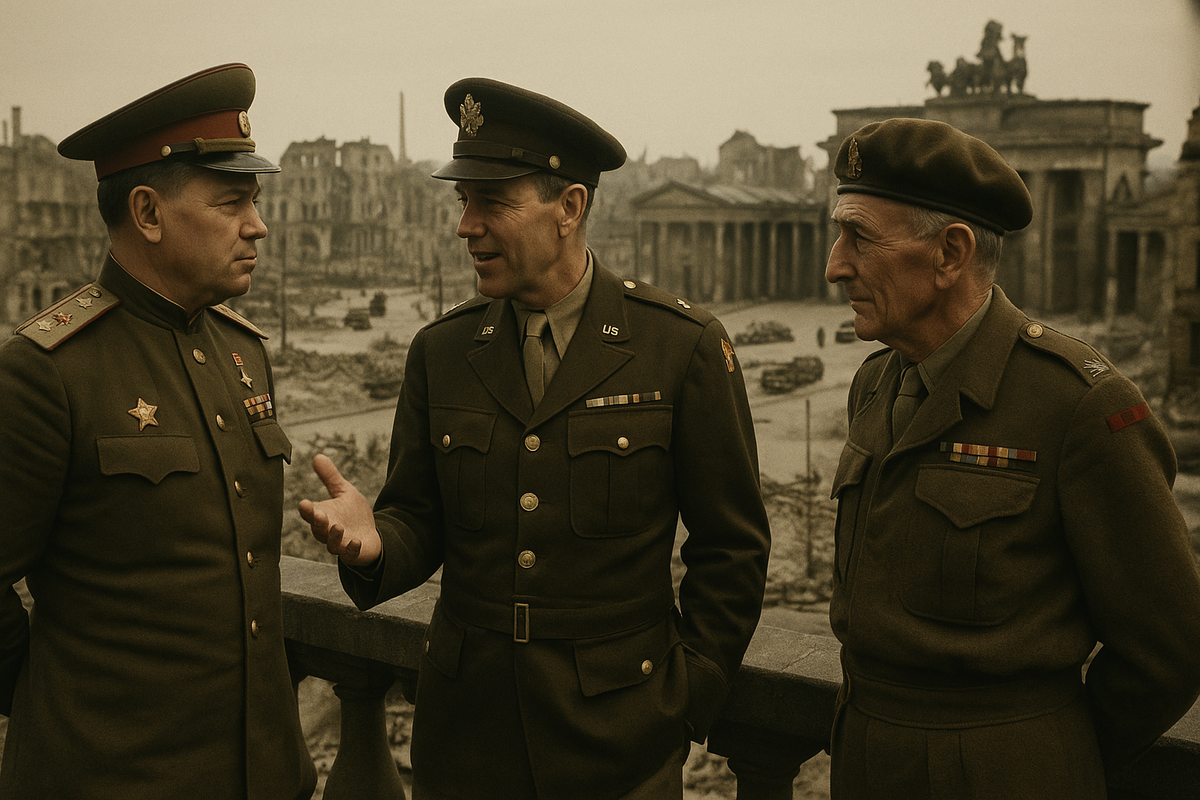
Inside: the wreckage of Berlin, where four nations sat around a table pretending they were still allies.
Ernest O. Hauser's article "Where the Russians Like Us, But—" wasn't just foreign correspondence. It was a dispatch from the future, filed from the exact moment when World War II victory curdled into Cold War suspicion. Eighteen months after defeating Hitler, the Americans, British, Soviets, and French were learning that winning a war together was easier than governing a country together.
For readers settling into their living rooms that December, the magazine delivered an unsettling message: the war is over, but peace is a lie we're all agreeing to tell—for now.
Berlin, 1946: Where Victory Went to Die
Germany in 1946 was a laboratory experiment in international governance, and the results were already failing.
The Allied Control Council—the A.C.C.—brought together the four occupying powers to administer defeated Germany. On paper, it was a model of cooperation: dismantling Nazism, preventing German militarization, rebuilding a shattered nation. In practice, it was a bureaucratic nightmare that exposed every fault line of the emerging superpower conflict.
Hauser didn't romanticize it. He described meetings that dragged for hours while interpreters translated every clause, every objection, every procedural point. He showed American generals baffled by Soviet formality, Russian officials arriving late and rigid while their Western counterparts prided themselves on speed and informality. The cultural differences weren't charming—they were symptomatic of something deeper.
The article included a photograph that told the whole story in one image: Russian Proconsul Sokolovsky pinning a medal on American Proconsul McNarney. All smiles. All ceremony. All theater. Hauser made it clear that the medals meant nothing. Behind the staged camaraderie, every side was already choosing their position for the fight ahead.
He called the A.C.C. a "microscope of world government"—a place where global ideological divides were magnified into debates over semicolons and procedure. If you wanted to understand how the alliance that defeated fascism would fracture, you could watch it happen in real time, one committee meeting at a time, in a ruined German capital.
Issue at a Glance
Publication: The Saturday Evening Post
Issue Date: December 21, 1946
Cover Artist: John Falter
Featured Article: "Where the Russians Like Us, But—" by Ernest O. Hauser
Historical Context: Published 18 months after V-E Day, at the dawn of the Cold War
The Post's Strategic Genius: Normalcy and Apocalypse, Side by Side
The Saturday Evening Post understood something profound about its audience: Americans in 1946 needed both comfort and truth.
The Falter cover gave them the first. His Falls City Christmas scene—painted by an artist who'd grown up on those very streets—was a celebration of American abundance at a time when Europe was starving. It said: this is what we fought for. This is what we preserved.
Hauser's article gave them the second. It said: the world you fought to save is already breaking apart.
That contrast wasn't accidental. The Post had spent decades mastering the balance between Norman Rockwell's vision of American life and hard-edged reporting on the forces threatening it. Fiction, humor, cartoons, and ads for new cars shared pages with dispatches from the frontlines of history. Millions of families trusted the magazine to explain the world to them precisely because it never forgot they lived in Falls City, even when it was reporting from Berlin.
The December 21, 1946 issue is that formula perfected: a Christmas cover promising continuity, an article inside diagnosing fracture.
What Hauser Saw (And What He Knew Was Coming)
The brilliance of "Where the Russians Like Us, But—" lies in its title. The comma and the dash do all the work.
"The Russians Like Us" acknowledges the remaining moments of genuine respect between former allies. Soviet officers admired American efficiency. American diplomats appreciated Russian resilience. In late 1946, cooperation was still possible.
"But—" is the sound of history turning.
Hauser documented the signs: Soviet propaganda already painting the West as imperialist. American frustration with Russian stonewalling. French and British maneuvering for their own interests. Every meeting of the A.C.C. was a reminder that shared victory wasn't the same as shared vision.
The article captures the precise moment when "we" became "us and them." Berlin would soon be blockaded. Germany would be split in two. The Cold War would define the next four decades. In December 1946, Hauser was watching it begin.
Bureaucracy as Ritual
Hours spent debating language and procedure. The A.C.C. as a "microscope of world government" where every disagreement was magnified.
Cultural Collision
Soviet formality versus American informality. These weren't just different styles—they were different worldviews.
Theater of Unity
Medals pinned, ceremonies staged, photographs taken. All performance masking fundamental distrust.
The Interpreters' Power
Every word carried across ideological and linguistic lines. Translation wasn't neutral—it was negotiation.
The Magazine That Held Two Americas
John Falter painted the America we wanted to believe in: prosperous, traditional, unchanged by war.
Ernest Hauser reported the America that actually existed: powerful, uncertain, locked in a struggle it was only beginning to understand.
The Saturday Evening Post gave readers both, because both were true.
That's the magazine's legacy, and that's why issues like this one matter. They show us how Americans made sense of their moment—what they celebrated, what they feared, and how they prepared for what came next.
Why Collectors and Historians Hunt This Issue
Historical Timing
Published at the Cold War's ignition point, before the term "Cold War" was even common parlance. This is evidence of the moment when peace became impossible.
Ernest O. Hauser's Reporting
A firsthand account of Allied diplomacy from someone who understood he was witnessing a hinge moment in history. Primary source material for Cold War scholars.
John Falter's Cover
A pristine example of mid-century American illustration, beloved by collectors of Post art alongside Rockwell and Leyendecker.
Complete Cultural Package
Stories, ads, features, and commentary—a full snapshot of how Americans lived and thought in December 1946. Not just journalism, but a time capsule.
Original issues from this era are finite. Every year, more deteriorate or disappear. What remains are artifacts that can't be replicated by reprints or digital scans. Holding the December 21, 1946 issue means holding the same pages that Americans read while trying to understand why peace felt so much like the beginning of another war.
Explore the Archive
Original issues of The Saturday Evening Post are more than collectibles—they're primary sources. Each magazine preserves the art, literature, and journalism that shaped mid-century American consciousness.
Browse The Saturday Evening Post CollectionWhether you collect Cold War history, mid-century illustration, or the cultural artifacts of postwar America, these magazines offer something irreplaceable: the chance to see history through the eyes of the people who lived it.