
Harry Belafonte's Journey to the Holy Land
Faith, Culture, and the Power of Brotherhood in Ebony Magazine's December 1960 Issue
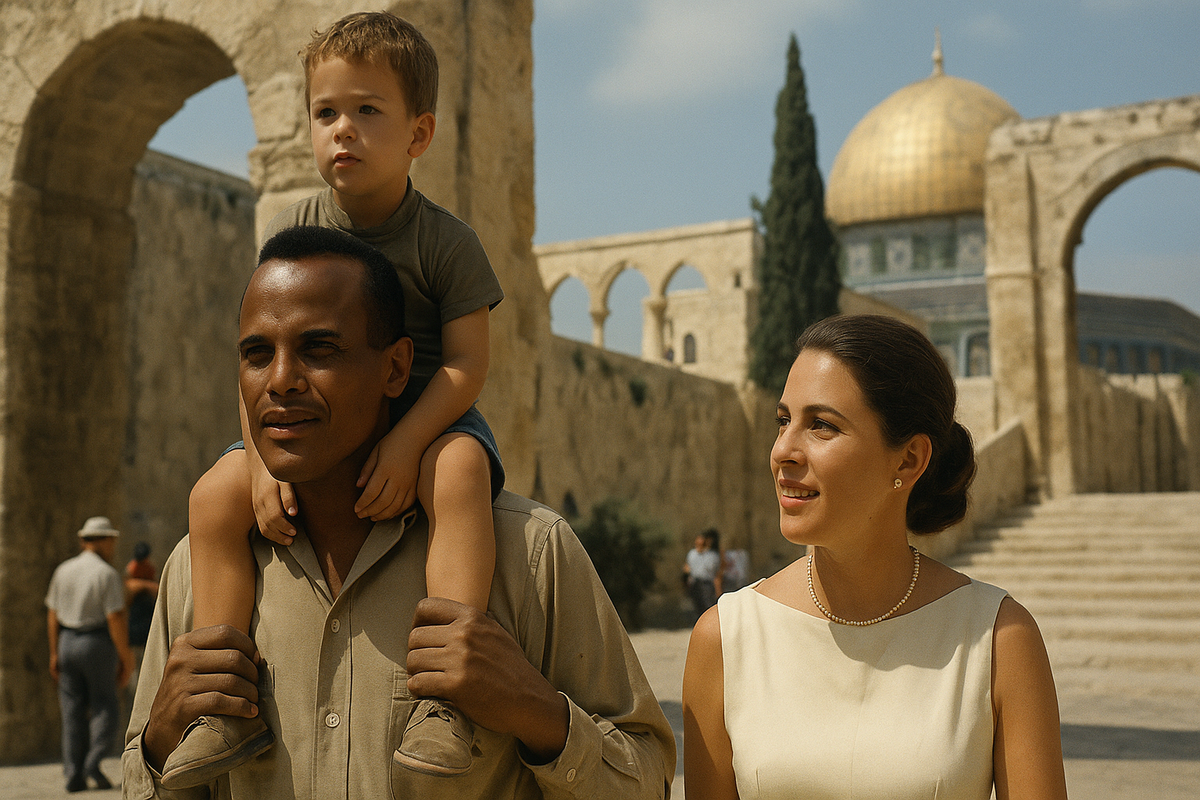
In December 1960, as students across the American South were being beaten for sitting at lunch counters and seventeen African nations were tearing down colonial flags, Harry Belafonte stood in Jerusalem with his son perched on his shoulders, asking a question that cut to the bone: "How could a people face so much scorn and persecution and produce so much genius?"
The moment was captured in Ebony Magazine, and it wasn't tourism. It was theology. It was politics. It was Belafonte doing what he did best—using his celebrity as a bridge between struggles, his pilgrimage to Israel serving as a mirror for the African American fight for dignity at home.
This wasn't the kind of story you'd find in Life or Look. This was Ebony at its finest: refusing to separate the spiritual from the political, the personal from the universal, the entertainer from the activist. The December 1960 issue didn't just document a famous singer's vacation. It positioned Belafonte as a global ambassador of African American thought, connecting Jewish resilience with Black liberation in a single, powerful narrative arc.
Archive Details
Historical Figure: Harry Belafonte
Issue Date: December 1960
Archive Source: Ebony Magazine
Feature Title: "Belafonte in the Holy Land"
Historical Context: Published during the Year of Africa and months after the Greensboro sit-ins
The Year Everything Converged
Nineteen sixty was a hinge year. The Greensboro sit-ins in February had ignited a wave of student-led protests across the South. By April, the Student Nonviolent Coordinating Committee had formed. Segregation was being challenged daily, but so was the resistance—fierce, violent, unrelenting.
Globally, the Cold War cast its shadow over everything. Seventeen African nations gained independence in what became known as the Year of Africa. For African Americans, these weren't distant headlines. Decolonization abroad and desegregation at home were part of the same conversation, the same hunger for self-determination.
Belafonte's trip to Israel landed in this charged moment. It wasn't escape. It was engagement—a deliberate effort to trace connections between oppressed peoples worldwide and to anchor activism in universal principles of justice.
Ebony understood the assignment. While mainstream publications either ignored Black perspectives or flattened them into caricature, Ebony documented African American cultural, political, and spiritual life with unflinching depth. Publishing Belafonte's reflections wasn't just good journalism. It was a declaration: African American voices belonged in global conversations about faith, humanity, and peace.
How Ebony Told the Story
The magazine's visual language was intimate and immediate. Readers saw Belafonte in Jerusalem with his wife Julie and their children—David riding his father's shoulders as they spoke with rabbis and friars. They saw him in Nazareth, standing near holy shrines. They saw him mobbed by crowds so eager that some required hospital treatment after being crushed. These weren't paparazzi shots. They were portraits of immersion: Belafonte touching people, listening, learning.
The text matched the photography's reverence. Written in Ebony's signature style—clear, urgent, unapologetic—the article wove personal reflection with broader commentary. Belafonte invoked Freud, Marx, Einstein, and Jesus, drawing a through-line from Jewish genius to African American resilience. His reflections on Nazareth—calling the birthplace of Jesus the right place for a philosophy of peace—echoed the same longing for brotherhood that Martin Luther King Jr. was preaching from pulpits across the South.
But Ebony didn't stop at inspiration. The article pivoted seamlessly to political reality: apartheid in South Africa, strife in the Congo, tensions in Asia. The message was clear. The world still had miles to go before it could claim to live up to any gospel of justice.
This was Ebony's genius. Other magazines might have covered Belafonte as a Hollywood star on tour. Ebony positioned him as a moral voice, linking his artistic fame to his political commitments. Entertainment wasn't separate from social commentary. It was the same project: shaping identity, dignity, and pride for a generation.
The Pilgrimage in Scenes
The article captured moments that crackled with meaning:
Jerusalem, Overwhelmed
Admirers mobbed Belafonte in the streets—not as a foreign celebrity but as a brother. The crowd's intensity spoke to his global reach and the universality of his message.
The Kibbutz
Belafonte sang Hineh Ma Tov ("How good it is for brothers to dwell in togetherness") with near-perfect Hebrew pronunciation. Music, as always, was his passport across borders.
Father and Icon
Julie and the children appeared throughout. Photos of Belafonte carrying his son weren't filler—they underscored his role as a father transmitting values of unity and peace, not just a performer collecting applause.
Holy Sites as Human Sites
He visited King David's tomb, the Church of the Annunciation, and other shrines. Each encounter was presented as both spiritual and tactile—conversations with craftspeople, friars, rabbis, ordinary worshippers.
Christmas as Indictment
Belafonte tied the holiday to humanity's failures, saying it emphasized how far we'd strayed from Christ's message. He connected this explicitly to apartheid, colonial violence, and racial injustice.
The Mirror
Again and again, Belafonte framed Israel as a reflection of the wider world. Just as the Holy Land struggled with division, America struggled with segregation. His conclusion wasn't soft. Brotherhood wasn't optional. It was survival.
Ebony as Artifact
These magazines aren't just reading material. They're original artifacts—printed in real time, carrying the voices, struggles, and achievements of African Americans at a moment when mainstream media often ignored or distorted those stories.
For cultural historians, collectors, and families preserving heritage, Ebony issues are irreplaceable. They document how African Americans shaped—and were shaped by—the great events of the 20th century. From civil rights milestones to global cultural exchanges, they capture the depth and dignity of Black life in a transformative era.
Why This Issue Matters to Collectors
Historical Timing
Published the same year as the Greensboro sit-ins and the Year of Africa, this issue captures a singular moment when domestic and global liberation movements were converging in African American consciousness.
Cultural Icon at Peak Influence
Belafonte was at the height of his fame and his activism. This profile captures both identities in full.
Visual Archive
The photography alone—Belafonte with rabbis, friars, children, crowds, and his own family—makes this issue a standout for collectors and historians.
High Demand
Issues featuring milestone figures like Belafonte, Martin Luther King Jr., Muhammad Ali, or other cultural luminaries consistently command attention in the vintage magazine market.
To own this issue is to hold a piece of history—a record of how African American media in 1960 positioned one of its most beloved figures as a global voice for peace.
Explore the Collection
If Belafonte's journey resonates with you, there's much more to discover. Our collection spans Ebony magazines from the 1940s through the 1980s—each issue a time capsule documenting politics, fashion, sports, music, and culture in ways no other publication could.
Browse Ebony Magazine CollectionWhether you're a seasoned collector, a history buff, or someone honoring family heritage, vintage Ebony magazines offer something irreplaceable: the ability to hold history in your hands, exactly as it was first reported and celebrated.
Conclusion
The December 1960 issue of Ebony Magazine, with its feature "Belafonte in the Holy Land," remains a remarkable artifact of African American and global history. Belafonte's reflections on faith, brotherhood, and peace spoke not just to the people of Israel but to the world—and especially to African Americans engaged in their own struggle for justice.
Ebony captured that moment with unmatched depth, blending celebrity culture with moral reflection, entertainment with politics, photography with prophetic commentary. Today, this issue endures as both a collectible treasure and a historical document.
To hold it is to hear Belafonte himself: urging us to see beyond borders, beyond color, beyond conflict—to the simple truth of our shared humanity.