
The Diplomat America Couldn't Afford to Ignore
Jawaharlal Nehru, Time Magazine, and India's Gamble on Nonalignment in 1956
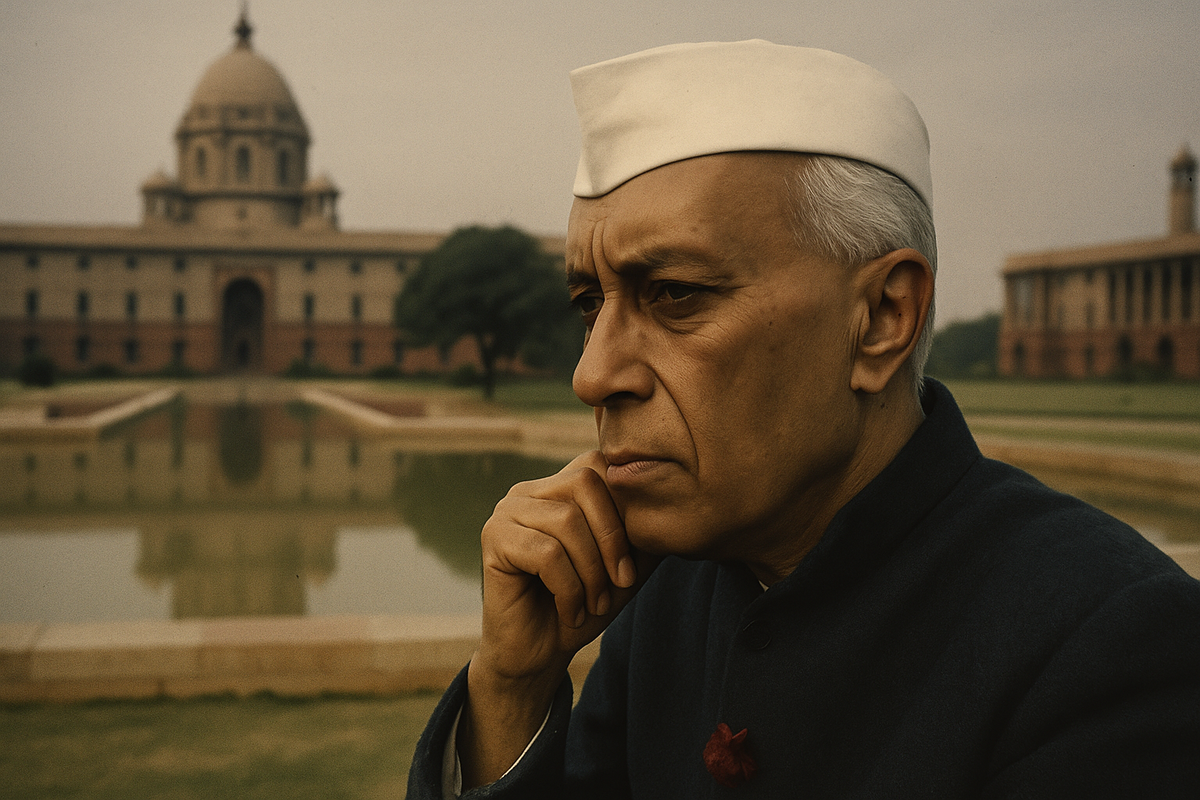
On July 30, 1956, millions of Americans opened their mailboxes to find Jawaharlal Nehru staring back at them.
Not smiling. Not reassuring. Just staring—intense, cerebral, unblinking—from the cover of Time Magazine. This was no courtesy profile of a distant foreign dignitary. This was an urgent dispatch from the front lines of the Cold War, and the question it posed was existential: Would the world's largest democracy choose Washington, Moscow, or neither?
Nehru's answer would determine the fate of 360 million people. And possibly the balance of global power itself.
Archive Details
Historical Figure: Jawaharlal Nehru, Prime Minister of India
Issue Date: July 30, 1956
Archive Source: Time Magazine
Historical Context: Published weeks before the Suez Crisis and Hungarian Uprising
The Man Who Refused to Choose
By the summer of 1956, the Cold War had calcified into binary logic. You were with the United States or against it. You embraced the Soviet revolution or you were its enemy. Neutrality was weakness. Fence-sitting was cowardice.
Jawaharlal Nehru rejected the entire premise.
India's first Prime Minister—groomed by Mahatma Gandhi through decades of struggle against British rule, imprisoned repeatedly for his defiance, educated at Harrow and Cambridge yet devoted to Indian sovereignty—had articulated a doctrine that infuriated both superpowers: nonalignment. India would accept aid from East and West alike. It would join neither camp. It would chart its own course.
To Washington, this looked like naive idealism at best, veiled communism at worst. To Moscow, it represented an opening—a chance to seduce a vast nation away from Western influence. To Nehru, it was India's only path to genuine independence.
The July 30, 1956 issue of Time arrived at the precise moment this gamble faced its severest test. The Bandung Conference of 1955 had formalized the Non-Aligned Movement, with Nehru standing alongside Egypt's Gamal Abdel Nasser and Yugoslavia's Josip Broz Tito. But rhetoric was one thing. Survival was another. With the Middle East approaching crisis and superpower tensions escalating, could nonalignment hold—or would India be forced to choose sides after all?
When Time Made You See the World
Time Magazine in 1956 wasn't background noise. It was how America understood the planet.
This wasn't the digital scroll of headlines, forgotten in seconds. This was 30 cents, delivered to your door, read in living rooms and barbershops and break rooms across the country. When Time devoted its cover to someone, that person mattered. When it sent correspondents to profile a world leader, Americans paid attention.
The Nehru issue deployed every weapon in Time's editorial arsenal. Photographs traced his evolution: the privileged young student in England, the revolutionary seated beside Gandhi, the statesman conferring with Tito and Nasser. The prose combined biography with geopolitical analysis, cultural commentary with economic assessment. Readers learned about India's staggering poverty—the malnutrition, the underdevelopment, the challenge of feeding and educating hundreds of millions. They confronted Nehru's "socialist pattern of society," praised as visionary by some, dismissed as bureaucratic by others.
But the piece went deeper. It revealed Nehru's aristocratic Kashmiri heritage, his devotion to his daughter Indira (who would later lead India herself), his moral conviction that nonalignment wasn't opportunism but principle. Time gave Americans not just facts but texture—the sense of a man wrestling with impossible choices on behalf of a nation that had only been free for nine years.
The cover itself was a statement. Direct photographic realism replaced Time's earlier illustrated style. No artistic interpretation. No softening. Just Nehru's face, demanding Americans look him in the eye and reckon with what he represented.
The Profile That Captured a Turning Point
What made this issue essential wasn't just who it profiled, but when.
The July 30, 1956 issue landed in the brief, volatile calm before two hurricanes: the Suez Crisis and the Hungarian Uprising. Within months, the world would witness Britain and France invading Egypt while Soviet tanks crushed rebellion in Budapest—simultaneous explosions that would test every assumption about power, alliance, and the post-colonial order. Nehru's nonalignment would face its defining trial.
This issue captured that hinge moment. It showed Americans a leader who refused to play by their rules, who criticized both superpowers, who believed poor nations could forge a third path. Many readers found him frustrating. Some found him dangerous. But Time made clear: to misunderstand Nehru was to misunderstand the future of Asia.
Nehru's Balancing Act
The profile revealed how Nehru refused pressure from Washington or Moscow, seeing nonalignment as India's moral duty while accepting aid from both sides.
Economic Struggles
Time described India's poverty in stark terms—the challenge of feeding and educating hundreds of millions under Nehru's "socialist pattern of society."
The Western Perception
Many Americans found Nehru frustrating for refusing to take sides, but the magazine emphasized his importance to understanding Asia's future.
Personal Portrait
The issue included glimpses of Nehru's aristocratic Kashmiri heritage, his British education, his closeness to Gandhi, and his devotion to his daughter Indira.
The article detailed his balancing act—how he navigated between Washington and Moscow without surrendering India's autonomy. It explored his economic struggles, the monumental task of industrializing a desperately poor nation while maintaining democratic institutions. It presented his vision of India as a moral force, not merely a strategic prize.
And it did something else: it introduced Americans to the idea that the Cold War might not be settled by the superpowers alone. By featuring Nehru alongside Tito and Nasser, Time signaled that a new world order was emerging—one shaped not just by American power or Soviet ideology, but by the collective will of newly independent nations.
Why Collectors Prize This Issue
Historical Timing
Published at the cusp of 1956's twin crises, it captures the moment before the shockwaves hit—when nonalignment was still theory, before it would be tested by fire.
Iconic Cover
Nehru's portrait ranks among the most recognizable images of the decade, symbolizing India's emergence as a decisive force in global affairs.
Cultural Documentation
Beyond politics, the issue provides rich detail on mid-century India's social and economic realities—invaluable for historians studying post-colonial development.
Collector Demand
Mid-1950s Cold War issues, particularly those profiling major non-Western leaders like Nehru, Khrushchev, Nasser, and Tito, are consistently sought after.
Preservation of Perspective
This isn't retrospective analysis. It's how Americans first encountered the concept of nonalignment, complete with the confusion, skepticism, and grudging respect that defined the initial Western response.
A Defining Moment
Owning this issue means holding the moment India announced it would not be anyone's satellite—when Nehru's vision challenged the assumption that every nation must choose a master.
An Artifact That Still Speaks
Like Life Magazine's great photo essays, Time's mid-1950s profiles endure because they captured urgency in real time. The July 30, 1956 issue doesn't just describe Nehru's predicament—it conveys the stakes. A vast, impoverished democracy attempting to navigate between nuclear-armed superpowers. A leader betting everything on the belief that independence of thought could survive pressure from both East and West.
Today, as debates about multipolarity and strategic autonomy return to the global stage, this issue feels uncannily current. It reminds us that India's choices in the 1950s weren't sidebar history—they helped construct the world we still inhabit.
Explore the Archive
Thousands of original Time magazines from the 1920s through the 1970s are available in our collection. Each issue is a primary source—a window into how events were reported, debated, and understood as they unfolded. From wartime coverage to cultural shifts, from scientific breakthroughs to diplomatic crises, these magazines trace entire decades of human experience.
Browse Time Magazine CollectionWhether you collect for investment, research, or the simple pleasure of holding history in your hands, these magazines are living artifacts. They connect us directly to the voices, images, and arguments that shaped the 20th century.
The Bellwether's Gamble
The July 30, 1956 issue of Time Magazine remains one of the most significant Cold War profiles ever published. Its examination of Jawaharlal Nehru revealed not merely the biography of a statesman, but the destiny of a nation—and the fragility of balance in a world divided into armed camps.
To hold this issue is to hold the moment when India declared itself the bellwether of the nonaligned world, when Nehru's refusal to choose sides offered hope, caution, and a fundamental challenge to the Cold War's binary logic.
For anyone who values history as something more than abstraction, vintage Time magazines aren't reading material—they're original artifacts from an age when print journalism defined how the world understood itself. And through them, the past speaks without translation.