
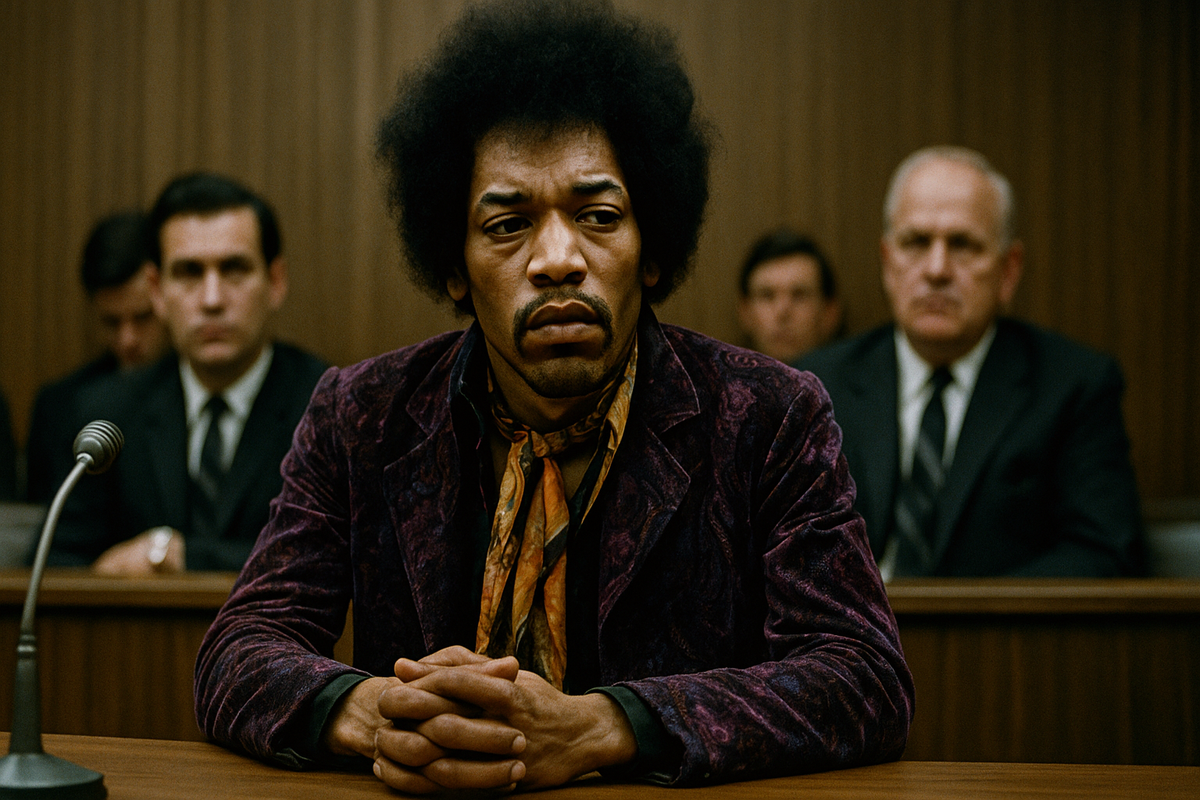
The Night They Tried to Stop Jimi Hendrix
Rolling Stone's Real-Time Chronicle of the 1969 Toronto Bust
On May 3, 1969, customs agents at Toronto International Airport opened Jimi Hendrix's luggage and found what they claimed was heroin and hashish. Within hours, the greatest guitarist alive was in handcuffs. By nightfall, impossibly, he was onstage at Maple Leaf Gardens, playing to thousands who refused to believe the headlines already being written about him.
Three weeks later, Rolling Stone published what would become one of rock journalism's most essential documents: a real-time account of how close the counterculture came to losing its most incendiary voice to a Canadian prison cell.
The May 31, 1969 issue didn't just report a scandal. It captured the exact moment authorities decided to make an example of rock and roll itself.
Historical Archive
Featured Artist: Jimi Hendrix
Publication: Rolling Stone Magazine
Issue Date: May 31, 1969
Headline: "Hendrix Busted in Toronto"
Writers: Ritchie Yorke and Ben Fong-Torres
Historical Context: Three months before Woodstock, during peak counterculture crackdown
When the Establishment Went to War with the Guitar
By spring 1969, Jimi Hendrix had already rewritten the physics of the electric guitar. He'd set his Stratocaster on fire at Monterey Pop. He'd turned "The Star-Spangled Banner" into a weapon. He was months away from Woodstock, where he would play the Vietnam War through his amplifier and make the earth shake.
But none of that mattered to the Royal Canadian Mounted Police.
The cultural battle lines were hardening fast. Authorities had watched Woodstock Nation grow from a marketing slogan into an actual force, and they were done watching. Marijuana, LSD, and harder substances—whether tied to creativity or not—had become the front line in a generational war. High-profile musicians weren't just celebrities anymore. They were targets.
Hendrix's arrest wasn't random. It was tactical. Toronto's narcotics enforcement was particularly unforgiving, and Canada had become a proving ground for crackdowns that U.S. authorities were watching closely. The message was clear: fame bought you nothing but a bigger spotlight when you fell.
For Hendrix, the stakes were existential. A conviction meant prison time, a destroyed career, and the end of everything he'd built since leaving Seattle with a guitar and impossible dreams.
Rolling Stone Refuses to Look Away
When Ritchie Yorke and Ben Fong-Torres filed their report for Rolling Stone, they did something most mainstream outlets wouldn't: they treated Hendrix as a serious artist caught in a political trap, not a reckless celebrity getting what he deserved.
The article laid out the facts with surgical precision. Hendrix arrived at Toronto International Airport for a show. Customs officials searched his bags. They claimed to find heroin and hashish. Hendrix posted bail and, in a moment that still defies belief, walked onstage that same night and played his scheduled gig. The crowd came anyway—thousands of them—as if applause could override a court summons.
Hendrix denied ownership of the drugs. He suggested they could have been planted, slipped into his luggage by someone with access and motive. It wasn't paranoia. Musicians traveling internationally in 1969 knew they were being watched.
But Rolling Stone gave readers more than the police blotter version. The writers contextualized the arrest within Hendrix's brutal touring schedule, his visible exhaustion, and the mounting pressure of being asked to save rock and roll every single night. They showed a human being, not a headline.
The magazine's tone carried urgency without sensationalism. There was no smugness, no moralism—just the unease of watching someone extraordinary walk a legal tightrope with the world watching.
The Counterculture Holds Its Breath
This wasn't just about Jimi Hendrix. It was about whether the system could break what it couldn't control.
Hendrix embodied everything authorities feared about the late sixties: Black, brilliant, sexually magnetic, politically uncontainable, and adored by white youth who were supposed to be listening to their parents instead. His arrest sent a shockwave through the counterculture because everyone understood what was really happening. This was a test case.
Rolling Stone's placement of the story—nestled alongside coverage of John Lennon and Yoko Ono's "Ballad of John & Yoko" and scenes from Berkeley's street protests—made the connections explicit. Rock music, political rebellion, and generational warfare weren't separate stories. They were the same story.
Fans didn't abandon Hendrix. If anything, the arrest clarified whose side they were on. The fact that he still performed the night of his arrest became its own form of resistance—a refusal to let the machinery of the state dictate when the music stopped.
Hendrix would eventually be acquitted in December 1969, after a trial that became a spectacle of its own. But the arrest foreshadowed the chaos that would consume his final year. By September 1970, he was dead at twenty-seven, having burned through a lifetime of music in less than a decade.
Counterculture Under Siege
Authorities increasingly targeted musicians as visible symbols of the psychedelic and anti-establishment movement. Hendrix's arrest was among the most high-profile examples of this systematic crackdown.
The Fragility of Icons
Despite his genius and global acclaim, Hendrix remained vulnerable to legal and political systems designed to restrain cultural revolutionaries.
Journalism as Witness
Rolling Stone's coverage provided the counterculture with a voice that refused to accept the establishment's narrative of events.
Foreshadowing Tragedy
Though acquitted, the arrest marked the beginning of turbulence that would define Hendrix's final year before his death in 1970.
Why This Issue Still Matters
Rolling Stone in 1969 wasn't just covering music. It was documenting a cultural emergency in real time, with the kind of long-form seriousness that treated rock and roll as something worth defending intellectually, not just emotionally.
The Hendrix article exemplified what made the magazine essential: it refused to separate art from politics, or celebrity from consequence. It gave readers the space to understand not just what happened, but why it mattered—why a customs search at a Canadian airport was actually a battle over who controlled the future.
Alongside the Hendrix piece, this issue captured John and Yoko's media wars, campus uprisings, and the escalating tension between youthful idealism and institutional power. It wasn't a magazine. It was a transcript of 1969 as it happened, unedited and unresolved.
For Collectors: A Document Worth Preserving
Historic Documentation
This issue documents one of the most significant legal incidents involving a rock star in the 1960s, reported with immediacy that no retrospective can replicate. It's not someone remembering 1969 fifty years later—it's 1969 speaking for itself.
Cultural Convergence
The convergence of stories—Hendrix's arrest, Lennon's provocations, Berkeley's barricades—makes this issue a singular time capsule. Few single magazines capture so many pressure points of a collapsing cultural order.
Hendrix Memorabilia
For Hendrix collectors specifically, contemporary documentation of his career is scarce and fiercely sought after. A magazine that covered his arrest as news, not nostalgia, carries exponential value.
Increasing Scarcity
Surviving copies from Rolling Stone's late-sixties run, particularly in readable condition, are becoming museum pieces. The magazine was printed on cheap newsprint meant to be discarded. That most copies didn't survive makes the ones that did irreplaceable.
A Living Artifact of Rock's Most Dangerous Year
Rolling Stone's 1969 issues remain indispensable because they are both historical record and living argument. They preserve the raw confusion and adrenaline of watching the counterculture realize it was under siege.
The May 31, 1969 issue is more than old paper. It's proof that journalism can rise to meet the moment—that writers can capture not just events, but the psychic temperature of a generation coming apart.
Jimi Hendrix walked out of that Toronto courtroom in December 1969. Nine months later, he was gone. What remains is the music, the legend, and documents like this—reminders that his genius burned so bright, even the law couldn't look away.
Experience 1969 as It Happened
From Hendrix to the Beatles to Woodstock—these aren't reprints. They're the original chronicles of the greatest musical generation in history, preserved exactly as the world first read them.
Browse Rolling Stone Magazines Collection