
When America Discovered the Amish
Inside the 1940 Saturday Evening Post That Changed Everything
On March 30, 1940, millions of Americans opened their mailboxes to find something unexpected waiting inside their weekly Saturday Evening Post: a window into a world that had deliberately chosen to stay behind.
G. Paul Musselman's feature "Hook-and-Eye and Shoo-Fly Pie" wasn't just another human-interest story. It was the first time mainstream America had been given an intimate, photographically documented portrait of the Amish—a people who had lived among them for generations yet remained stubbornly, purposefully invisible. For readers navigating a nation hurtling toward war and industrialization, the timing was electric. Here was a community that had looked at the twentieth century and said no thank you.
The article would become one of the most culturally resonant pieces the Post ever published.
Archive Details
Publication: The Saturday Evening Post
Issue Date: March 30, 1940
Feature Article: "Hook-and-Eye and Shoo-Fly Pie" by G. Paul Musselman
Cover Artist: Norman Rockwell
Historical Context: Published on the eve of U.S. entry into World War II
The World That Opened That Magazine
Spring 1940 was a hinge moment in American history. Europe was already burning—Poland had fallen, France would collapse within weeks—yet the United States remained officially neutral, caught between isolationist impulses and mounting dread. At home, the Great Depression still cast long shadows even as New Deal electrification projects and defense manufacturing promised a return to prosperity.
Into this anxious, transitional moment came the Amish: horse-drawn, hook-and-eyed, resolute. They represented something Americans weren't sure they still possessed—rootedness, faith, immunity to the seductions of progress. The Post's decision to spotlight them was editorial brilliance. To readers who'd watched Main Street give way to chain stores, family farms surrender to mechanization, and neighbors trade front porches for radio sets, the Amish offered both comfort and confrontation.
Their Ordnung—the strict code governing dress, technology, and daily conduct—wasn't merely religious practice. It was cultural resistance, a living argument that modernization was a choice, not an inevitability. That a national magazine would dedicate substantial space to documenting this resistance suggests how deeply Americans were questioning what they were becoming.
The Post at the Height of Its Power
By 1940, The Saturday Evening Post had transcended magazine status to become a weekly referendum on American identity. With Norman Rockwell covers that turned ordinary moments into national parables, and editorial content blending fiction, humor, and cultural commentary, the Post didn't just reflect American values—it helped define them. Circulation exceeded three million. Families didn't simply read it; they gathered around it.
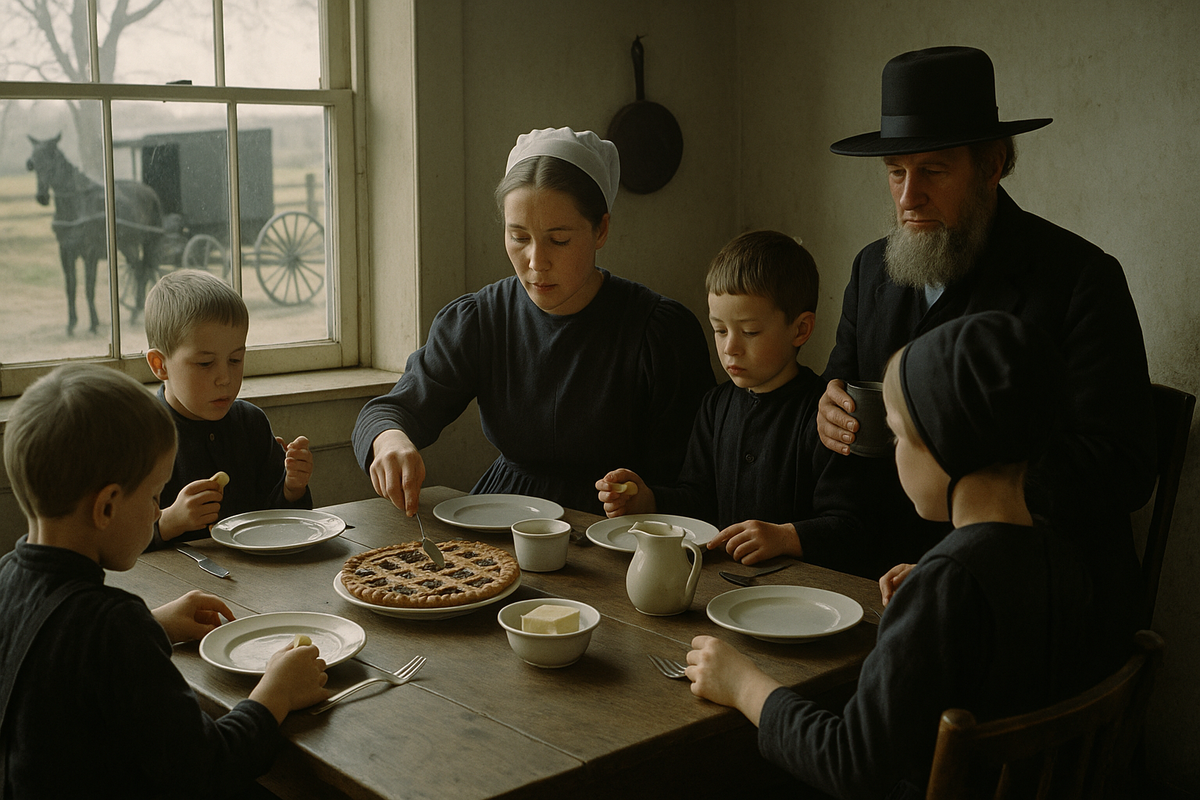
"Hook-and-Eye and Shoo-Fly Pie" deployed the magazine's full arsenal: Musselman's descriptive prose combined with photographs that gave the Amish three-dimensional reality. Readers encountered children bent over slates in one-room schoolhouses. Farmers guiding horse-drawn plows through Pennsylvania fields. Elders in black coats and broad-brimmed hats, some turning away from the camera in discomfort—a gesture that itself became the story.
What Life magazine accomplished with its war photography, the Post achieved here with cultural documentation. The Amish ceased being rumor or curiosity and became present—their plain dress, their communal meals, their quiet defiance rendered tangible through image and word.
What the Article Revealed
Musselman's piece worked as cultural anthropology. Each detail accumulated into a larger portrait:
The hook-and-eye fasteners that gave the article its title weren't ornamental—they signified rejection of vanity down to the smallest act of dressing. The shoo-fly pie wasn't just dessert; it was Pennsylvania Dutch cuisine as philosophy, sweetness achieved through simplicity.
Plain Dress & Identity
Photographs documented broadfall trousers and bonnets, the uniform of humility enforced by the Ordnung.
Education & Labor
Schooling ended at eighth grade, children returning to farm work rather than pursuing modern ambitions.
Technology Refusal
Horse-drawn buggies weren't nostalgia but active choice—automobiles represented not convenience but corruption.
Community Governance
The Ordnung governed everything: what to wear, what to grow, when to worship, how to die.
Separation from the World
Elders enforced rules not as tyranny but as collective protection against the world's encroachment.
Pacifism & Faith
Most striking in 1940, as war fever built, was Amish refusal to bear arms—theological bedrock that would soon be tested.
Even leisure followed pattern—skating, sledding, simple games—entertainments that required nothing modern America was selling.
The Mirror in the Magazine
What made "Hook-and-Eye and Shoo-Fly Pie" powerful in 1940—what makes it fascinating today—is how it functioned as reflection. Americans didn't just read about the Amish; they measured themselves against them. Every photograph of a horse-drawn buggy asked: What have we sacrificed for speed? Every image of plain dress wondered: What do our fashions signal about us? Every description of communal meals questioned: When did we stop eating together?
The Amish hadn't frozen in time. They were actively, deliberately preserving something—faith, humility, community coherence—that required saying no to modernity's promises. That took strength mainstream America wasn't sure it still possessed.
The article gave readers permission to be nostalgic, certainly, but also to be critical. If progress was inevitable, why did these photographs feel like loss?
Why This Issue Endures
Historical Threshold
Published mere months before America's inevitable entry into World War II, it captures the nation's last peacetime spring, its final moment of choosing what kind of country it would be.
Cultural Documentation
The Amish feature represents early mainstream media attempting to understand—not mock, not exoticize, but genuinely understand—a subculture that rejected everything mass media represented.
Artistic Pedigree
Norman Rockwell covers transform even ordinary issues into collectibles; paired with significant editorial content, they become archive-worthy.
Collector Scarcity
Issues surviving in good condition grow scarcer each year. Paper deteriorates. Covers tear. What remains becomes more valuable as cultural artifact.
For historians studying how Americans viewed cultural difference, for collectors documenting the Post's golden age, for anyone tracking how mainstream media negotiated with communities that refused to be mainstream—this issue is essential.
A Living Artifact
The March 30, 1940 Saturday Evening Post remains more than paper and ink. It's evidence of a conversation Americans were having with themselves about what to keep and what to surrender as the modern age arrived. By documenting the Amish—a people who'd already made that choice—the magazine created something rare: journalism that works as philosophy.
Hold this issue in your hands today and you're not just holding history. You're holding a question that never gets old: What matters enough to preserve when the world demands you change?
The Amish answered one way. America answered another. The Post documented both, and in doing so, created something that outlasts them all.
Explore the Complete Archive
The Saturday Evening Post chronicled American life from 1821 through 1969 and beyond. Those mid-century decades produced some of the most vital cultural journalism in American history. Each issue is a time capsule, preserving not just events but atmosphere, the texture of ordinary life lived in extraordinary times.
Browse The Saturday Evening Post Magazine Collection